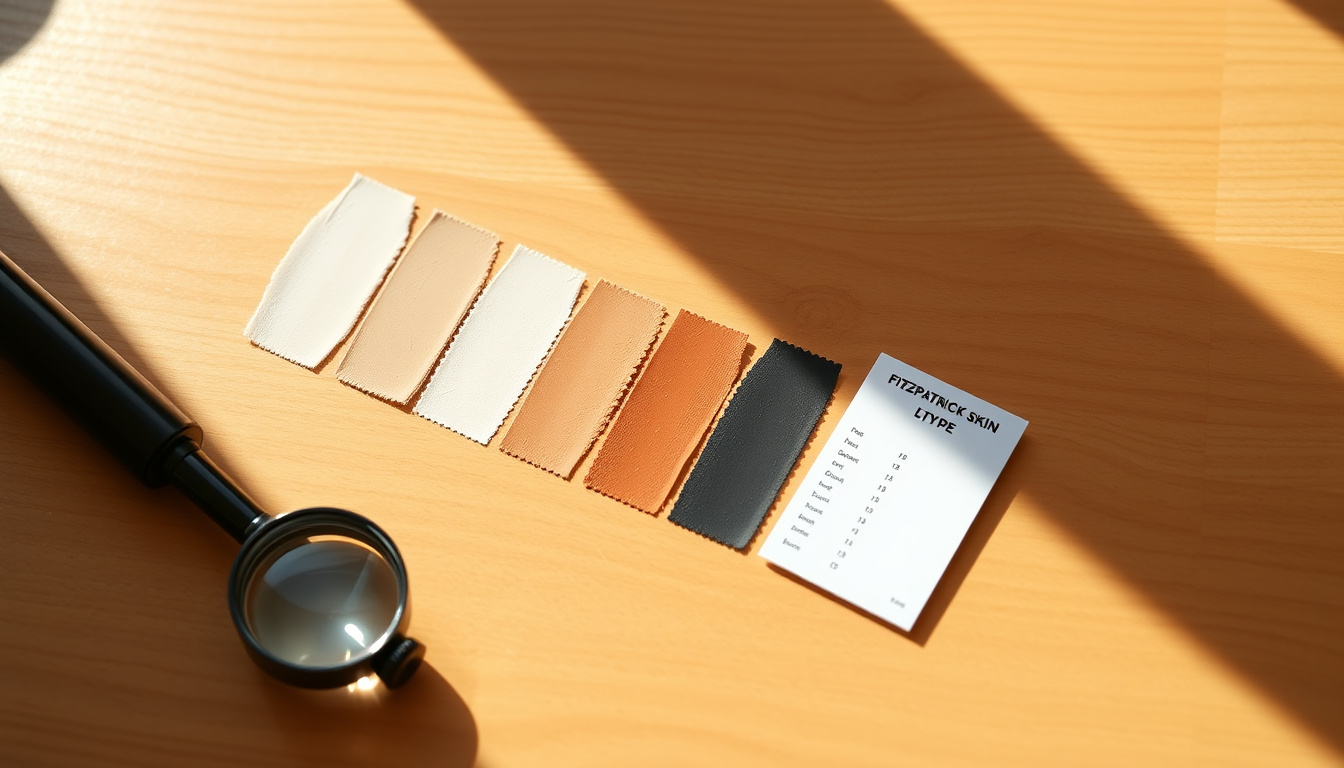

You’ve probably glanced at the sun and wondered: will I burn or bronze? That simple question sits at the heart of the Fitzpatrick skin type scale, a system dermatologists have used for decades to classify how skin reacts to ultraviolet light.
Number of skin types: 6 · Year developed: 1975 · Developer: Thomas B. Fitzpatrick · Basis: Reaction to UV exposure · Common use: Dermatology and skin cancer risk assessment
Quick snapshot
- Scale has 6 types based on UV reaction (Healthline (consumer health resource))
- Developed by Thomas B. Fitzpatrick in 1975 (StatPearls (medical reference))
- Used widely in dermatology and cosmetic medicine (UHD NHS (NHS trust patient leaflet))
- Whether the scale is equally accurate for all ethnicities (PMC (NIH research database))
- 1975: Scale first published (StatPearls)
- 2020s: Ongoing debate about representation of dark skin (PMC)
Six skin types, one pattern: the lower the number, the less melanin protection and the higher the sunburn risk.
| Property | Value |
|---|---|
| Developer | Thomas B. Fitzpatrick |
| Year introduced | 1975 |
| Number of categories | 6 |
| Basis of classification | Skin reaction to UV exposure |
| Primary use | Assessing sun sensitivity and skin cancer risk |
How do I know my Fitzpatrick Skin Type?
Understanding the Fitzpatrick scale
- The scale classifies skin based on self-reported response to 45–60 minutes of early summer noon sun in northern latitudes (StatPearls (medical reference))
- Six types from I (pale, always burns) to VI (dark, never burns)
- Originally created to avoid phototoxicity in PUVA therapy for patients with dark hair and eyes (PMC (NIH research database))
Self-assessment questions for skin type
Ask yourself two things: how easily do you burn, and how much do you tan after repeated sun exposure? The NHS Fitzpatrick chart (UK health service resource) provides a standard questionnaire:
- If you always burn within 30 minutes and never tan, you are likely Type I.
- If you usually burn but tan minimally after a few days, you are likely Type II.
- If you sometimes burn and tan gradually to a light brown, you are likely Type III.
- If you rarely burn and tan easily to a moderate brown, you are likely Type IV.
- If you very rarely burn and tan profusely to dark, you are likely Type V.
- If you never burn and are deeply pigmented, you are likely Type VI.
Using the chart to determine your type
Print or view the NHS chart (patient leaflet) and tally your answers. A higher score on burning questions pushes you toward Type I/II; higher answers on tanning questions push you toward Type V/VI. Clinical assessment by a dermatologist may differ from self-assessment because it also considers skin colour, eye colour, and hair colour objectively.
- Access the NHS Fitzpatrick chart (patient leaflet) and print or display it.
- Answer the questionnaire about your skin’s burning and tanning history.
- Tally your scores: higher burning score = lower type; higher tanning score = higher type.
- Identify your likely type from the six categories.
- Schedule a dermatology consult for formal classification, especially if your heritage is mixed or you have skin of colour.
Misclassifying your type could mean using the wrong SPF or intensity of laser treatment. Type I patients need maximum UV protection; Type VI patients can still get sun damage but often underestimate their risk (PMC (NIH research)).
The implication: self-assessment is a useful starting point, but a dermatologist can fine-tune your classification – especially if you have skin of colour or a mixed heritage.
What is Fitzpatrick’s skin type in Ireland?
Why Irish skin is often associated with type I and II
- Many Irish people have Type I or II due to high prevalence of fair skin, red hair, and freckles (UHD NHS (NHS trust))
- Type I is characterised by red hair, freckles, and light eyes – traits common in Celtic populations
Prevalence of fair skin in Ireland
Ireland has one of the highest proportions of Type I and II skin globally. According to StatPearls (medical reference), Type III is most common overall (48% in the US), but in Ireland the distribution is skewed toward the lower types.
Risk of skin cancer in Celtic populations
Low melanin means less natural protection. Healthline (consumer health resource) notes that lower Fitzpatrick skin phototypes carry a higher melanoma risk. In Ireland, the National Cancer Registry reports that melanoma incidence has been rising – a pattern linked to the combination of fair skin and outdoor lifestyles.
Even within Ireland, not everyone fits neatly. People with Type III ancestry (e.g., from Mediterranean or Hispanic roots) may be undercounted in the fair-skin narrative.
The pattern: the scale highlights a real geographical risk gradient, but it also reinforces a stereotype that all Irish skin reacts the same way – which it doesn’t.
Is the Fitzpatrick scale still used?
Current applications in dermatology
- Still widely used in clinical settings to determine UVB, PUVA, and laser dosages (StatPearls (medical reference))
- Also used in cosmetic procedures (e.g., laser hair removal, chemical peels) to minimise burns
Criticisms and limitations
- Classifications are subjective and less accurate for darker skin types (PMC (NIH research database))
- People with Type V–VI can still sunburn but may underestimate cancer risk because they rarely burn
- Scale was originally developed for white skin patients (I–IV) and Type V–VI were added later (StatPearls)
Alternatives and updates
Modified versions exist – for example, Roberts added a subjective element for erythema. However, the Fitzpatrick scale remains the most common because it is simple, free, and requires no equipment. Researchers are now developing scales that better capture melanin variations across ethnicities.
The trade-off: the scale’s simplicity is also its weakness. For a quick triage it works, but for personalised care, clinicians need to consider skin colour, ancestry, and actual UV response separately.
Can people with Fitzpatrick type 1 skin tan?
Definition of type I skin
- Type I: always burns, never tans – highly sensitive to UV (Healthline (consumer health resource))
- Type II: usually burns, tans minimally (UHD NHS (NHS trust))
Sunburn and tanning response
The defining trait of Type I is that it never develops a tan. Any melanin produced is insufficient to darken the skin; instead, UV exposure causes inflammation (burn). This is due to minimal baseline melanin and the skin’s inability to upregulate melanogenesis.
Melanin production in fair skin
Fair skin has lower amounts of eumelanin. While minimal tanning can occur over days of repeated exposure, it will be negligible – and comes at the cost of cellular damage. Healthline (consumer health resource) states that “lower FSP indicates skin burns more easily than tans”. For Type I, tanning is virtually impossible.
No. If you are Type I, your skin will never achieve a sun tan safely. Using self-tanner is the only way to get colour without UV damage.
The consequence: people with Type I skin must rely on SPF 50+ and protective clothing year-round – even in cloudy weather.
Which skin type is the rarest?
Distribution of skin types globally
- Type III is most common (48% in the US) (StatPearls (medical reference))
- Types I and II together account for about 35% in the US
- Types V and VI are less common in the US but dominant in other regions
Type I and II are less common worldwide
Globally, very fair skin (Type I) is the rarest because it requires specific genetic traits – low melanin production, often with red hair and blue eyes – that are concentrated in Northern Europe. PMC (NIH research database) notes that type distribution varies widely by region, and no single type is universally common.
Global distribution varies by region
In Africa, Type VI dominates; in South Asia and Latin America, Types IV and V are common; in East Asia, Types III and IV are typical. Type I is practically absent in equatorial regions. The upshot: rarity is relative to geography.
The pattern: Type I is rarest overall, but only because most of the world’s population lives near the equator where sun exposure selects for more melanin.
Confirmed facts
- Scale has 6 types based on UV reaction (Healthline)
- Developed by Thomas B. Fitzpatrick in 1975 (StatPearls)
- Used widely in dermatology and cosmetic medicine (UHD NHS)
What’s unclear
- Accuracy for all ethnicities (PMC)
- Exact global distribution of types
- Self-assessment vs clinical agreement
What dermatologists and health bodies say
“The Fitzpatrick skin-type chart is used to classify skin based on how it reacts to sun exposure.”
“Skin phototype (Fitzpatrick skin type) describes a way to classify the skin by its reaction to exposure to sunlight.”
“The Fitzpatrick Skin Scale is a scientific way of classifying skin types into six categories.”
For Irish readers – and anyone with fair, freckled skin – the Fitzpatrick scale is a useful shorthand for understanding your sun sensitivity. But it is not a perfect description of who you are. The scale’s biggest limitation is that it was built for a clinical context (PUVA dosing) and later stretched to skin‑cancer risk assessment without equal validation across all skin tones. For people with darker skin, self-assessment can understate risk; for people with very fair skin, the scale overstates danger only if it ignores modern sun‑protection options. The practical takeaway: use the scale as a rough guide, but make sunscreen, regular skin checks, and professional advice your real safety net.
arpansa.gov.au, usdermatologypartners.com, geartopdesign.com
Understanding your Fitzpatrick skin type can help you better recognize skin cancer early signs and take appropriate sun protection measures.
Frequently asked questions
What is Fitzpatrick skin type 2?
Type II skin usually burns, tans minimally, and is common among people with fair skin and light hair or eyes.
How does Fitzpatrick skin type affect sunscreen choice?
Lower types (I‑II) should use SPF 50+ and avoid peak UV; higher types (IV‑VI) can use SPF 30 but still need protection.
Can Fitzpatrick skin type predict skin cancer risk?
Yes. Lower types have higher melanoma risk, but all types can develop skin cancer.
What is the difference between Fitzpatrick type 4 and 5?
Type IV rarely burns and tans easily to moderate brown; Type V very rarely burns and tans profusely to dark.
Do I need a doctor to determine my skin type?
You can self-assess using the NHS chart, but a dermatologist can give a more accurate clinical classification.
Is the Fitzpatrick scale used for all skin colors?
Yes, but it was originally designed for white skin and may be less accurate for darker skin; alternatives are being developed.
Related stories




Noah Harper is Senior Reporter at Southern Monitor, covering breaking stories and explainers.