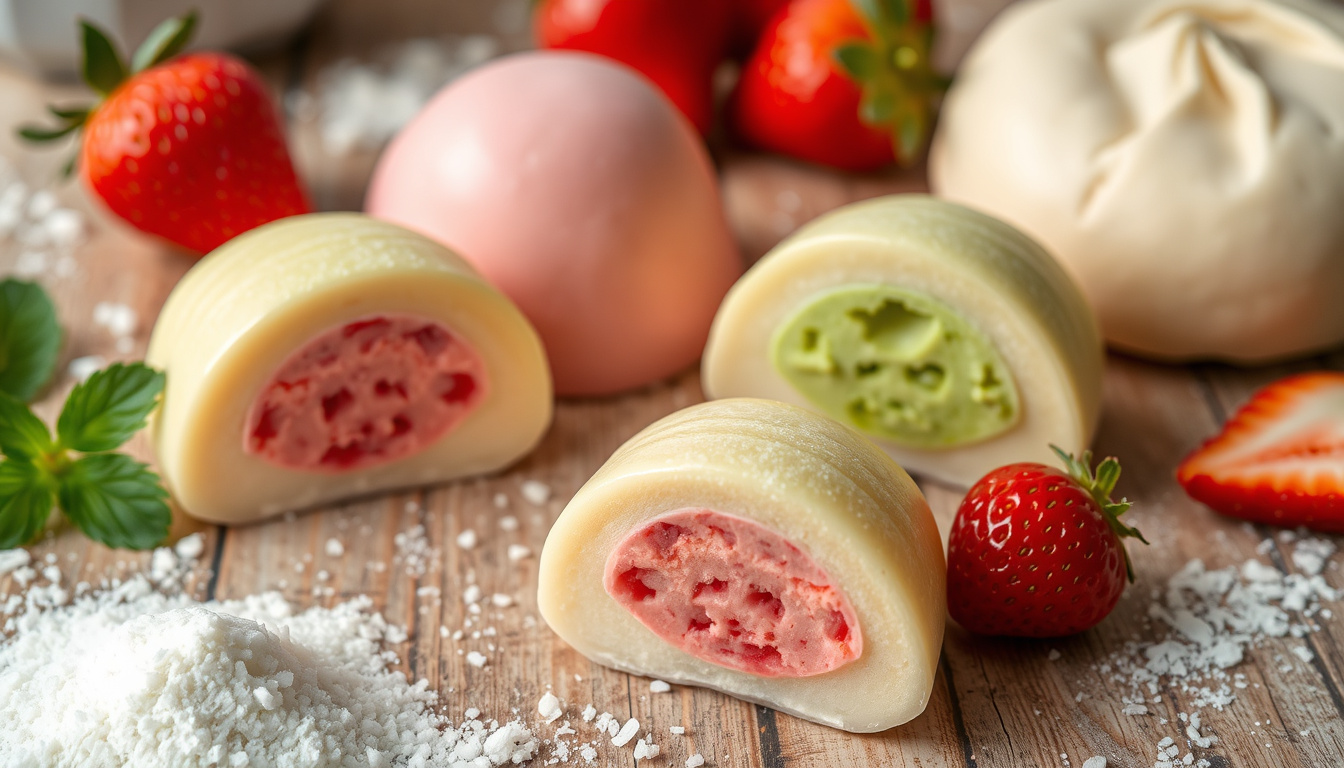
Anyone who’s grabbed a single mochi ice cream piece from the freezer and ended up eating half the box already knows the appeal. That soft, chewy bite with a cool, creamy center hits differently — and for those watching calories, it turns out there’s a real case for keeping a stash handy. Here’s everything you need to know about mochi ice cream: what goes into it, why it’s different, and whether it deserves a spot in your freezer.
Core Ingredients: Japanese mochi (pounded sticky rice) + ice cream filling · Pioneered In: United States · Texture: Soft, chewy rice dough wrapping ice cream · Common Flavors: Mango, passionfruit, pistachio · Recipe Simplicity: 3-ingredient versions available
Quick snapshot
- Mochi ice cream uses pounded sticky rice (Wikipedia)
- Mikawaya bakery produced the original three flavors: green tea, red bean, mango (Japan House UI)
- Exact calorie counts vary by brand — figures range from 60 to 120 per piece across sources (Kimecopak, Little Moons)
- Yatsuhashi Mochi created around 1689 in Kyoto; Mikawaya later pioneered modern mochi ice cream (Yummy Bazaar)
- Vegan and sugar-free adaptations are expanding the market beyond traditional dairy-based products (Little Moons)
| Attribute | Detail |
|---|---|
| Definition | Mochi (sticky rice) wrapped around ice cream |
| Origin | Japanese mochi tradition; US pioneered modern mochi ice cream |
| Size | Bite-sized (e.g. 32–40g per piece) |
| Vegan Options | Available (mango, passionfruit flavors) |
What is mochi ice cream made of?
Mochi ice cream is a confection made from Japanese mochi — a sweet rice dough — with an ice cream filling at its center. The exterior comes from glutinous rice flour (sometimes called mochiko), which gives the product its signature chewy bite. The interior is frozen ice cream in flavors ranging from classic vanilla to more adventurous options like green tea matcha or black sesame.
Key ingredients
At its core, mochi ice cream has two components: the outer mochi shell and the inner ice cream. The mochi itself typically contains glutinous rice flour, sugar, and water, though some recipes substitute ingredients like applesauce for a lower-calorie version. Ice cream fillings provide the creamy interior, with dairy serving as the base for most traditional varieties.
Mochi ice cream relies on just a handful of ingredients: rice flour, sugar, water, and whatever flavor fills the center. That simplicity is part of why it’s considered a cleaner frozen treat compared to heavily processed ice creams.
Mochi dough details
Traditional mochi dough uses glutinous rice flour, which differs from regular rice flour in that it contains higher amylopectin content, creating the sticky, stretchy texture mochi is known for. When making mochi at home, the dough is typically microwaved until translucent, then cooled and wrapped around a small scoop of ice cream before being frozen solid.
Ice cream fillings
Traditional mochi ice cream flavors include vanilla, chocolate, and strawberry. Wikipedia notes that other common flavors include Kona coffee, plum wine, green tea, and red bean — a nod to Japanese culinary traditions. Mikawaya, the brand credited with originating modern mochi ice cream, lists over eight varieties including Green Tea Matcha, Mango, Passion Fruit, and Cookies.
One piece of mochi ice cream (35–40 grams) contains 100–120 calories, with 2–3 grams of fat and 2–3 grams of protein. Kimecopak reports that carbohydrates range from 15–20 grams per piece. Some brands offer significantly lower calorie counts: Little Moons reports their balls range from 60 to 85 calories each, while My/Mochi cites an average of 100 calories per ball.
What is special about mochi ice cream?
The magic of mochi ice cream lies in its texture contrast: a soft, slightly elastic rice shell gives way to a smooth, cold ice cream center. That combination — chewy exterior, creamy interior — creates a mouthfeel that regular ice cream simply can’t replicate. The product emerged from combining Japanese mochi tradition with American ice cream culture, and Japan House at the University of Illinois credits Mikawaya bakery as selling the original modern mochi ice cream.
Unique texture
The texture works because the mochi shell stays slightly pliable even when frozen, unlike a waffle cone that goes rigid. That elasticity comes from the amylopectin starch in glutinous rice, which retains moisture and flexibility at low temperatures. When you bite into a piece, the mochi gives slightly before snapping — then your teeth hit the frozen cream inside.
That bite-sized format (typically 32–40 grams per piece) naturally enforces portion control. You get the full ice cream experience — flavor, creaminess, satisfaction — in a compact package that prevents the “just one more scoop” spiral.
Cultural origins
Mochi itself has deep roots in Japanese culinary tradition. Yummy Bazaar traces Yatsuhashi Mochi to Kyoto around 1689. Regional variants abound: Kanto-style Sakura mochi uses shiratamako flour in a pink pancake form, while Kansai-style uses domyojiko rice grains fully wrapping the filling. Bokksu documents these variations as distinct cultural expressions within the same dish category.
Bite-sized format
The individual portioning is intentional and functional. Unlike scooping ice cream from a tub — where one serving can easily become three — mochi ice cream comes pre-measured. My/Mochi positions this explicitly: “The average mochi ball is about 100 calories. Whereas filling up a bowl of ice cream might equate to over 350 calories, a small 100 calorie snack won’t throw off your weight loss goals.”
Is mochi healthier than ice cream?
Comparing mochi ice cream to traditional scoops reveals a meaningful calorie gap. A single mochi piece runs 60–120 calories depending on brand, while a standard bowl of ice cream can easily top 350 calories. My/Mochi makes the case directly: “a small 100 calorie snack won’t throw off your weight loss goals” when contrasted with full-bowl alternatives.
Calorie comparison
The portion control argument holds up across brands. Kimecopak confirms mochi ice cream is lower in calories than traditional scoops due to its compact size. Little Moons puts it bluntly: “our mochi balls range from 60 to around 85, so it’s pretty guilt-free indulgence.”
| Product | Calories | Source |
|---|---|---|
| Mochi ice cream (general) | 100–120 per piece | Kimecopak |
| Little Moons mochi | 60–85 per ball | Little Moons |
| My/Mochi ball | 100 per ball | My/Mochi |
| Traditional ice cream bowl | 350+ per serving | My/Mochi |
| DIY coffee mochi | 30 per serving | Lemon8 (tier3) |
Nutritional differences
Beyond calories, mochi ice cream brings specific nutritional trade-offs. Kimecopak reports 2–3 grams of fat and 2–3 grams of protein per piece, with carbohydrates ranging from 15–20 grams. Moishi notes each mochi contains about 1 gram of fat, is low in saturated fats, and is cholesterol-free.
The implication: the fat and protein numbers look modest, but sugar content in the dough can offset some of those apparent advantages depending on the brand.
Dietary benefits
For those with dietary restrictions, mochi ice cream offers specific advantages. Kimecopak confirms it is gluten-free, made from glutinous rice flour rather than wheat. Little Moons states it is suitable for gluten-free, vegetarian, and some vegan diets. The rice base also means it’s lower in saturated fat than many traditional ice cream options.
The mochi itself may offer digestive benefits. Little Moons notes that “mochi itself is low in saturated fat, very low in cholesterol, and contains nutrients good for digestion.” The resistant starch in rice-based products can act as prebiotic fiber, supporting gut health in ways dairy-based ice cream cannot.
Little Moons“Mochi itself is low in saturated fat, very low in cholesterol, and contains nutrients good for digestion.”
Is mochi healthy or unhealthy?
Mochi ice cream lands somewhere in the middle of the frozen dessert spectrum — better than a pint of regular ice cream, but not a health food. The rice-based shell offers some fiber and prebiotic potential, while the ice cream interior delivers dairy protein and fat. The main trade-off is sugar: some brands pack enough sweeteners to offset the calorie advantage.
Pros and nutritional profile
For those watching calories, mochi ice cream’s portion control is its strongest asset. Kimecopak emphasizes that portion control helps prevent overeating. The gluten-free rice base works for those avoiding wheat, and vegan varieties (typically fruit-based fillings) avoid dairy entirely. Little Moons explicitly markets their product as suitable for multiple dietary approaches.
Potential downsides
The caution flag comes from sugar content. Kimecopak notes that mochi ice cream “has high sugar content in some brands” and is “not suitable for rice flour sensitivity.” Those monitoring blood sugar or following low-carb approaches should treat mochi as an occasional treat rather than a daily staple.
Mochi ice cream’s small size makes it easy to eat several pieces at once — quickly erasing the calorie gap versus regular ice cream. A four-piece serving can hit 400+ calories before you realize it.
Digestive concerns
For some eaters, mochi presents a specific risk. The sticky rice dough expands when it meets stomach acid and digestive enzymes, which can cause discomfort if eaten in large quantities or by those with sensitive digestive systems. Kimecopak flags that mochi ice cream is “not suitable for rice flour sensitivity.” Those unfamiliar with the product should start with a single piece before committing to a full pack.
Upsides
- Portion control — bite-sized format prevents overeating
- Lower calorie than traditional ice cream scoops
- Gluten-free option for those avoiding wheat
- Vegan varieties available (fruit-based fillings)
- Contains protein from dairy filling
- Low in saturated fat compared to many frozen desserts
Downsides
- High sugar content in some brands
- Not suitable for rice flour sensitivity
- Easy to overeat due to sweet taste
- Contains dairy (not suitable for all vegans)
- Not appropriate for low-carb or ketogenic diets
- May cause digestive discomfort in large quantities
How do you eat mochi ice cream?
The standard approach is simple: eat it frozen, straight from the package. The texture is designed to work at freezer temperatures — the mochi shell stays chewy while the interior holds its shape. Letting it thaw even slightly turns the ice cream into soup and leaves you with a soggy shell.
Best methods
The ideal serving is one piece, straight from the freezer, at a time. If you want to mix things up, try placing a piece in a bowl and letting it sit for 30–60 seconds to soften just the very outer edge — you’ll get a slightly more pronounced chew before hitting the frozen core. Some eaters prefer to bite off the top, scoop out the ice cream, then eat the shell separately.
Storage tips
Keep mochi ice cream frozen at all times. The product is designed for freezer storage and maintains quality for weeks when kept at consistent sub-zero temperatures. Little Moons notes their product is suitable for standard freezer storage. Once opened, reseal the package to prevent freezer burn, which degrades both the mochi texture and ice cream quality.
Serving suggestions
Mochi ice cream works as a standalone snack, a dessert course after a meal, or a playful addition to a dessert board. For a quick palate cleanser, try alternating between a fruity mochi (mango, passionfruit) and a richer option (green tea, cookies). The bite-sized format also makes it practical for portion-controlled snacking — one or two pieces can satisfy a sweet craving without derailing calorie targets.
If you spot a “sugar-free” or “low-calorie” variant, check the ingredient list carefully. Some sugar substitutes affect the texture, making the mochi shell less chewy and more prone to tearing. Natural sweeteners like those used in Zhang Catherine’s sugar-free mochi preserve more of the traditional texture.
Buying guide: where to find mochi ice cream
Major grocery retailers have embraced mochi ice cream over the past decade. My/Mochi and Little Moons dominate premium positioning, while Mikawaya offers the heritage credibility as the original innovator. Trader Joe’s carries an accessible house brand version at a lower price point.
The table below breaks down major brands by calorie range, dietary options, and where to find them.
| Brand | Calorie Range | Dietary Options | Availability |
|---|---|---|---|
| Little Moons | 60–85 per ball | Gluten-free, vegan options | Major retailers |
| My/Mochi | 100 per ball | Vegetarian | Widespread |
| Mikawaya | 100–120 per piece | Traditional dairy | Specialty stores |
| Trader Joe’s | Varies | Check label | Trader Joe’s only |
Price per piece typically ranges from $1.50–$3.00 depending on brand and retailer. Multipacks from warehouse clubs offer better per-unit pricing for regular consumers. When comparing value, factor in calorie density — a higher-priced but lower-calorie brand may deliver better cost-per-calorie for weight-conscious buyers.
Making mochi ice cream at home
DIY mochi ice cream requires just three core ingredients and minimal equipment. The technique involves making a simple mochi dough, cooling it, wrapping it around frozen ice cream scoops, and returning the assembled pieces to the freezer. All Purpose Veggies provides a recipe using applesauce as a lower-calorie base with matcha for added antioxidants.
Basic three-ingredient recipe
The simplest version requires glutinous rice flour (mochiko), water, and ice cream. Combine the flour with enough water to form a thick batter, microwave until translucent (about 2–3 minutes), cool slightly, then flatten and wrap around a small ice cream ball. Freeze immediately.
Low-calorie adaptations
For a healthier spin, substitute applesauce for part of the sugar content. All Purpose Veggies recommends 8 oz applesauce, 1 cup mochiko flour, 1 tsp matcha, and 2 tbsp sugar (optional) for an applesauce green tea mochi. Prep time runs about 10 minutes, with 3 minutes of microwave cooking.
Homemade mochi ice cream avoids the stabilizers and preservatives in commercial versions — but also lacks the precise portion control of factory-sealed pieces. Without pre-measured individual wraps, it’s easy to make oversized servings that cancel out the calorie advantage.
Flavor variations
Beyond the classics (vanilla, chocolate, strawberry), try incorporating matcha powder into the dough for a green tea version with added antioxidants. My/Mochi notes that popular Japanese flavors include red bean, black sesame, mango, and plum wine — all of which transfer well to homemade versions using standard ice cream as the base.
Japan House (Educational Institution)“Today, the bakery is credited as selling the original mochi ice cream.”
Home cooks who skip the factory-sealed portions should weigh each piece to match the 35–40 gram standard that delivers the 100–120 calorie count cited across sources.
For health-conscious frozen treat seekers, mochi ice cream earns its place in the freezer. The portion control advantage is real — you get the full ice cream experience in a compact format that makes overeating genuinely harder. My/Mochi frames it well: a 100-calorie ball compared to 350+ for a bowl of traditional ice cream. Just watch the sugar content in sweeter brands, and if you’re watching carbs or blood sugar, treat it as an occasional treat rather than a daily option. The gluten-free base and vegan adaptations also make it accessible for dietary restrictions that rule out conventional ice cream.
Related reading: Sweet and Sour Pork Recipe: Crispy Cantonese Style
Frequently Asked Questions
What flavors of mochi ice cream are available?
Traditional flavors include vanilla, chocolate, and strawberry. More adventurous options include green tea, matcha, black sesame, red bean, mango, passion fruit, Kona coffee, and plum wine. Wikipedia catalogs the common range, while Mikawaya lists over eight varieties from the originator brand.
Where can I buy mochi ice cream near me?
Major grocers including Whole Foods, Trader Joe’s, Costco, and standard supermarkets carry mochi ice cream. Specialty Asian grocery stores typically offer a wider selection including Japanese-specific brands. Online retailers provide home delivery for premium brands like Little Moons and My/Mochi.
How do you pronounce “mochi”?
The Japanese word “mochi” is pronounced “MOH-chee” with a long “o” sound and emphasis on the first syllable. Some English speakers pronounce it “MOH-chi” with a short “o,” but the standard romanization uses the long vowel. The word refers specifically to the pounded sticky rice cake, while the ice cream variant adds “ice cream” as the descriptor.
What is the price of mochi ice cream?
Pricing varies by brand and retailer, typically ranging from $1.50–$3.00 per piece for individual servings. Multipacks and bulk options at warehouse clubs reduce per-unit cost. Premium brands like Little Moons command higher prices than generic grocery store versions, but often deliver better flavor variety and dietary flexibility.
Does Trader Joe’s sell mochi ice cream?
Yes, Trader Joe’s carries their own house-brand mochi ice cream at a lower price point than premium brands. Availability varies by location and season. Check your local Trader Joe’s freezer section for current stock, or use the retailer’s product locator on their website.
Is mochi ice cream gluten-free?
Yes. Kimecopak confirms mochi ice cream is gluten-free, made from glutinous rice flour rather than wheat flour. Little Moons explicitly states their product is suitable for gluten-free diets. Always check the label for cross-contamination warnings if you have celiac disease or severe gluten sensitivity.
How long does mochi ice cream last in the freezer?
Mochi ice cream maintains quality for 2–3 months when stored at consistent freezer temperatures. Little Moons recommends standard freezer storage. Extended storage beyond 3 months may result in freezer burn, affecting both texture and flavor. Always reseal opened packages to prevent moisture loss and quality degradation.
Related stories





Thomas Webb leads fact-checking, source verification and corrections at Southern Monitor.