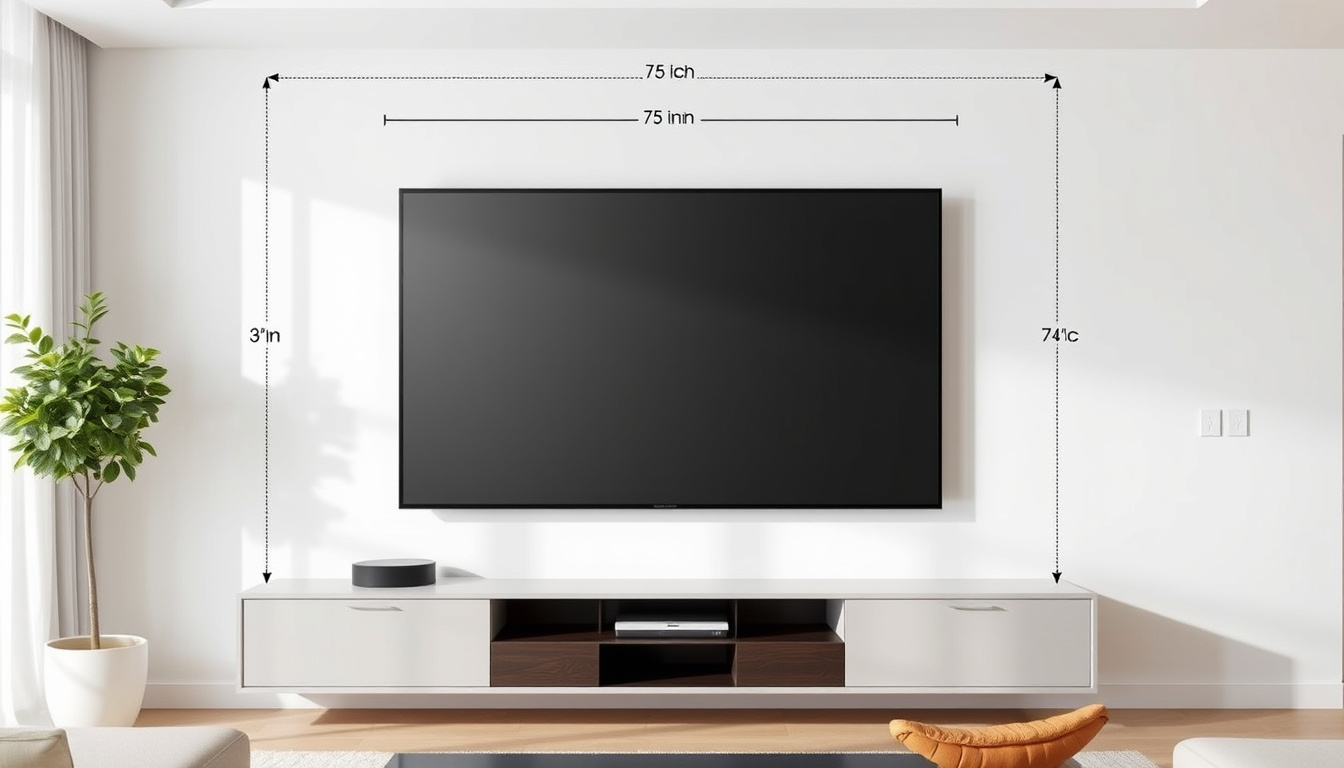
A 75-inch TV isn’t just larger than a 65-inch—it requires 25% more wall space and sits in a completely different placement category. This guide gives you the exact dimensions, brand-by-brand comparisons, and space-planning specifics you need before buying.
Screen Diagonal: 75 inches (190.5 cm) · Typical Width: 66 inches (167.6 cm) · Typical Height: 38 inches (96.5 cm) · Optimal Viewing Distance: 9–12 feet
Quick snapshot
- 75″ diagonal screen size (TCL Global Official)
- 66 inches width on average (TCL Global Official)
- 38 inches height on average (TCL Global Official)
- QLED and OLED panel options
- Stand footprint varies by series
- VESA mounting pattern standard
- 9–12 feet viewing distance for 4K
- Room fit depends on furniture and layout
- Wall space requires at least 70 inches width
- Immersive cinematic experience
- Requires larger room and budget
- Ideal for home theater setups
| Measurement | Inches | Centimeters |
|---|---|---|
| Diagonal Size | 75 inches | 190.5 cm |
| Average Width | 66 inches | 167.6 cm |
| Average Height | 38 inches | 96.5 cm |
| Optimal Distance | 9–12 feet | 2.7–3.7 m |
What is the dimension of a 75 inch TV?
The “75 inch” designation refers to the diagonal screen measurement from corner to corner, not the width or height of the visible display. All 75-inch TVs follow the standard 16:9 aspect ratio used for consumer television content, which means the actual visible dimensions fall within a predictable range.
For the 75 inch TV dimensions, it has a diagonal screen size of 75 inches, or about 65.4 inches in width and 36.8 inches in height (TCL Global Official). Manufacturers round these figures slightly, so actual model widths typically range from about 65.5 to 66.2 inches depending on bezel design.
Width and height without stand
Real-world dimensions vary by manufacturer. The Samsung Series 7 75MU7000 measures 168.46 cm wide by 96.64 cm tall by 6.01 cm deep without its stand (Gadgets Now IndiaTimes comparison). The Sony BRAVIA KD-75X8000H comes in at 168.6 cm wide by 97.0 cm tall by 8.0 cm deep without the stand.
The TCL 75C2US is notably slimmer, measuring just 5.4 cm deep without its stand compared to Sony’s 8.0 cm profile (Gadgets Now IndiaTimes comparison). This depth difference matters for wall-mount installations where every centimeter counts.
Dimensions with stand variations
When mounted on their factory stands, the overall height increases noticeably. The Samsung 75MU7000 reaches 105.65 cm tall with its stand in place, while the Sony KD-75X8000H adds about 6.4 cm to reach 103.4 cm total height (Gadgets Now IndiaTimes comparison). Stand widths themselves vary considerably—budget models often use narrower feet that may not fit on shorter entertainment centers.
Stand width isn’t standardized across brands. Measure your furniture before ordering—a TV with 50-inch-wide feet won’t balance on a 44-inch console.
What are the dimensions of a 75 inch TV in CM?
Converting 75-inch TV dimensions to centimeters is straightforward once you understand the math. One inch equals exactly 2.54 centimeters, so the diagonal becomes 75 × 2.54 = 190.5 cm. From there, the width and height follow the 16:9 aspect ratio’s proportions.
Width and height in centimeters
For the 75 inch TV dimensions in cm, expect approximately 167.6 cm width and 96.5 cm height for the screen alone. The actual model width—including bezels—typically runs 168 to 169 cm. TCL lists their 75-inch viewable area at 165.4 cm wide by 93 cm high, accounting for the slight bezel inset (TCL Global Official).
Depth measurements change significantly with and without stands. Without a stand, most 75-inch TVs measure between 5.4 and 8.0 cm thick. The Sony KD-75X8000H is 8.0 cm deep without stand, while the TCL 75C2US achieves 5.4 cm—making it noticeably more wall-mount friendly.
Converting to millimeters
Millimeter precision matters more for mount compatibility than for general placement. Converted measurements put the Samsung 75MU7000 at 1,684.6 mm wide without its stand. The Sony KD-75X8000H measures 1,686 mm wide and 970 mm tall without the base, which means Sony’s model is about 1.4 mm narrower but 4 mm taller.
VESA mount patterns are measured in millimeters and typically standardized, but always verify your model’s specific pattern before purchasing a wall mount.
How wide is a 75 inch Samsung TV?
Samsung’s 75-inch TVs generally fall within the industry standard width range, though specific measurements vary by series. The company’s 2025 lineup includes models from budget-friendly UHD sets to premium QLED and OLED displays, each with slightly different dimensional profiles.
Samsung model specifics
The Samsung Series 7 75MU7000—a 4K UHD model—measures 168.46 cm wide by 96.64 cm tall by 6.01 cm deep without its stand (Gadgets Now IndiaTimes comparison). With the stand attached, height increases to 105.65 cm and depth extends to 35.61 cm. Premium models like the Samsung S95D may have different proportions due to OLED panel construction.
Samsung 75-inch QLED and OLED TVs typically maintain similar width specifications but vary in bezel thickness and panel depth. The company’s higher-end displays often feature thinner bezels, which slightly reduces the overall width compared to budget models.
Mounting width considerations
For wall mounting, the Samsung 75MU7000’s 168.46 cm width requires a mount rated for screens at least 70 inches wide to allow comfortable positioning. The 6.01 cm depth without stand is relatively standard, meaning most full-motion mounts will accommodate it without issue. However, OLED models like the S95D may require specific mounts designed for lighter weight and thinner profiles.
Samsung’s standard 75-inch width of roughly 66 inches means most wall studs at 16-inch intervals will catch the mounting holes, but always measure your specific model’s VESA pattern before drilling.
How much space is required for a 75 inch TV?
A 75-inch TV demands more floor and wall space than most people initially assume. Beyond the screen itself, you need clearance for the stand, ventilation space behind wall-mounted units, and enough room for viewing angles and foot traffic.
Wall mount space requirements
For wall mounting, plan for a minimum of 70 inches horizontal clearance and approximately 42 inches of vertical space to comfortably position the TV with room for cables and mounting hardware. The Samsung 75MU7000 needs about 6.01 cm of depth clearance without a stand, or 35.61 cm with the factory stand attached if you’re using a console instead.
A 75-inch 16:9 TV has 25% larger area than a 65-inch equivalent, which means it won’t just be wider—it will dominate more wall space visually and physically (Display Wars screen size calculator). Factor this into your layout before committing to wall installation.
Stand footprint and room fit
TV stands typically need to be at least as wide as the TV’s stand width, which varies by model. Some Samsung models use V-shaped feet that spread 40 to 50 inches apart, while others use narrower center-stand designs. Measure your entertainment center before purchasing—TCL’s 75C2US is 167.3 cm wide with stand, requiring furniture at least 44 to 48 inches deep to accommodate the 37.1 cm depth.
Consumer Reports identifies 75-inch TVs from LG, Samsung, and Sony among the top performers for 2026, noting that room fit is a critical decision factor for this screen size (Consumer Reports TV testing). Their testing emphasizes that proper placement affects both viewing experience and room traffic flow.
TCL positions its 75-inch TVs for spacious living areas with cinematic immersion, but a large screen in a too-small room causes eye strain rather than enjoyment—measure twice, buy once.
What is the recommended viewing distance for televisions?
Viewing distance directly impacts how much detail your 75-inch TV can deliver. Sit too close and you’ll see pixels; sit too far and you’ll lose the immersive effect that makes large screens worthwhile.
Industry guidelines and optimal immersion
For a 75-inch TV, the optimal viewing distance falls between 9 and 12 feet for 4K content. This range balances pixel visibility against the screen’s ability to fill your field of view without requiring head movement. According to TCL’s specifications, the 75 inch TV dimensions translate to a width of about 65.4 inches and height of 36.8 inches (TCL Global Official), which at 10 feet fills approximately 33 degrees of horizontal vision—considered ideal for cinematic immersion.
RTINGS recommends placing your 75-inch TV at 36.8 to 65.4 inches distance for optimal experience, with the closer range preferred for brighter rooms and the farther distance for controlled lighting (RTINGS TV testing laboratory). Their testing shows that room lighting significantly affects where within the range you should sit.
Calculating your specific distance
The simplest formula multiplies the screen diagonal by 1.5 to 2.0 for 4K viewing. For 75 inches, that’s 112.5 to 150 inches, or 9.4 to 12.5 feet. Tom’s Guide’s 2026 coverage notes that new 75-inch models from LG, Samsung, Hisense, and TCL are rolling out with improved viewing angle performance, making optimal distance recommendations slightly more flexible for larger rooms.
For 1080p content, you would sit closer—around 7.5 to 9 feet—to notice the same level of detail. For 8K content (when available), the optimal distance extends to 3 to 6 feet, though 8K content remains rare.
RTINGS tests found that 9-12 feet works for most rooms, but if your seating is fixed at 14 feet, a 75-inch may feel underwhelming—a projector might serve that room better.
Confirmed facts
- 75-inch diagonal measures exactly 190.5 cm
- Typical width: 65.5–66.2 inches depending on bezel design
- Height without stand: 36.8–38 inches
- All compared models feature 3840×2160 4K resolution
- TCL 75C2US depth without stand: 5.4 cm
- Sony KD-75X8000H depth without stand: 8.0 cm
What’s unclear
- Exact stand dimensions for 2026 models (Samsung U8000F, TCL 75QM6K, Sony BRAVIA 3)
- Bezel width variations across different production batches
- VESA mount pattern specifications for newer 2025–2026 models
- Official Samsung or Sony spec sheets for latest 75-inch releases
75-Inch TV Specifications by Model
Three popular 75-inch models show how dimensions, weight, and depth vary across manufacturers—even at the same screen size. The implication: brand choice directly affects wall-mount feasibility and furniture requirements.
| Model | Width (cm) | Height (cm) | Depth (cm) | Weight (kg) |
|---|---|---|---|---|
| Samsung 75MU7000 (with stand) | 168.46 | 105.65 | 35.61 | — |
| Samsung 75MU7000 (without stand) | 168.46 | 96.64 | 6.01 | — |
| Sony KD-75X8000H (with stand) | 168.6 | 103.4 | 40.2 | — |
| Sony KD-75X8000H (without stand) | 168.6 | 97.0 | 8.0 | 30.7 |
| TCL 75C2US (with stand) | 167.3 | 103.1 | 37.1 | — |
| TCL 75C2US (without stand) | 167.3 | 96.3 | 5.4 | 38.9 |
The pattern here is clear: Sony and Samsung run slightly wider than TCL, but TCL wins on depth. Weight varies significantly—the TCL 75C2US weighs 38.9 kg without its stand, while the Sony KD-75X8000H is lighter at 30.7 kg. What this means for buyers: that 8.3 kg difference affects which studs or mounting systems you need for wall installation.
Pros and Cons of a 75-Inch TV
Upsides
- Cinematic immersion that smaller screens cannot match
- 25% more screen area than a 65-inch for better detail visibility
- Optimal for home theater rooms and large living spaces
- 4K resolution fully appreciated at proper viewing distances
- 2026 models from top brands offer improved smart features
Downsides
- Requires minimum 70-inch clearance space for comfortable setup
- Higher cost than 55-65 inch alternatives
- Weight issues for wall mounting (up to 38.9 kg for some models)
- May overwhelm smaller living rooms and cause eye strain
- Stand footprint varies—verify furniture compatibility
What the experts say
The best 75-inch TV in the mid-range price bracket is the TCL QM8, combining Mini LED performance with reasonable depth for wall mounting.
These are the best 75- and 77-inch TVs of 2026, tested by our experts for picture quality, smart features, and room compatibility.
New 75-inch TVs from LG, Samsung, Hisense, and TCL are rolling out in spring 2026, offering improved panel technology across price tiers.
For buyers choosing a 75-inch TV, the dimensional reality is non-negotiable: plan for at least 66 inches of width and 38 inches of height, with the stand adding another 6 to 10 cm in height and potentially 35-40 cm in depth. Room fit matters as much as technical specifications—a set that overwhelms your space will deliver frustration instead of the immersion you’re paying for. The spring 2026 rollout of new models from Samsung, TCL, and Sony gives buyers fresh options, but the space planning fundamentals remain unchanged.
Related reading: Specs for popular models · Thinnest models comparison
youtube.com, youtube.com, gadgets360.com, versus.com, samsung.com
When scaling down from 75-inch models, the 65-inch TV dimensions guide provides precise measurements for popular 65-inch alternatives in living rooms.
Frequently asked questions
What is the exact size of a 75 inch TV?
A 75-inch TV measures 75 inches (190.5 cm) diagonally across the screen, with an average width of about 66 inches (167.6 cm) and height of approximately 38 inches (96.5 cm). Actual dimensions vary slightly by manufacturer due to bezel design and panel construction.
What is the actual size of a 75 inch TV?
The actual screen size of a 75-inch TV is 75 inches diagonal, which translates to roughly 65.4 inches width and 36.8 inches height for the visible display area. The physical television frame is slightly larger, typically 66 to 66.5 inches wide.
How wide is a 75 TV in cm?
A 75-inch TV is approximately 167.6 cm wide. Models range from about 165.4 cm to 168.6 cm depending on the manufacturer. The Samsung 75MU7000 measures 168.46 cm wide, while the TCL 75C2US comes in at 167.3 cm.
What are the disadvantages of a 75-inch TV?
The main disadvantages include the need for a large room (minimum 70-inch clearance), higher cost compared to smaller sizes, significant weight for wall mounting (up to 38.9 kg for some models), and the risk of overwhelming smaller living spaces, causing eye strain rather than immersive viewing.
Is a 75 TV too big for a living room?
A 75-inch TV may be too big if your viewing distance is less than 9 feet, your room has limited wall space, or your entertainment center is narrower than 48 inches. Rooms with 12-16 feet of viewing distance and open layouts typically accommodate 75-inch sets comfortably.
How to Measure TV Dimensions?
Measure TV dimensions by measuring the diagonal screen from corner to corner for the stated size. For width and height, measure the visible screen excluding bezels. For depth, measure from the back panel to the front bezel with the TV face-down. Always verify your entertainment center’s internal dimensions before purchasing.
What are 75 Inch TV dimensions in mm?
A 75-inch TV is approximately 1,676 mm wide and 965 mm tall (visible screen). The Samsung 75MU7000 measures 1,684.6 mm wide by 966.4 mm tall without its stand. Convert to millimeters by multiplying inch measurements by 25.4.
How much space do you need for a 75 inch TV?
You need at least 70 inches of horizontal wall or furniture space for a 75-inch TV, plus 42 inches of vertical clearance. For viewing distance, plan for 9-12 feet from the screen. The stand depth adds 12-16 inches if using a console rather than wall mounting.
Related stories





Thomas Webb leads fact-checking, source verification and corrections at Southern Monitor.