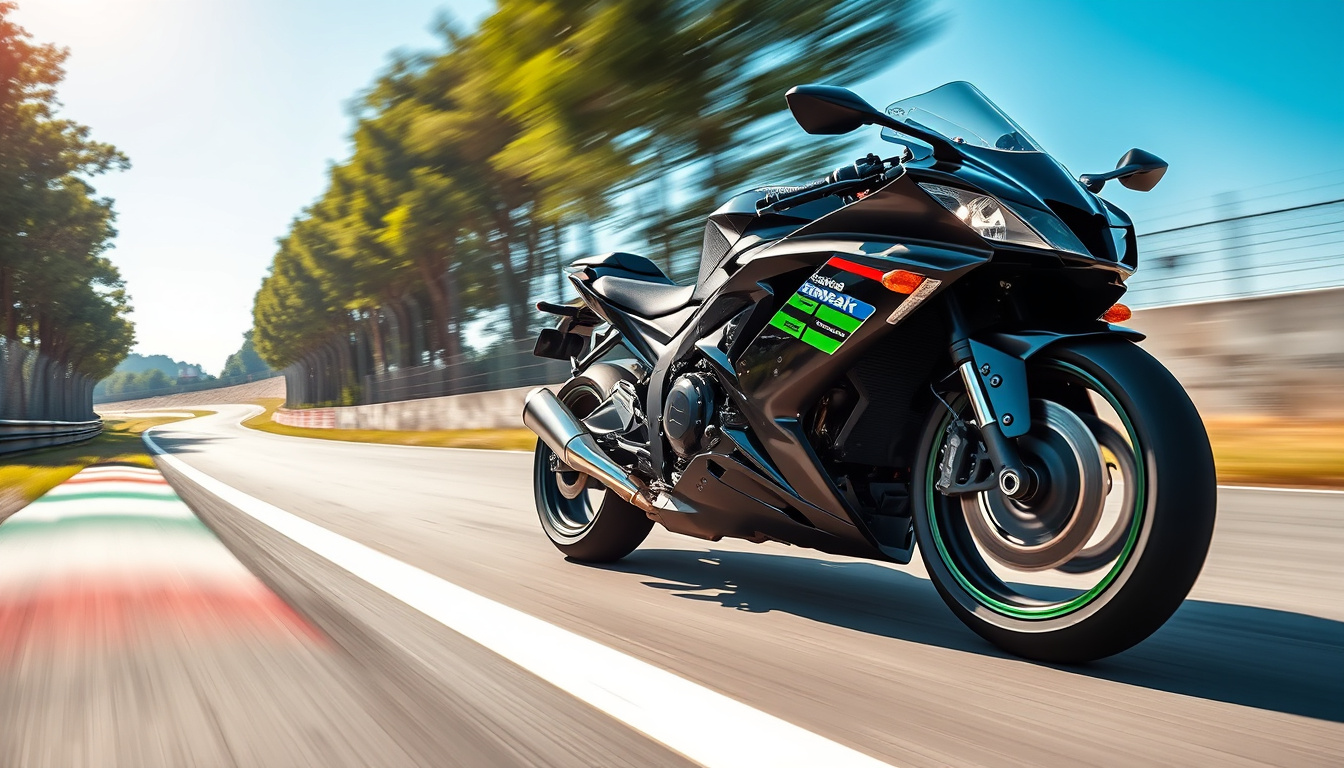

Few production motorcycles push the boundaries of what’s mechanically possible the way the Kawasaki Ninja H2R does. This track-only machine isn’t built for Sunday morning cruises—it’s engineered to dominate closed circuits with a supercharged engine that produces more horsepower than most supercars. Riders and gearheads keep asking how a bike that can’t legally ride on public roads ended up as one of the most talked-about machines in motorsport. The answer lies in numbers: 310 hp from a 998cc engine, a claimed top speed that reads like a misprint, and a design philosophy built entirely around winning on the track.
Engine Displacement: 998cc ·
Max Horsepower: 310 hp ·
Top Speed: 400 km/h (249 mph) ·
Type: Closed-course hypersport ·
Power Source: Supercharged
Quick snapshot
- 998cc supercharged inline-four engine (The Bike Junction spec sheet)
- 310 hp standard / 326 hp with ram air intake (BikeBound full review)
- 121 lb-ft torque at 12,500 rpm (BikeBound full review)
- Official US retail price in dollars (not publicly listed by Kawasaki)
- Real-world top speed varies by track conditions, rider skill, and gearing modifications
- Exact wheel horsepower figures differ between dyno testing methods
- H2 vs H2R comparison published 2014 (ChapMoto head-to-head)
- Drag races against supercars filmed at Minter Airfield (recent) (ChapMoto head-to-head)
- MotoGP speed records at Mugello matched by H2R simulation (ChapMoto head-to-head)
- Closed-course only homologation limits street legal use worldwide
- Aftermarket modifications push power beyond factory 326 hp claims
- Collector values rising as production potentially phases out
| Specification | Value |
|---|---|
| Model | Ninja H2R |
| Engine | 998cc supercharged inline-four |
| Power | 310 hp (326 hp ram air) |
| Torque | 165 Nm (121 lb-ft) |
| Top Speed (claimed) | 400 km/h |
| Fuel Capacity | 17 liters |
| Usage | Closed-course only |
Is the Ninja H2R the fastest bike?
The Kawasaki Ninja H2R holds a specific claim in motorcycle history: it’s the world’s most powerful supercharged hypersport production motorcycle, according to Kawasaki’s official product page (Kawasaki official listing). That title requires context. When testing against tuned supercars, the H2R beat a modified McLaren MP4-12C producing 700 hp in a drag race to 200 mph at the half-mile mark, as documented by RevZilla (RevZilla supercar drag test). However, a modified Nissan GT-R with 1,350 hp ultimately passed the H2R at the 0.75-mile mark in a one-mile drag race.
Claimed top speed records
Kawasaki officially claims the H2R can reach 400 km/h (249 mph) (The Bike Junction spec sheet). Some testing sources report top speeds beyond 240 mph on closed courses (BikeBound full review). However, real-world dyno testing shows wheel horsepower typically registers between 230-240 hp on Dynojet machines despite the 310 crank hp claim from the manufacturer.
Comparisons to other production bikes
The H2R dwarfs its street-legal sibling. The Ninja H2 produces 197 hp compared to the H2R’s 310-326 hp, and maxes out at 186 mph versus the track-only model’s higher potential (BikeBound full review). Against the BMW S1000RR—a versatile street and track superbike—the H2R trades versatility for raw speed maximization (Procycles superbike comparison). The H2R matches MotoGP bikes in the 125-150 mph range but falls behind in standing kilometer times (16.98 seconds at 200 mph versus 15.54 seconds at 222 mph), according to comparison testing on YouTube (YouTube H2R vs MotoGP comparison).
The H2R wins pure top speed against almost any production motorcycle, but it sacrifices the versatility that makes bikes like the BMW S1000RR practical for both street and track riding.
Bottom line: Kawasaki built a track weapon that outpaces most exotic supercars on the drag strip, but the H2R’s 310-326 hp advantage evaporates the moment you need to do anything other than go in a straight line.
What is H2R top speed?
The Ninja H2R’s top speed generates more confusion than clarity. Kawasaki markets the bike as capable of 400 km/h (249 mph), a figure that appears on official product materials. Independent testing and simulations suggest the real-world top speed sits around 212 mph (342 km/h), with dyno data indicating the bike isn’t geared to actually achieve the 400 km/h figure in stock trim (MotoStatz acceleration data).
Reported speeds in km/h and mph
Multiple sources confirm the discrepancy between Kawasaki’s claimed 400 km/h and observed real-world speeds. Testing shows the H2R hitting approximately 342 km/h (212 mph) in real conditions, with simulation data from track testing also arriving at the 212 mph figure (YouTube H2R vs MotoGP comparison). The gap exists because achieving the manufacturer’s claimed speed would require specific gearing modifications and ideal conditions that most track days don’t provide.
Conditions for 400 km/h achievement
Reaching Kawasaki’s 400 km/h claim requires specific circumstances: maximum ram air intake at high speed, optimal aerodynamic conditions, a skilled rider in tuck position, and often track-specific gearing adjustments. The supercharger spins up to 130,000 rpm producing 14+ psi of boost (BikeBound full review), and the aerodynamic winglets help stabilize the bike at extreme speeds, but stock gearing appears to limit the bike below its theoretical maximum.
Aftermarket gearing changes and modified exhaust systems have reportedly pushed H2R speeds beyond factory claims on custom builds, but these modifications fall outside Kawasaki’s warranty and intended use parameters.
How much HP does a H2R have?
The Kawasaki Ninja H2R produces between 310 and 326 horsepower depending on conditions, making it the most powerful production motorcycle engine Kawasaki has ever built. The 998cc supercharged inline-four delivers this output through a precisely engineered forced induction system developed with Kawasaki Heavy Industries’ turbine division (BikeBound full review).
Engine power output details
At the crankshaft, the H2R produces 305.75 bhp at 14,000 rpm without ram air intake engaged (The Bike Junction spec sheet). With ram air forcing additional air into the supercharger at speed, power rises to 326 horsepower. The engine generates 165 Nm of torque at 12,500 rpm, translating to approximately 121 lb-ft. The six-speed manual transmission features a one-down, five-up shift pattern with up and down quick-shifter capability.
Supercharger role in performance
The H2R’s supercharger is a mechanical marvel. Spinning at up to 130,000 rpm, it maintains boost pressure above 14 psi to force more air/fuel mixture into the combustion chambers than atmospheric pressure alone would allow. This mechanical (forced induction) enables the 998cc engine to match or exceed the output of much larger displacement motors. The supercharger uses a self-lubricating system integrated with the engine’s oil circulation, reducing complexity compared to aftermarket turbo setups (BikeBound full review).
The H2R’s supercharger essentially turns a 998cc engine into a 1500cc-class powerplant, explaining how it produces more horsepower than bikes with displacements twice its size.
Is the Ninja H2R 1000cc?
The Ninja H2R is often assumed to be a “1000” or “literbike,” but its exact displacement is 998cc—not a round 1,000. This distinction matters because the H2R shares its engine architecture with the street-legal H2, which also displaces 998cc rather than the rounded 1000cc figure that marketing often uses.
Exact engine displacement
Kawasaki specifies 998cc across official materials and verified measurements from multiple sources (The Bike Junction spec sheet). The bore and stroke dimensions create this displacement figure from the inline-four cylinder layout. This puts the H2R in the same class as other high-performance inline-four superbikes, though its supercharged induction differentiates it entirely from naturally aspirated competitors.
Comparison to street-legal H2
The street-legal Ninja H2 shares the same 998cc displacement but produces significantly less power. The H2 generates 197 hp—113 hp less than the H2R—because it requires emissions equipment, street-legal exhaust systems, and a tune optimized for public road use (BikeBound full review). The H2 reaches 186 mph versus the H2R’s higher potential, and its top speed tests show it completing the 0-100 km/h run in 12.87 seconds versus the H2R’s 9.72 seconds to the same mark (ChapMoto head-to-head).
Kawasaki Ninja H2R specs
Beyond the headline-grabbing horsepower figure, the H2R packs a comprehensive specification list designed for track domination. Every component serves a purpose in extracting maximum performance or maintaining stability at extreme speeds.
Full technical specifications
The 998cc engine features a steel trellis frame paired with fully adjustable KYB suspension front and Öhlins rear suspension (BikeBound full review). The bike uses a titanium exhaust system with no emissions equipment—legal only for closed-course use. Cornering management systems, launch control, and an up/down quick-shifter come standard. The aerodynamic package includes winglets that generate downforce at speed, improving high-speed stability and corner entry confidence.
Key features like suspension and aerodynamics
TheÖhlins TTX rear shock delivers independent compression and rebound adjustment, allowing teams to fine-tune the H2R’s behavior for specific track configurations. The aerodynamic winglets—small fins integrated into the upper fairing—produce measurable downforce at speeds above 150 mph, helping the front end resist lifting under hard acceleration. Combined with the bike’s 17-liter fuel capacity and approximately 20 km/L fuel economy under normal riding, the H2R balances extreme performance with reasonable track-session range.
When you line the H2R against its street-legal counterpart, the performance gap is dramatic: the track-only model makes roughly 130 more horsepower and includes aerodynamic downforce hardware the street bike simply cannot justify.
| Feature | H2R Specification | Street H2 Comparison |
|---|---|---|
| Engine | 998cc Supercharged | 998cc Supercharged |
| Power | 310-326 hp | 197 hp |
| Top Speed | 400 km/h claimed | 186 mph |
| Usage | Track only | Street legal |
| Exhaust | Titanium, no emissions | Street-compliant |
| Rear Suspension | Öhlins | Kayaba |
| Aerodynamics | With winglets | Without winglets |
| Price (India) | ₹79.90-87.39 Lakh | Lower |
Five categories define the performance comparison between these machines: power output, top speed capability, legal usage, component specification, and cost. The H2R wins every performance metric but sacrifices street legality and costs significantly more.
Performance advantages
- 310-326 hp versus 197 hp in street H2
- Track-optimized without emissions equipment
- Öhlins rear suspension and aerodynamic winglets
- Won drag race against tuned 700 hp McLaren MP4-12C
- Supercharger enables 130,000 rpm boost pressure
Limitations and trade-offs
- Track-only legal status bans street use globally
- No official US retail price published
- Higher cost than street-legal alternatives
- Real-world top speed below 400 km/h claim
- Requires skilled rider to exploit potential
The Kawasaki Ninja H2®R ABS motorcycle is the world’s most powerful supercharged hypersport closed-course motorcycle.
— Kawasaki (Manufacturer)
The heart of the H2R is its legendary supercharged 998cc inline-four, developed jointly with Kawasaki Heavy Industries’ turbine division.
— BikeBound (Motorcycle Review)
For riders seeking the absolute pinnacle of production motorcycle performance, the Kawasaki Ninja H2R delivers numbers that blur the line between superbike and prototype. The trade-off is clear: raw speed maximization in exchange for street legality, practicality, and accessible pricing. Track day enthusiasts and collectors increasingly view the H2R as a benchmark machine—the bike against which all other hypersport machines measure themselves.
mychiptuningfiles.com, youtube.com, youtube.com, youtube.com
Frequently asked questions
What bike can go 400 km per hour?
Kawasaki claims the Ninja H2R can reach 400 km/h (249 mph), though real-world testing shows speeds closer to 342 km/h (212 mph) in stock trim. No other production motorcycle carries an official claim this high, making the H2R uniquely positioned as a track-only speed machine.
Is H2R faster than F1?
An F1 car reaches over 370 km/h (230 mph), making it faster than the H2R in top speed. However, for short acceleration bursts and drag races from a standing start over half-mile distances, the H2R’s power-to-weight ratio can keep pace with some supercars briefly.
How fast can a H2R go in mph?
Real-world testing documents the H2R reaching approximately 212 mph (342 km/h). Kawasaki’s official claim of 249 mph (400 km/h) requires specific conditions, gearing modifications, and optimal circumstances not typically met in standard track usage.
Which is the no. 1 fastest bike in the world?
The H2R holds the title of most powerful supercharged production motorcycle, but its track-only legal status means it cannot compete for the fastest lap times on open circuits. Among street-legal bikes, the Ducati Panigale V4 and BMW S1000RR vie for the top spots on public roads.
What are Kawasaki Ninja H2R specs?
The H2R features a 998cc supercharged inline-four producing 310-326 hp, 165 Nm torque, Öhlins rear suspension, aerodynamic winglets, up/down quick-shifter, and titanium exhaust. It runs 0-100 km/h in approximately 3 seconds and completes standing quarter mile in 9.76 seconds at 164 mph.
Kawasaki Ninja H2R price dollar?
Kawasaki has not publicly published an official US retail price for the H2R. In India, pricing ranges from ₹79.90-87.39 Lakh (approximately $95,000-$104,000 USD at current exchange rates), though US pricing remains unavailable through official channels.
Kawasaki Ninja H2R for sale?
The H2R is available through authorized Kawasaki dealers but only for closed-course use. Due to emissions and noise regulations, the bike cannot be registered for public road use in most countries, limiting its market to track day enthusiasts and collectors.
Royal Enfield Himalayan 450
Mitsubishi Outlander 7 Seater
Related stories





Thomas Webb leads fact-checking, source verification and corrections at Southern Monitor.