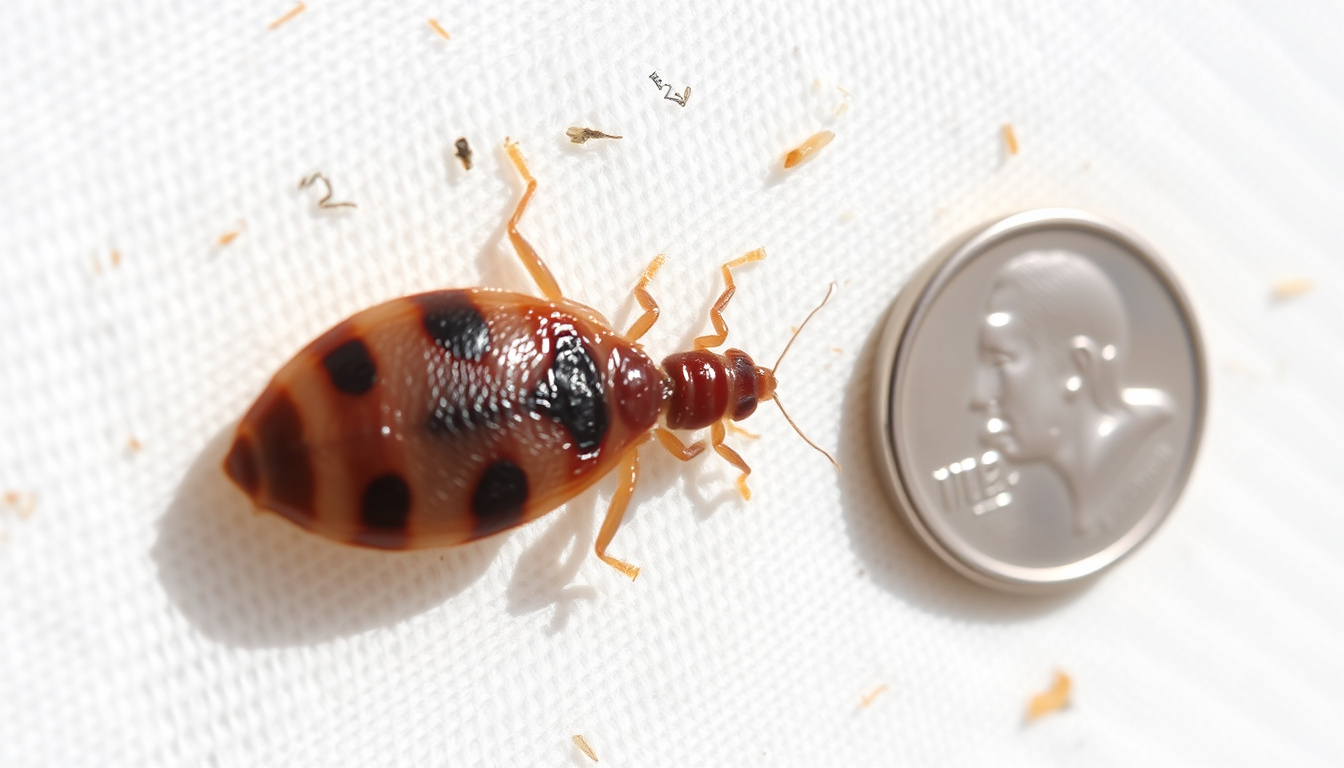

Few pests trigger as much alarm as bed bugs, and for good reason: they feed on your blood while you sleep. But the first step to protecting your home is knowing exactly what you’re looking for. Bed bugs are surprisingly small, but entirely visible to the naked eye at every life stage, according to the US EPA (federal environmental agency). This guide walks you through what they look like, how to spot an infestation early, and how to tell them apart from lookalikes.
Adult bed bug length: 5–6 mm (¼ inch) ·
Adult color: Reddish-brown ·
Wings: None (wingless) ·
Common misidentification: Bat bugs, carpet beetles, booklice ·
Visible to naked eye: Yes, adults and nymphs
Quick snapshot
- Whether bed bugs can transmit Chagas disease — CDC (U.S. public health agency) states no evidence
- Exact prevalence in specific regions due to underreporting (CDC (U.S. public health agency))
- Whether unfed first-instar nymphs are always visible — Virginia Department of Agriculture (state regulatory authority) notes they are difficult to see unless moving or recently fed
- How long a single mated female can initiate an infestation before detection is possible (CDC (U.S. public health agency))
- Eggs hatch in 6–10 days (US EPA)
- Five nymphal instar stages before adulthood (Virginia Department of Agriculture (state regulatory authority))
- Life span 4–6 months (up to a year in cool conditions) (Cornell University IPM program)
- Steam treat infested areas at 130°F
- Use mattress encasements to trap bugs
- Contact a licensed pest control professional
Six key facts about bed bugs — one pattern: every life stage is visible to the naked eye, and size changes dramatically with feeding.
| Attribute | Value |
|---|---|
| Size | Adults: 5–6 mm (¼ inch) |
| Color | Reddish-brown (darkens after feeding) |
| Wings | None — cannot fly |
| Life span | 4–6 months (up to a year in cool conditions) |
| Feeding schedule | Every 5–10 days |
| Egg production | 1–7 eggs per day per female |
The pattern: bed bugs are small but not microscopic. Their feeding cycle and color changes are your best visual cues.
What do bed bugs look like to the human eye?
Adult bed bugs are about the size of an apple seed — 5 to 7 mm long — and are reddish-brown, flat, and oval-shaped when unfed, according to the US EPA (federal environmental agency). After a blood meal, they become elongated, balloon-like, and bright red. The Virginia Department of Agriculture and Consumer Services (state regulatory authority) notes that a fed bed bug can resemble a torpedo or a plump raspberry seed.
If you see a small, reddish bug that suddenly looks like a balloon after you squash it, it’s almost certainly a fed bed bug — a key visual signature that separates them from lookalikes.
What do bed bugs look like on a mattress?
- Small dark specks (fecal spots) on seams and folds — the Cornell University IPM program says a rusty color on a wet tissue after wiping confirms it’s bed bug feces.
- Shed skins (exoskeletons) from nymphs molting.
- Tiny white eggs (1 mm, about the size of a pinhead) glued to rough surfaces (US EPA).
- Live bugs themselves — adults easily seen against white sheets.
What do bed bugs look like on sheets?
- Rusty or reddish blood stains from crushed bugs.
- Dark ink-like spots (fecal matter).
- Small yellowish translucent nymphs that look like moving grains of rice (US EPA).
What do bed bugs look like on skin?
- Bites appear as small, red, itchy welts, often in a line or cluster.
- Some people show no reaction, making bites an unreliable detection method.
The implication: visual signs on your mattress and sheets — fecal spots, shed skins, and the bugs themselves — are far more reliable than bites for early detection.
How to identify a bed bug infestation?
The Cornell University IPM program recommends checking these specific signs:
What are the first signs of bedbugs?
- Small blood spots on sheets (often from being crushed while feeding).
- Dark fecal spots on mattress seams — the Cornell University IPM program says these are one of the best early indicators.
- Shed skins (exoskeletons) from the five instar stages (VDACS).
- Live nymphs and eggs in crevices.
What does a bed bug bite look like?
- Red, raised welts with a darker red center, often in a cluster or line.
- Bites on exposed skin: arms, legs, face, neck.
- Itching may appear hours or days later.
If you have a line of three bites in a row on your arm, that’s the classic “breakfast, lunch, dinner” pattern of a bed bug feeding — almost no other insect bites this way.
What are three signs you might have bed bugs?
- Fecal spots on mattress or box spring seams.
- Shed skins or live bugs in the folds of your mattress.
- Unexplained bites in a line or cluster on your body.
The trade-off: waiting for bites to appear usually means the infestation is already well-established. Fecal spots and shed skins give you a much earlier warning.
What can be mistaken for a bed bug?
Several insects are regularly mistaken for bed bugs. The table below compares the most common lookalikes, using data from Cornell University IPM program and Orkin (national pest control company).
| Pest | Size | Color | Key difference from bed bug |
|---|---|---|---|
| Bed bug (Cimex lectularius) | 5–7 mm | Reddish-brown | Oval, flat, no wings |
| Bat bug | 4–5 mm | Reddish-brown | Longer hairs on pronotum (Cornell University IPM program) |
| Carpet beetle | 2–4 mm | Patterned (white, brown, black) | Rounder, patterned, not a blood feeder |
| Booklouse | 1–2 mm | Pale, translucent | Prefers damp environments, not blood-feeding |
| Spider beetle | 2–4 mm | Dark brown | Long legs and antennae, not flat |
What this means: if the bug you found has antennae longer than its head or a patterned shell, it’s not a bed bug. The bat bug is the trickiest lookalike — only a close look at the pronotum hairs can tell them apart.
What bugs look like bed bugs?
- Bat bugs: nearly identical, but distinguished by longer hairs on the pronotum.
- Carpet beetles: rounder, colored patterns, often found in carpets and closets.
- Booklice: tiny, pale, and prefer humidity — they feed on mold, not blood.
- Flea beetles: jumping insects that do not feed on humans.
- Spider beetles: long legs, resemble spiders, not flattened.
The catch: misidentification leads to wrong treatments. Bat bugs, for example, require bat removal, not bed bug pesticides. Always capture a specimen (in tape or a sealed bag) and send a photo to an extension service for confirmation if unsure.
What kills bed bugs instantly?
The US EPA (federal environmental agency) confirms that steam at 130°F (54°C) kills bed bugs and eggs on contact. Heat is the only instant killer available to homeowners.
What can I spray on my mattress for bed bugs?
- EPA-registered insecticides containing pyrethrins or neonicotinoids can be used according to label directions (US EPA).
- Diatomaceous earth is a desiccant that works over days, not instantly.
- Avoid foggers and bug bombs — they scatter bed bugs deeper into walls and furniture.
How to get rid of bed bugs?
- Step 1 (clean): Wash all bedding and clothing in hot water and dry on high heat.
- Step 2 (steam): Use a handheld steamer to treat mattress seams, box springs, and baseboards at 130°F.
- Step 3 (encase): Encase mattress and box spring in zippered bed bug-proof covers.
- Step 4 (treat): Apply EPA-registered spray strictly following label instructions.
- Step 5 (monitor): Install interceptor traps under bed legs and check weekly for at least 8 weeks.
Why this matters: foggers are the most common DIY mistake. They force bed bugs into hiding, often spreading the problem to adjacent rooms.
What is the main cause of bed bugs?
Bed bugs are primarily spread through travel and secondhand furniture, according to the US EPA. They hitchhike on luggage, clothing, and used items — not because of dirty homes. Clutter gives them more places to hide, but cleanliness alone won’t prevent an infestation.
A five-star hotel is just as likely to have bed bugs as a budget motel. The risk is human movement, not hygiene. Hotels with high turnover see more hitchhikers.
Females lay 1–7 eggs per day, so populations explode quickly if left unchecked. The Cornell University IPM program notes that early detection — even a single bug — can prevent a full infestation.
The pattern: most bed bug incidents start with a single mated female laying eggs after returning from travel. That’s why inspecting luggage and secondhand furniture is the most effective prevention step.
Confirmed facts
- Adult bed bugs are visible to the naked eye (US EPA)
- They feed on blood, primarily at night (Cornell University IPM program)
- Bed bugs are not known to transmit diseases to humans (CDC (U.S. public health agency))
- Steam at 130°F instantly kills bed bugs (US EPA)
What’s unclear
- Whether bed bugs can transmit Chagas disease — CDC (U.S. public health agency) states no evidence
- Exact prevalence in specific regions due to underreporting
- Whether unfed first-instar nymphs are reliably visible — Virginia Department of Agriculture (state regulatory authority) notes they are difficult to spot unless moving
- Exact life span under varying temperature and humidity conditions — estimates range from 4 months to over a year
“The adult bed bug is about the size of an apple seed and is easily seen with the naked eye.”
— US EPA, Bed Bug Appearance and Life Cycle
“Bat bugs are nearly identical to bed bugs; the key difference is hair length on the pronotum.”
— Cornell University IPM program
For the homeowner facing a possible infestation, the choice is clear: inspect for physical signs (fecal spots, shed skins, live bugs) rather than waiting for bites. If you spot a bug, capture it and use the comparison table above — or send a photo to your local cooperative extension service. A confirmed identification saves time, money, and misplaced pesticide use.
Frequently asked questions
Can bed bugs fly?
No. Bed bugs are wingless and cannot fly. They move by crawling and hitchhiking on luggage and clothing (US EPA).
Do bed bugs carry diseases?
Research is ongoing, but the CDC (U.S. public health agency) states there is no evidence that bed bugs transmit diseases to humans. Their bites can cause secondary infections from scratching.
How long can bed bugs live without feeding?
Adult bed bugs can survive 4–6 months without a blood meal in normal room conditions, and up to a year in cooler temperatures (Cornell University IPM program).
Where do bed bugs hide during the day?
They hide in mattress seams, box springs, bed frames, behind headboards, in cracks of furniture, and behind baseboards. The US EPA recommends inspecting these areas with a flashlight and credit card to scrape cracks.
Are bed bugs more active at night?
Yes. They are nocturnal and feed on sleeping hosts. However, a hungry bed bug can bite during the day if it detects human presence (Cornell University IPM program).
Can you see bed bug eggs with the naked eye?
Yes. Eggs are about 1 mm long — the size of a pinhead — and are pearly white. They are often glued to rough surfaces like wood or fabric seams. You may need a magnifying glass to spot them initially (US EPA).
Do bed bug bites itch immediately?
Not always. Many people show no reaction for days or weeks. Others develop red welts within hours. The CDC (U.S. public health agency) notes that delayed reactions make bites an unreliable detection method.
Related reading: King Quilt Cover Size Guide | Carnival Splendor Deck Plan: Best Cabins, Free Upgrades & Dining
Related stories





Thomas Webb leads fact-checking, source verification and corrections at Southern Monitor.