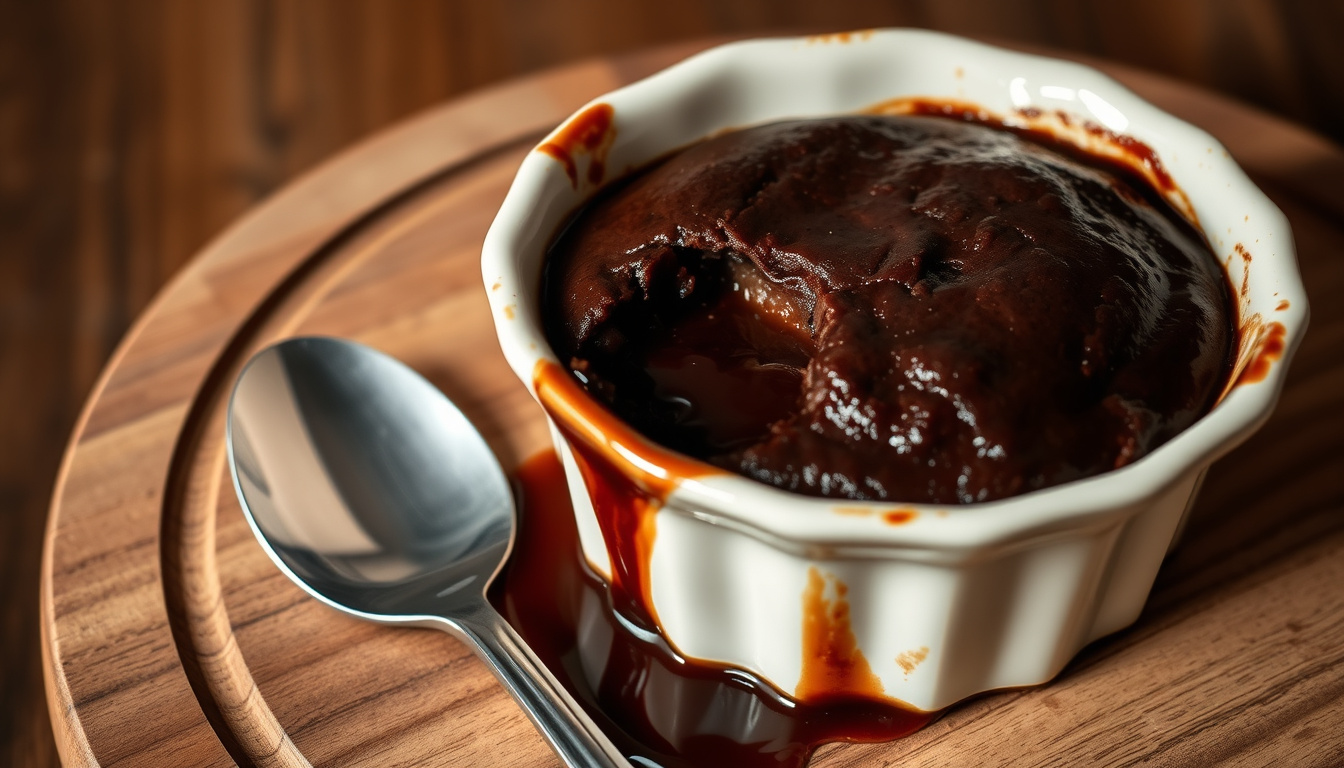
You know that moment when you pull a baking dish out of the oven and discover that the cake on top has hidden a pool of silky chocolate sauce underneath? That’s the magic of a chocolate self saucing pudding — a clever dessert that creates two distinct layers in about 35 minutes.
Prep time: 10 minutes ·
Cook time: 35 minutes ·
Servings: 6 ·
Baking temperature: 180°C (350°F) ·
Key ingredient: Cocoa powder
Quick snapshot
- Flour, sugar, cocoa, baking powder
- Milk, butter, vanilla
- Hot water for the sauce layer
- 10 minutes prep, 35 minutes bake
- Batter goes into dish, then dry topping, then hot water
- Serve warm, often with ice cream
- From mixing bowl to table: about 45 minutes total
- Sauce forms in the last 10-15 minutes of baking
- Best eaten within 30 minutes of leaving the oven
The table below summarizes the key baking parameters for chocolate self-saucing pudding.
| Attribute | Value |
|---|---|
| Average bake time | 35-40 minutes at 180°C (350°F) |
| Typical serving size | 6 servings |
| Main thickener | Baking powder (rises) and heat (sets cake) |
| Sauce volume | About 1 cup of sauce per batch |
The dish size is critical: a 1.5-1.6 litre baking dish ensures the cake and sauce set properly.
How to make chocolate self-saucing pudding?
Gather the ingredients
- Whisk dry ingredients: flour, sugar, cocoa, baking powder, salt.
- Combine wet ingredients: milk, melted butter, vanilla.
- Pour wet into dry and stir until just combined – batter will be thick.
- Spread batter into a greased baking dish.
- Sprinkle combined sugar and cocoa topping evenly over batter.
- Gently pour hot water over the back of a spoon onto the topping.
- Bake at 180°C (350°F) for 35-40 minutes, then serve warm.
- 1 cup all-purpose flour
- 1/2 cup granulated sugar
- 1/4 cup cocoa powder
- 2 teaspoons baking powder
- 1/2 cup milk
- 1/3 cup melted butter
- 1 teaspoon vanilla extract
- For the topping: 1/2 cup sugar + 1/4 cup cocoa + 1 1/4 cups hot water
These are the core ingredients used across multiple sources. RecipeTin Eats calls for whisking the dry ingredients — flour, baking powder, sugar, cocoa, and salt — together before adding the wet. Sugar Salt Magic follows the same base but includes an egg and combines butter, sugar, egg, vanilla, and milk separately. Desert Island Dishes also mixes eggs, melted butter, and milk before folding into the dry ingredients. The variation is minor, but the structure stays the same: a thick batter that will support the sauce layer above it.
Prepare the batter
Whisk the dry ingredients in a bowl: flour, cocoa, baking powder, sugar, and a pinch of salt. In a separate jug, combine the milk, melted butter, and vanilla. Pour the wet into the dry and stir until just combined. The batter should be thick — RecipeTin Eats warns against overmixing, which can create lumps and affect the cake’s texture. The Flavor Bender reinforces this: overworking the batter leads to a dense rather than tender cake layer.
Assemble and bake
Pour the batter into a greased baking dish. RecipeTin Eats uses a 5–6 cup dish; Katy’s Food Finds recommends a 1.6 litre (6 cup) dish; Sugar Salt Magic prefers an 8-inch pie dish. Sprinkle the combined sugar and cocoa topping evenly over the batter. Now pour the hot water gently — RecipeTin Eats and Katy’s Food Finds both suggest pouring over the back of a dessert spoon to avoid disturbing the layer beneath.
Bake at 180°C (350°F) for 35-40 minutes. Sugar Salt Magic uses 180°C / 350°F / 160°C fan; Desert Island Dishes uses 160°C fan / 180°C / 355°F. A YouTube demonstration suggests 160°C / 325°F for 35–40 minutes, checking for bubbling edges and a springy top.
Serve immediately
The pudding is at its best warm, straight from the dish. Spoon into bowls, making sure each serving gets both cake and sauce. Ice cream or cream balances the richness, but it’s equally good on its own.
The two-step pour — batter, then dry topping, then hot water — is the only sequence that works. Reverse it, and you’ll end up with chocolate soup rather than a layered dessert.
The pattern is clear: the two-step pour is non-negotiable for a layered result.
What is a self-saucing pudding?
Definition and origin
A self-saucing pudding is a batter-based dessert that creates its own sauce during baking. The cake layer rises to the top, and a fudgy chocolate sauce forms underneath. The dessert is also known as a pudding cake or upside-down pudding. RecipeTin Eats describes it as a “warm, moist chocolate cake with a silky sauce.” BBC Food (Mary Berry variant) notes that the sauce “miraculously ends up on the bottom.” It’s especially popular in Australia, New Zealand, and the UK, where “pudding” refers to any dessert course.
“Warm, moist chocolate cake with a silky sauce.” — RecipeTin Eats
“The sauce miraculously ends up on the bottom.” — BBC Food
How the sauce forms
The science is straightforward: when the baking powder in the batter heats up, it produces bubbles that lift the cake layer. The hot water and sugar mixture sinks through the porous batter and settles at the bottom. The cocoa in that water layer thickens as it cooks, turning into a smooth sauce. RecipeTin Eats explains that the batter must be thick enough to support the weight of the water without dispersing.
Common variations
- Chocolate chips or espresso powder folded into the batter for a deeper flavor
- Gluten-free: substitute all-purpose flour with a 1:1 gluten-free blend
- Egg-free versions exist, using extra milk or a flax egg as a binding agent
Understanding this mechanism helps home cooks troubleshoot when the layers don’t separate.
What is the difference between self-saucing and regular pudding?
The table below highlights the main differences between self-saucing and regular pudding.
| Feature | Self-saucing pudding | Regular pudding |
|---|---|---|
| Cooking method | Baked in the oven at 180°C (350°F) | Stovetop, stirred over medium heat |
| Texture | Spongy cake on top, liquid sauce underneath | Custard-like and uniform, no separate layers |
| Sauce formation | Hot water poured over batter before baking creates sauce | No separate sauce — thickened with cornstarch or eggs |
| Serving temperature | Warm, straight from the oven | Can be served warm, chilled, or at room temperature |
| Primary thickener | Baking powder (for cake structure) + heat | Cornstarch, eggs, or both |
The trade-off: self-saucing pudding gives you two textures for nearly the same effort as a regular one, but it requires precise dish size and baking time. A regular pudding is more forgiving and can be made on the stovetop in about 15 minutes.
How long do you cook chocolate self-saucing pudding?
Standard baking time
35-40 minutes at 180°C (350°F) is the consensus. Sugar Salt Magic recommends 35-40 minutes at 180°C / 350°F / 160°C fan. Desert Island Dishes also uses 35 minutes at 160°C fan / 180°C / 355°F. RecipeTin Eats suggests 35-40 minutes as a safe window for a 5–6 cup dish.
Signs of doneness
The cake top should spring back when lightly pressed, and the sauce should bubble at the edges of the dish. A YouTube demonstration shows that the edges will be noticeably bubbling after 35 minutes at 160°C / 325°F.
Adjusting for different dish sizes
Using a shallow dish spreads the batter thin, reducing baking time by 5-8 minutes. A deeper dish requires the full 40 minutes. A 1.5-1.6 litre (6 cup) dish is the sweet spot for most recipes — Katy’s Food Finds and RecipeTin Eats both agree on this volume.
What ingredients are needed for chocolate self-saucing pudding?
Core dry ingredients
- All-purpose flour: 1 cup
- Granulated sugar: 1/2 cup
- Cocoa powder: 1/4 cup
- Baking powder: 2 teaspoons
- Salt: a pinch
Liquid ingredients
- Milk: 1/2 cup
- Unsalted butter: 1/3 cup, melted
- Vanilla extract: 1 teaspoon
- Egg: 1 large (optional; some recipes skip it)
Topping mixture
- Granulated sugar: 1/2 cup
- Cocoa powder: 1/4 cup
- Hot water: 1 1/4 cups (almost boiling)
Optional add-ins
- Chocolate chips — add 1/3 cup to the batter before pouring
- Espresso powder — 1/2 teaspoon intensifies the chocolate flavor
- Orange zest or cinnamon for a flavor twist
With these ingredients, you can adapt the recipe to your taste while keeping the core method intact.
What we know and what’s uncertain
Confirmed
- Self-saucing pudding requires a hot water pour over the batter.
- The sauce forms during baking due to density differences.
- It is also known as pudding cake.
Unclear
- Exact origin is debated; no single inventor documented.
- Princess Diana’s favorite dessert is sometimes reported as chocolate self-saucing pudding, but sources vary.
Related reading: Chocolate Self-Saucing Pudding · Chocolate Self-Saucing Pudding Recipe
For a foolproof version that delivers a tender sponge with a glossy sauce every time, try this chocolate self saucing pudding recipe from Reef Voice.
Frequently asked questions
Can I use milk instead of water in the topping?
Yes, but milk has dissolved solids that can scorch at the bottom of the dish. Water creates a cleaner, silkier sauce without the risk of burning. Use boiling water for best results.
Why did my self-saucing pudding not form a sauce?
The most common reason is that the batter was too thin — the water dispersed into the batter rather than sinking through it. Another possibility: the dish was too shallow, causing the water to evaporate before forming a sauce. Finally, if the oven temperature was too low, the sauce may not have thickened properly.
Can I make this in a slow cooker?
Yes. Use the same ingredients and method, but cook on HIGH for 2 hours. The texture will be softer and more spoonable than the oven version. Check at 1.5 hours if your slow cooker runs hot.
How do I reheat self-saucing pudding?
Individual servings microwave in 20-second bursts until warm. For the whole dish, cover with foil and heat at 150°C (300°F) for 10-15 minutes. Avoid reheating more than once — the sauce thickens and loses its silky quality on the second pass.
Is self-saucing pudding the same as a chocolate lava cake?
No. Lava cake has a deliberately liquid center held inside a firm shell, achieved by underbaking. Self-saucing pudding creates its sauce through a different mechanism — hot water poured over the batter migrates to the bottom during baking. The result is a thin sauce layer, not a molten core.
Can I add nuts or chocolate chips to the batter?
Yes. Fold in up to 1/3 cup of chocolate chips, chopped walnuts, or pecans after mixing the batter. The chips will melt slightly and create pockets of fudge within the cake layer.
How long does self-saucing pudding keep?
Covered in the refrigerator, it keeps for up to 3 days. The sauce will thicken as it cools, so reheat before serving. The cake layer softens slightly over time, so it’s best eaten fresh on the day of baking.
What is the best dish to bake self-saucing pudding in?
A 1.5-1.6 litre (6 cup) baking dish, about 8 inches wide and 2-3 inches deep. Pyrex or ceramic dishes work best because they distribute heat evenly. Avoid deep dishes — the water won’t reach the bottom in time, and the cake may burn before the sauce sets.
Related stories





Noah Harper is Senior Reporter at Southern Monitor, covering breaking stories and explainers.