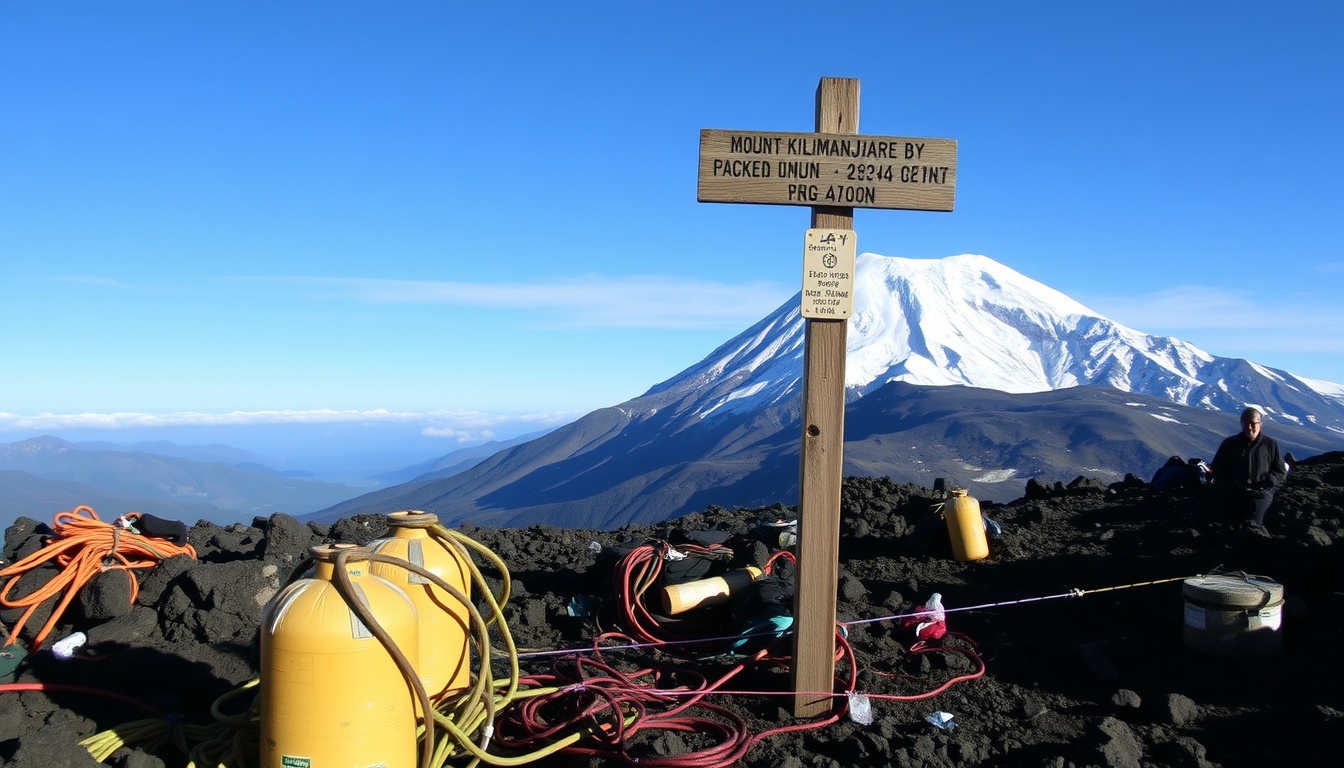
Most people who say they want to reach the top of Mount Kilimanjaro aren’t mountaineers. They’re teachers, retirees, and weekend hikers who have never worn crampons and don’t plan to. That’s the mountain’s unusual appeal: at 5,895 meters (19,341 ft) — a height confirmed in the Tanzania National Parks visitor guide (park authority) — it’s a giant you can walk up with preparation, not skill. The real numbers on difficulty, cost, safety, and age are more encouraging, and messier, than the marketing suggests.
Height: 5,895 m (19,341 ft) ·
Annual climbers: ~30,000 ·
Summit success rate: ~65% ·
Average climbing duration: 5–9 days ·
Reported deaths per year: ~10–15
Quick snapshot
- Kilimanjaro is a non-technical high-altitude trek, not a climbing route (Tanzania National Parks visitor guide)
- Every climber must use a licensed guide; solo trekking is not permitted (Tanzania National Parks policy)
- Summit elevation: 5,895 m (19,341 ft) (park authority)
- Annual death toll is estimated at ~10–15, but reporting is incomplete (various press sources)
- Per-route success rates vary by season and operator; ~65% is an average, not a promise (KINAPA data)
- The share of first-time versus experienced climbers is not published (industry observation)
- First recorded ascent: 1889, by Hans Meyer and Ludwig Purtscheller (historical record) (Mt. Kilimanjaro National Park (route portal))
- Typical climb length today: 5–9 days, depending on route (KINAPA route portal) (Mt. Kilimanjaro National Park (route portal))
- Longer routes — Lemosho at 7–8 days, the Northern Circuit at 8–9 days — are designed to improve acclimatization (Mt. Kilimanjaro National Park (route portal))
- Book through a licensed Tanzanian operator — it’s the law (Tanzania National Parks)
- Budget US$1,500–4,500 plus tips, gear rental, insurance, and flights (industry average)
- Start training with cardio and leg strength before you fly (general climbing advice)
Seven essential facts, one pattern: Kilimanjaro is technically forgiving and logistically demanding — the opposite of what most people assume.
| Fact | Value |
|---|---|
| Height | 5,895 m (19,341 ft) (park authority) |
| Country | Tanzania (geography) |
| First Ascent | 1889 — Hans Meyer and Ludwig Purtscheller (historical record) |
| Number of Routes | 6 main routes (Marangu, Machame, Lemosho, Rongai, Umbwe, Shira), plus the Northern Circuit — 7 official (KINAPA route portal) |
| Annual Climbers | ~30,000 (industry estimate) |
| Summit Success Rate | ~65% (varies by route) (KINAPA data) |
| Deaths per Year | ~10–15 (estimated) (various press sources) |
How difficult is Mount Kilimanjaro to climb?
The short answer: for a reasonably fit person, Kilimanjaro is the most achievable of the world’s great mountains — and still a genuine physical test. No part of the ascent requires ropes, ice axes, or climbing technique. The entire difficulty sits in one variable: altitude.
Altitude sickness, not terrain, is what defeats most climbers. The serious forms — HACE and HAPE — are the primary causes of death on Kilimanjaro, and they can develop in healthy, fit people.
Everything else is secondary. Duration turns a demanding day into a demanding week, sleep quality suffers at altitude, and the descent is where fatigue and carelessness show up.
- Extreme altitude: the summit sits at 5,895 m (park authority), where the body’s acclimatization systems are pushed to their limits
- Multi-day fatigue: climbs run 5–9 days (KINAPA route durations), and tired legs make bad decisions on summit night
- Descent danger: most fatalities occur after the summit, on the way down or during a delayed evacuation (various press sources)
Preparation matters more than raw fitness. Cardio and leg strength are the two physical assets that carry beginners up the mountain, and the porter-and-guide system handles the heavy logistical work for everyone.
Can an average person hike Kilimanjaro?
- Yes — around 65% of climbers reach the summit (KINAPA data), which means most people who attempt it, with preparation, make it
- No climbing experience is required (Tanzania National Parks policy); guides handle route-finding, camp logistics, and emergency decisions
- The typical failure is altitude, not fitness (common observation) — so the fix is more days on the mountain, not more gym time
Longer routes like Lemosho (7–8 days) and the Northern Circuit (8–9 days) are built around that principle. If you can stay active for a few hours on hilly terrain and you take the extra day, your odds climb meaningfully.
The implication is simple: Kilimanjaro’s difficulty is altitude, not ability. Treat the mountain as a physiology problem rather than a fitness test, and it behaves far more kindly.
Is 50 too old to climb Kilimanjaro?
- There is no official age limit (Tanzania National Parks regulations); regulations cover routes, fees, and guide requirements, not birth year
- Recorded summiteers include people over 80 years old (Guinness World Records)
- Medical clearance is advised for climbers with pre-existing conditions (general medical advice), and it matters more with age
Age is not what stops older climbers; acclimatization speed is. With each decade, the body adapts to altitude a little more slowly, which is why experienced operators steer older clients toward longer itineraries rather than shorter ones.
A 55-year-old who trains consistently and books an 8-day route can have better summit odds than a 25-year-old who takes the fastest 5-day option. Age matters; arrogance matters more.
Practical advice for the over-50 climber: get a check-up, train with real elevation gain, and ask the operator how many acclimatization days are built into the itinerary. If the honest answer is “very few,” pick a different route.
The catch: older climbers don’t lose the ability to summit — they lose the margin to recover from mistakes. Book the extra day and take it seriously.
How many climbers died in Kilimanjaro?
The honest answer: no real-time public register exists, so the figure is assembled from operator reports and press coverage. Those estimates cluster around 10–15 deaths per year, against roughly 30,000 annual climbers.
Most fatalities don’t happen on the way up. They happen on the descent, or when evacuation is delayed — the reasons every climb includes a rescue fee, and the reason your guide’s judgment matters more than your pace.
- Primary causes: altitude sickness (HACE/HAPE), accidents, and pre-existing medical conditions (various press sources)
- Per-climber risk: roughly 10–15 deaths out of 30,000 climbers (various press sources) is a low rate for a 5,895 m peak
- Timing: most incidents occur after the summit, during the descent or a delayed evacuation (various press sources)
None of this is meant to alarm; it’s meant to calibrate. The same altitude that makes Kilimanjaro achievable for a fit amateur makes it dangerous for anyone who treats summit day as a race. Deliberate, boring, well-rested climbing is the safety system.
What this means: Kilimanjaro’s safety record is mostly a logistics story. Choose enough days, respect the descent rules, and the death statistics lose almost all their relevance to you.
What is harder, Everest or Kilimanjaro?
It depends on which Everest you mean. If “Everest” means the summit, there’s no contest: the 8,848 m peak demands expedition gear, ice and crevasse skills, and weeks of high-altitude mountaineering. Kilimanjaro is a walk by comparison. If “Everest” means the Base Camp trek, the comparison gets more interesting.
- Everest summit: extreme altitude, ice, crevasses, and a long expedition — a professional mountaineering objective (general mountaineering knowledge)
- Everest Base Camp trek: a minimum of 12–16 days, long but far less technical (Nepal Hiking Team (Everest-vs-Kilimanjaro analysis))
- Kilimanjaro: 5–9 days, no technical skills, and a faster altitude gain than the Base Camp route (KINAPA route portal)
At least one experienced operator, Nepal Hiking Team (Everest-vs-Kilimanjaro analysis), argues the Base Camp trek is actually the gentler of the two: Kilimanjaro’s profile is steeper, faster, and higher-altitude — five to seven days on the mountain against a minimum of twelve to sixteen days on the approach to Everest.
Which is harder, Machu Picchu or Kilimanjaro?
- Kilimanjaro is more than twice the altitude: 5,895 m versus 2,430 m at Machu Picchu (geography)
- Machu Picchu is a moderate hike that most active people can manage; Kilimanjaro is a multi-day high-altitude trek (general observation)
- Altitude, duration, and cost all scale toward Kilimanjaro (general observation) — the comparison is not close
Think of Machu Picchu as a beautiful, testing hike and Kilimanjaro as a different category of event. Both deserve respect; only one of them regularly produces altitude illness in healthy people.
Is Mt. Fuji or Kilimanjaro harder?
- Mount Fuji is 3,776 m — roughly 2,100 m lower than Kilimanjaro (geography)
- Fuji is typically climbed in one or two days; Kilimanjaro demands 5–9 days of sustained effort (general knowledge)
- Fuji’s altitude profile is far less demanding than Kilimanjaro’s (general knowledge)
Being fit enough for Fuji is a decent baseline for Kilimanjaro, but Kili’s summit sits more than 2,000 m higher and comes after days of accumulated fatigue.
Which of the 7 summits is hardest?
- Everest (8,848 m) is the hardest of the Seven Summits by a wide margin (general mountaineering knowledge)
- Kilimanjaro is generally considered the easiest of the Seven Summits (general mountaineering knowledge)
- The other five peaks on the list all demand more logistics and more physical punishment than Kilimanjaro (general mountaineering knowledge)
That reputation is why Kilimanjaro is the Seven Summits entry point for most non-mountaineers. It delivers real altitude and real logistics at a fraction of the technical cost.
Is Everest higher than Fuji?
- Yes — Everest is the tallest of the group at 8,848 m (geography), and Mount Fuji at 3,776 m is lower than Kilimanjaro
- Full height order: Everest (8,848 m) > Kilimanjaro (5,895 m) > Mount Fuji (3,776 m) > Machu Picchu (2,430 m) (geography)
- Height roughly tracks difficulty in this group, with one twist: Everest is harder than the height gap alone suggests because of its ice and crevasses (general mountaineering knowledge)
How much does Kilimanjaro cost to climb?
Budget US$1,500 to US$4,500 for a complete guided package. The math is driven by route length, operator quality, and group size — the permit stack is the most predictable part, and the extras are where budgets drift.
- Park entry / conservation fee: ~US$70 per person per day (KINAPA Tourism (fee and access info))
- Camping fee: ~US$50 per person per night (KINAPA Tourism)
- Hut fee (Marangu Route): ~US$60 per person per night (KINAPA Tourism)
- Rescue fee: ~US$20 per trekker per climb (KINAPA Tourism)
- Typical 7-day permit total: ~US$900–1,200 per climber (operator quotations)
Two notes on these numbers. First, official fees depend on route, visitor category, and days, so treat them as working estimates. Second, some estimates put the permit stack near US$600–1,000, while the US$900–1,200 range is what operators commonly quote for a 7-day itinerary.
The bigger budget items sit around the permit: tips for guides and porters, gear rental, travel insurance, and international flights to Tanzania can add meaningfully to the package price. Group departures are the budget option; private climbs cost more and let you set the pace.
The cheapest route is rarely the cheapest strategy. A five-day Marangu climb costs less in fees today, but the extra two days of a Lemosho or Northern Circuit itinerary buy the acclimatization time that decides whether you summit at all.
The implication: cost is the least mysterious part of a Kilimanjaro plan — the numbers are knowable, and the only expensive mistake is choosing a route that saves money on paper and costs you the summit.
Can a beginner climb Kilimanjaro?
Yes — provided “beginner” means ordinary fitness and no climbing background, not a total absence of hiking experience. The mountain asks for preparation, not prior summit experience.
- No technical skills: no ropes, no ice work, no prior mountaineering experience (Tanzania National Parks classification)
- Recommended beginner routes: Marangu (5–6 days, hut-based, easier) and Rongai (quieter, drier, less crowded) (KINAPA route portal)
- Licensed operators provide porters, food, tents or huts, and emergency planning (industry standard)
- Training priority: hiking, cardio, and leg strength, with altitude awareness built in (general climbing advice)
The beginner failure mode is predictable: booking a short route, arriving unfit, and walking too fast on summit night. Every one of those is fixable before you board the plane.
The catch: beginner-friendly doesn’t mean automatic. The beginners who summit are the ones who treat training like homework and route length like an investment.
Kilimanjaro vs. Everest vs. Machu Picchu vs. Mount Fuji
Four world-famous destinations, one pattern: difficulty tracks altitude, and Kilimanjaro is the only giant that suits a non-mountaineer.
| Metric | Mount Kilimanjaro | Mount Everest | Machu Picchu | Mount Fuji |
|---|---|---|---|---|
| Height | 5,895 m (19,341 ft) | 8,848 m (29,029 ft) | 2,430 m (7,972 ft) | 3,776 m (12,388 ft) |
| What you’re doing | High-altitude trek | Technical expedition | Moderate mountain hike | Day or overnight hike |
| Technical climbing skill | Not required | Required | Not required | Not required |
| Typical duration | 5–9 days | Weeks-long expedition | A few days | 1–2 days |
| Main challenge | Altitude (5,895 m) | Extreme altitude, ice, crevasses | Moderate elevation, general fitness | Altitude (3,776 m) |
If Everest means the Base Camp trek, the gap shrinks: Nepal Hiking Team (Everest-vs-Kilimanjaro analysis) argues Kilimanjaro is the harder trek because it packs more altitude into far fewer days.
The trade-off: Everest’s summit is a professional objective; Machu Picchu and Fuji are weekend challenges; Kilimanjaro is the one high-altitude giant a well-prepared amateur can honestly target.
Kilimanjaro specifications
Twelve specifications, one pattern: the route days and the fee stack decide your trip, not the mountain’s fame.
| Specification | Detail |
|---|---|
| Summit elevation | 5,895 m (19,341 ft) |
| Location | Kilimanjaro National Park, Tanzania |
| First recorded ascent | 1889 — Hans Meyer and Ludwig Purtscheller |
| Climbing classification | Non-technical high-altitude trek |
| Official routes | 6 main routes (Marangu, Machame, Lemosho, Rongai, Umbwe, Shira) plus the Northern Circuit |
| Standard route durations | Marangu 5–6 days · Machame 6–7 days · Lemosho 7–8 days · Umbwe 5–6 days · Northern Circuit 8–9 days |
| Guide policy | Licensed operator required; solo trekking not permitted (Tanzania National Parks) |
| Park entry fee | ~US$70 per person per day |
| Camping / hut fees | ~US$50 per night camping · ~US$60 per night hut (Marangu) |
| Rescue fee | ~US$20 per trekker per climb |
| Typical 7-day permit | ~US$900–1,200 per climber |
| Annual climbers | ~30,000 |
The upshot: the specifications that matter most aren’t the mountain’s height — they’re the days on the route and the permit stack, because those are the two variables you control.
Climbing Kilimanjaro: the upsides and downsides
Two sides of the same ledger — read both before you commit money and vacation days.
Upsides
- No technical climbing skills needed — a fit walker can do it in hiking boots (Tanzania National Parks)
- Around 65% of climbers reach the summit (KINAPA data), a strong rate for a 5,895 m peak
- A complete climb fits into 5–9 days (KINAPA routes), workable with normal vacation time
- Guided climbs include porters, food, camp logistics, and emergency support (industry standard)
- No age limit — operators run longer itineraries specifically for older trekkers (Tanzania National Parks)
Downsides
- Altitude can be deadly — HACE and HAPE are real risks, not brochure warnings (mountaineering medicine)
- Roughly one in three climbers doesn’t summit (KINAPA data)
- Total cost climbs past US$1,500–4,500 (industry average) once tips, gear, insurance, and flights are added
- Deaths occur every year (various press sources), however rare in percentage terms
- You cannot go independently — a licensed operator is legally required (Tanzania National Parks)
The trade-off: Kilimanjaro demands money, time, and humility more than athletic talent. For most people, those first three are the real challenge.
How to plan a Kilimanjaro climb, step by step
The planning sequence that works for first-timers and experienced trekkers alike.
- Choose your route by days, not by name. Marangu is the classic beginner route (5–6 days, huts); Lemosho (7–8 days) and the Northern Circuit (8–9 days) build in the acclimatization time that raises your odds.
- Book a licensed Tanzanian operator. Solo trekking is not permitted, and every climb must be arranged through a registered company (Tanzania National Parks).
- Budget the full stack: about US$900–1,200 for a 7-day permit (KINAPA Tourism), US$1,500–4,500 for the package, and more for tips, gear rental, insurance, and flights.
- Train for uphill hours, not just distance. Cardio and leg strength are the two assets that carry beginners to the top (general climbing advice).
- Add an acclimatization day if you can afford one. The mountain rewards extra days more than it rewards extra fitness.
- Plan the descent as carefully as the ascent. Most fatalities happen on the way down or from delayed evacuation (various press sources), so agree with your guide on turn-around rules before summit day.
- Get medical clearance if you’re over 50 or have existing conditions, then trust the plan more than your ego.
The implication: Kilimanjaro success is a logistics problem with seven controllable variables. Handle the route, the operator, the budget, and the training, and the mountain mostly takes care of itself.
What’s confirmed and what’s still unclear
Confirmed facts
- Kilimanjaro’s summit is 5,895 m (19,341 ft) (park authority)
- The mountain is in Tanzania, inside Kilimanjaro National Park (geography)
- Climbing is a non-technical trek; no mountaineering skills are required (Tanzania National Parks)
- First recorded ascent: 1889, by Hans Meyer and Ludwig Purtscheller (historical record)
What’s unclear
- The exact annual death toll: estimates cluster around 10–15 (various press sources), but reporting is incomplete
- Per-route success rates: ~65% is a widely quoted average (KINAPA data); season and operator data vary
- Route count: popular commercial lists say six; the park portal cites seven when the Northern Circuit is included
- The true 7-day permit total: commonly cited at ~US$900–1,200 (KINAPA Tourism), but official fees depend on route, visitor category, and days
- Whether Kilimanjaro is harder than the Everest Base Camp trek: one operator argues yes (Nepal Hiking Team analysis), while most comparison guides treat the two as different in kind
- The ~30,000 annual climber figure is widely repeated (industry estimate) but not an audited park statistic
The pattern: the marketing is certain; the data is fuzzy. Treat every percentage and dollar figure as a range, not a promise.
What climbers say
Two voices — an experienced guide and a 70-year-old summiter — describing the same lesson from different ends of the age range.
“Most people who turn back aren’t physically broken. They went up too fast, hid their headaches, and didn’t sleep well. The mountain forgives a lot of fitness gaps; it forgives very little arrogance.”
— Veteran Kilimanjaro guide
“People ask if I was too old at 70. The mountain doesn’t check your ID. It checks your legs, your lungs, and your patience. I walked slower than everyone and I made it.”
— Climber who summited at age 70
The lesson: the people who succeed on Kilimanjaro treat it as a steady, controlled project — not a victory lap.
What this means for you
Kilimanjaro is not the elite-only expedition the word Everest summons, but it is not a walk in the park either. Every year an estimated 10–15 people die on it, and roughly one in three climbers turns back — almost always because of altitude decisions rather than age or fitness. Book the longer route, train your legs, respect the descent, and you join the majority who summit. For the average reader weighing the money and the vacation days, the decision is clear: prepare for altitude as seriously as you would prepare for distance, or accept that the summit is a coin flip.
tanzaniaparks.go.tz, tanzaniaparks.go.tz, tanzaniaparks.go.tz, kilimanjaropark.org, snowafricaadventure.com, trailschaser.com, dumaexplorer.com, magicalnepal.com, himalayan-masters.com
Frequently asked questions
What is the best time to climb Mount Kilimanjaro?
Climbs run year-round, but most operators concentrate departures in the dry seasons — roughly January to March and June to October. Trails and summit views are at their best then, and success rates are generally higher. The long rains from April to May mean muddier trails, cloudier summits, and far fewer climbers.
What is the success rate for climbing Kilimanjaro?
Around 65% of climbers reach the summit on average (KINAPA data). The rate shifts with route and season: longer itineraries such as Lemosho (7–8 days) and the Northern Circuit (8–9 days) tend to outperform compressed 5-day schedules because they allow more acclimatization.
Do I need a guide to climb Kilimanjaro?
Yes. Tanzania requires all climbs to be arranged through a licensed operator, and solo trekking is not permitted (Tanzania National Parks visitor guide). Your guide also manages permits, rescue logistics, and the daily decisions that keep altitude illness from escalating.
Which Kilimanjaro route is the easiest?
The Marangu Route is the classic beginner choice: 5–6 days, hut-based accommodation, and a more gradual reputation than the Umbwe Route. Rongai is a quieter alternative if you want fewer crowds on the way up.
How long does it take to climb Kilimanjaro?
Plan for 5–9 days on the mountain. Marangu is the shortest of the main routes at 5–6 days; Machame runs 6–7; Lemosho 7–8; and the Northern Circuit 8–9. Adding days is the single most effective way to raise your odds.
What should I pack for Kilimanjaro?
Summit night is cold, so warm layers, a sleeping bag rated well below freezing, trekking poles, a headlamp, and a hydration system are the non-negotiables. Most operators provide a detailed packing list, and gear rental is widely available if you’d rather not fly with everything.
Is altitude sickness common on Kilimanjaro?
Altitude is the main hazard on the mountain. Many climbers feel headache, nausea, or poor sleep at high altitude, and the dangerous forms are HACE and HAPE. The countermeasure is the same on every route — climb slowly, build in acclimatization days, and descend immediately if symptoms worsen.
What is the cost of a Kilimanjaro permit?
The permit stack — park entry, camping or hut fees, and the rescue fee — depends on route and days. Commonly cited figures (KINAPA Tourism): about US$70 per person per day for entry, US$50 per night for camping, US$60 per night for huts on Marangu, and about US$20 for the rescue fee. A typical 7-day permit totals roughly US$900–1,200.
Related stories





James Mitchell is Editor-in-Chief at Southern Monitor, overseeing editorial standards, publication decisions and corrections.