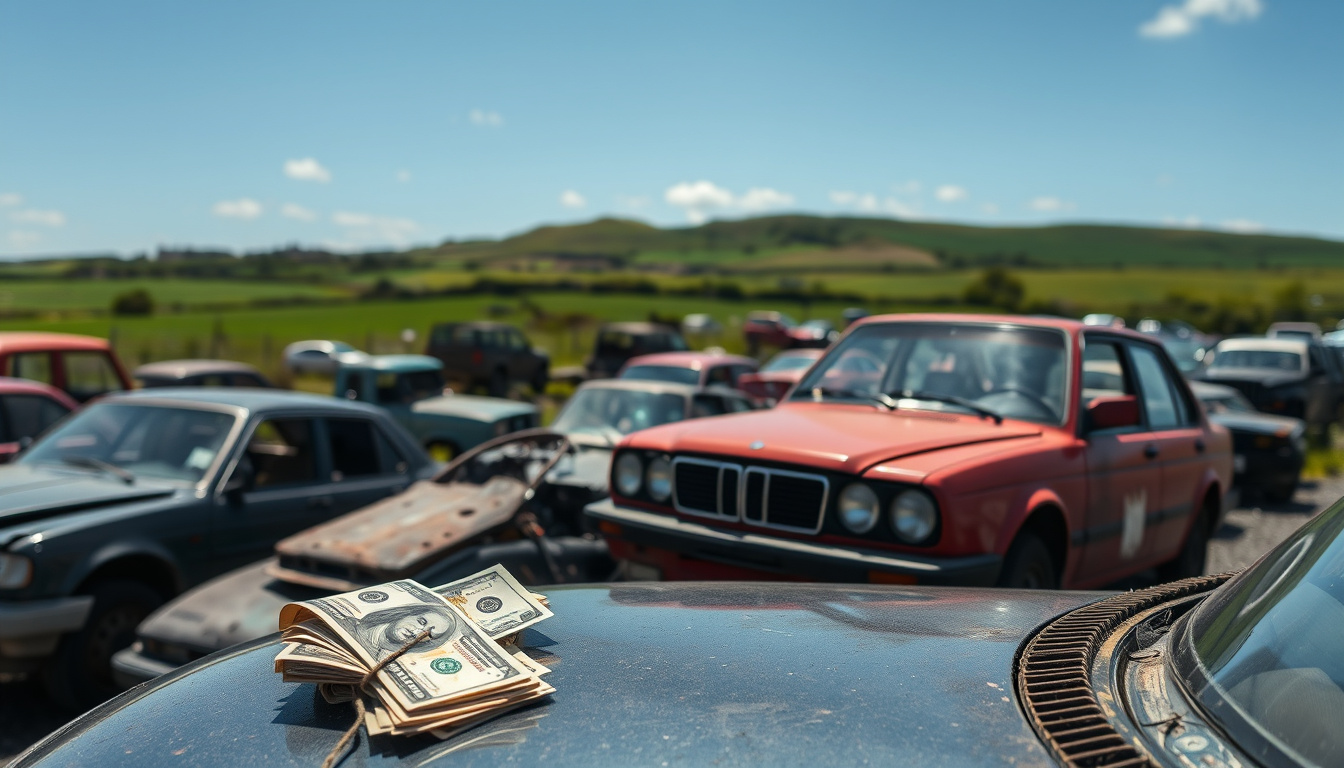
That old Astra sitting in the driveway has probably cost you more in tax and insurance than it’s worth. But underneath the rust and the missing wing mirror, it still holds real cash value—if you know where to sell it in Ireland’s fragmented scrap market.
Average payout for a standard family car: €150–€350 ·
Weight of average end-of-life vehicle: 1.2–1.5 tonnes ·
Licensed scrap dealers in Ireland (2023 est.): 180+ ·
Scrap car recycled or recovered: 95% ·
Top buyers offer collection in: 24–48 hours
Quick snapshot
- You receive cash on collection or drop-off (Car Take Away (licensed ATF network))
- Licensed ATFs issue a Certificate of Destruction (Cover in a Click (insurance & vehicle advice))
- Typical payout for a family car is €150–€350 (Car Take Away)
- Exact current scrap metal commodity prices are not published centrally — offers vary weekly
- Smaller local buyers may pay above or below national averages case-by-case
- Most national buyers offer free collection within 24–48 hours (Car Take Away)
- Payment is made on the spot or transferred within 24 hours (CarTakeBack Ireland blog (national recycler))
- Check your NCT and tax status – cars with residual tax can earn a refund (CarTakeBack Ireland blog)
- Request quotes from at least three licensed ATFs before accepting an offer (CarTakeBack Ireland blog)
The table below summarizes the key facts at a glance.
| Fact | Value |
|---|---|
| Average cash payment for a scrap car in Ireland | €150–€350 (Car Take Away) |
| Time to receive payment | Immediate on collection (Car Take Away) |
| Number of licensed ATFs in Ireland | Approximately 85 (as of 2023) – Cover in a Click notes at least one per city and council area |
| Legal minimum age of vehicle for scrapping | No minimum age – any end-of-life vehicle can be scrapped |
| Documents needed | Photo ID, proof of address, Vehicle Registration Certificate (or Form RF134 if logbook lost) – Car Take Away |
| Recycling rate | 95% of vehicle weight reused or recycled – compliant with ELV Directive 2000/53/EC |
Do you get money for scrapping a car in Ireland?
Yes – and it’s immediate. Licensed Authorised Treatment Facilities (ATFs) pay you cash or bank transfer the moment they take the car. The amount depends on weight, make, model, and location, but a typical family car brings in €150–€350.
How cash-for-scrap services work in Ireland
You book a collection or drop-off. The ATF inspects the vehicle, confirms its identity, and agrees a price. On handover, you get paid and receive a Certificate of Destruction (CoD). The ATF then deregisters the vehicle with the Department of Transport.
Legal requirements for scrapping a vehicle
- You must use an ATF – scrapping any other way is illegal.
- You need photo ID, proof of address, and the Vehicle Registration Certificate (logbook). If the logbook is missing, you can use Form RF134.
- Once the ATF issues the CoD, you can apply for a road tax refund (Form RF120) if at least three full months of tax remain.
Using an unlicensed scrapper may save you a few euro but leaves you legally liable for the car forever. The CoD is your proof that you’re no longer the owner – never skip it.
The pattern: Scrapping through a licensed ATF gives you instant cash, legal protection, and zero future liability — the only safe route in Ireland.
How do I get the most money for my scrap car?
Getting top euro means playing the game: compare multiple offers, know your car’s residual value, and consider stripping high-value parts before handover.
Compare multiple quotes from licensed buyers
Getting 3–5 quotes improves your final offer. National buyers like CarTakeBack and CashForCars.ie offer instant online valuations using your registration and Eircode. Local Dublin buyers sometimes pay more because they save on transport costs – but always check their ATF licence first.
Know your car’s scrap value before you sell
Use an online scrap value calculator (like the one at CarTakeBack.ie) to set a baseline. The average scrap car in Ireland fetches around €280, but actual offers vary by condition, location, and whether the car has missing parts.
Remove valuable parts before scrapping
Catalytic converters, alloy wheels, and batteries can be sold separately for more than the metal value. A catalytic converter alone can fetch €50–€200 depending on the model. If you remove them, you lose the scrap price for those parts, so weigh the maths.
Stripping parts takes time and you still need to scrap the shell. For most owners, the quickest cash is the full-car offer – especially if you factor in the hassle of selling parts on DoneDeal.
The implication: Comparing 3–5 quotes and keeping valuable parts intact usually nets the highest total payout — but stripping parts only pays off if you have the time to sell them.
Is it better to scrap or sell my old car?
It depends on the car’s mechanical health. Here’s when each route wins.
When scrapping makes more sense
- Repair costs exceed the car’s market value – scrapping puts cash in your pocket today.
- The car has no NCT or fails a costly test – scrapping avoids the repair bill.
- You want a guaranteed, no-fuss sale with instant payment and no buyer tyre-kicking.
When private sale or part-exchange is better
- The car is still running and cosmetically decent – you may fetch 2–5× the scrap value on a private ad.
- You need a new car – part-exchange with a dealer can be faster than scrapping and then buying separately.
- You have a rare model or one with strong demand – classic cars, even in poor condition, often sell for more to enthusiasts.
Private sale carries risk – test-drive accidents, payment scams, and endless negotiations. Scrapping is slower but safer for owners who just want the money and the liability gone.
The pattern: If the car runs and looks decent, private sale wins on cash — but for worn-out cars, scrapping through an ATF is safer and faster.
Who pays the highest price for a junk car?
No single buyer leads across all car types, but national networks tend to offer the most consistent rates. We compared the three main categories of Irish buyers.
| Buyer type | Typical offer range (family saloon) | Collection | Payment speed | Source |
|---|---|---|---|---|
| National network (e.g. CarTakeBack, CashForCars.ie) | €150–€400 | Free, nationwide, 24–48h | Bank transfer on collection | Car Take Away |
| Local Dublin buyer (independent ATF) | €120–€350 | Often free within a limited radius | Cash on spot | Varies – check ATF licence |
| Online quote aggregator | €100–€300 | Via partner ATF – may take 2–5 days | On collection | CarTakeBack blog |
The pattern: national recyclers often edge out locals because their volume allows them to offer competitive base rates. But a Dublin local buyer might match or beat that if they’re short on stock – always get three quotes.
The implication: National networks offer consistency and speed, but a local buyer with low stock can sometimes beat their price — always get at least three quotes.
How much can I get for scrapping my old car?
Payouts are tied to weight and current metal prices. Here’s a rough guide based on 2024–2025 data from Car Take Away and CarTakeBack.
Typical payout ranges by car type
- Small hatchback (VW Polo, Ford Fiesta): €100–€200
- Family saloon/estate (Ford Focus, VW Passat): €150–€350
- Large SUV/van (Volvo XC90, Ford Transit): €250–€500
How weight and metal prices affect value
A car weighing 1.2 tonnes with 650 kg of ferrous metal yields roughly €120–€180 just from steel. The rest comes from recyclable plastics, copper wiring, and the catalytic converter. Global scrap steel prices have been flat in early 2025, so offers are unlikely to spike – but they won’t crash either.
Upsides
- Instant cash with no haggling
- Free collection nationwide from top buyers
- Legal protection via Certificate of Destruction
- Environmentally responsible recycling (95% recovery)
Downsides
- You get less than private sale if car runs well
- Price depends on commodity markets – can drop
- Some buyers inflate headlines but cut offers on inspection
- Not all ATFs offer online quotes – phone-around needed
The pattern: Payouts range from €100 to €500 depending on size and metal content — checking current scrap steel prices before selling helps set realistic expectations.
Step-by-step: How to scrap your car for cash in Ireland
- Gather your documents – Photo ID, proof of address, Vehicle Registration Certificate (or Form RF134 if missing).
- Get 3–5 quotes – Use online forms from national buyers, then ring local ATFs. Compare the total cash offer, not just the per‑kg rate.
- Remove personal items and valuable parts – Sat-nav, phone mounts, floor mats. Consider removing catalytic converter and alloys if you have time to sell them.
- Book collection or drop-off – Most national networks offer free collection within 24–48 hours.
- Receive payment and CoD – Cash or bank transfer on the spot. The CoD arrives by post or email within a few days – keep it safe.
- Claim your road tax refund – If you have at least 3 full months of tax left, fill out form RF120 and present your CoD at the Motor Tax Office.
- Cancel your insurance – Notify your insurer after scrapping to avoid paying premiums on a vehicle you no longer own.
The implication: Following these seven steps ensures you get paid fast, stay legal, and don’t leave money on the table from tax refunds or valuable parts.
What’s confirmed and what’s still unclear
Confirmed facts
- You receive cash when you scrap a car in Ireland – on the spot or via transfer (Car Take Away).
- Licensed ATFs must issue a Certificate of Destruction under ELV regulations (Cover in a Click).
- Typical payout for a family saloon is €150–€350 (CarTakeBack Ireland blog).
- You can claim a tax refund if at least 3 months of tax remain (CarTakeBack Ireland blog).
- 95% of vehicle weight is recycled or recovered (Cover in a Click).
What’s unclear
- Exact current scrap metal prices aren’t published centrally – offers vary weekly.
- Some local buyers may pay above national averages depending on their stock levels – you only know after calling.
- Global scrap steel price fluctuations can change offers month-to-month, making it hard to predict long-term trends.
- Whether a local ATF will match a national network’s offer depends entirely on their current inventory needs.
What scrap car buyers and regulators say
“Our system connects sellers with a network of licensed ATFs who compete for the car, driving the price up. We’ve seen offers €100 higher than a single local quote.”
– Spokesperson, CarTakeBack Ireland
“The catalytic converter is the most valuable single component. Removing it before scrapping can net an extra €50–200, but you lose the weight it contributed to the scrap price – you need to work out the net gain.”
– Operator, CashForCars.ie
“Every end-of-life vehicle in Ireland must be treated by an Authorised Treatment Facility. That’s the law under the End‑of‑Life Vehicles Directive. If you scrap through an unlicensed operator, you remain the legal owner.”
– Environmental Protection Agency (EPA) Ireland representative
Bottom line: For an Irish car owner, the smart move is to collect three written offers from licensed ATFs, strip the catalytic converter if it’s worth more than the weight you lose, and walk away with both cash and a Certificate of Destruction. For a car that runs but looks tired, a private sale may still win; for everything else, scrapping through a national network delivers the safest, fastest result.
scrapmycarireland.ie, fastcarsalvage.com, scrapcarcomparison.co.uk
Frequently asked questions
Can I scrap a car that is not in my name?
Technically no – the registered owner must sign the transfer. If you bought the car but never changed ownership, you need to complete a change of ownership first.
What happens to my car after I scrap it?
The ATF depollutes it – fluids, batteries, tyres, and airbags are removed. Usable parts are sold, and the metal shell is shredded and recycled. Up to 95% of the vehicle weight is recovered.
Do I need to bring the log book to scrap my car?
Yes – the Vehicle Registration Certificate (logbook) is required. If you’ve lost it, you can use Form RF134 from the motor tax office instead.
How long does it take to get a certificate of destruction?
Most ATFs email or post the CoD within a week. Some issue it on the spot – ask before you hand over the keys.
Can I scrap a car with no NCT in Ireland?
Yes – NCT status does not affect the scrap value. A car with no NCT is often a prime candidate for scrapping since getting it tested may cost more than the car is worth.
Are there any cars that cannot be scrapped?
Most ATFs will take any private or commercial vehicle under 3.5 tonnes. Some refuse cars that have been burned out or contain hazardous waste, but licensed ATFs must have depollution equipment – call ahead.
What should I remove from my car before scrapping it?
Take out personal belongings, the spare wheel (if you want to keep it), and – if you plan to sell separately – the catalytic converter and battery. Note that removing the cat reduces the scrap weight, so calculate the net gain.
Do scrap car buyers accept vehicles with mechanical problems?
Yes – most buyers take cars in any condition, including those with blown engines, failed gearboxes, or accident damage. The scrap price already assumes the car is non‑running.
Related stories





Thomas Webb leads fact-checking, source verification and corrections at Southern Monitor.