
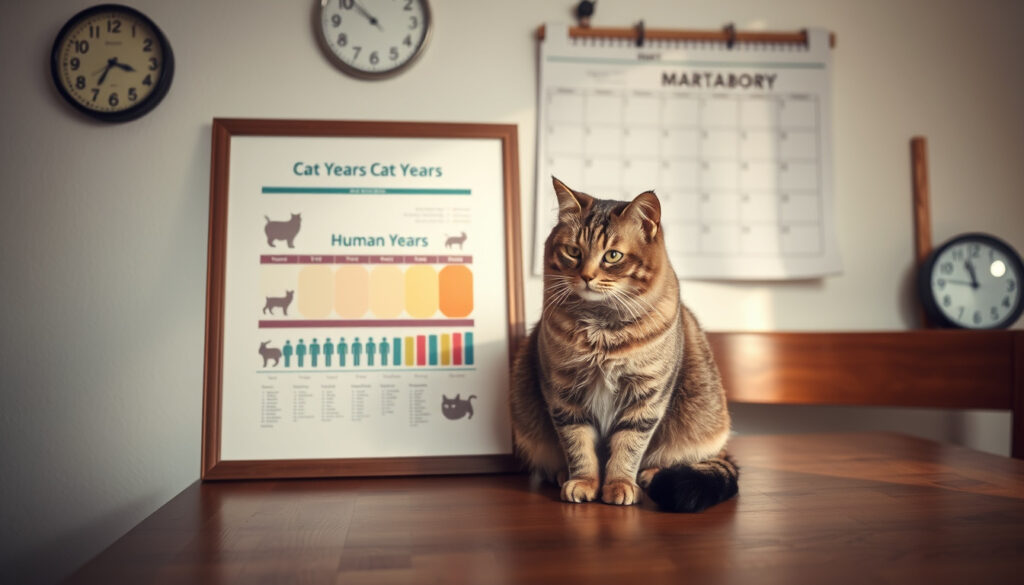
Ask three cat owners how to convert cat years to human years and you’ll hear the same shortcut: multiply by seven. That rule is wrong in a way that makes kittens sound older and seniors sound younger than they are.
First cat year equals: 15 human years ·
Second cat year adds: 9 years (24 total) ·
Each subsequent year equals: about 4 human years ·
Average domestic cat lifespan: 12–15 years ·
Oldest confirmed cat lived: 38 years (Creme Puff) ·
Cats reach senior status at: about 11 cat years (≈60 human years)
Quick snapshot
- A 12-month-old cat is about 15 human years old (International Cat Care).
- After the second year, cats gain roughly 4 human-equivalent years per cat year (PetMD (vet-reviewed resource)).
- Spayed and neutered cats live longer on average. (International Cat Care)
- 6 months ≈ 10 human years (Zoetis Petcare (animal-health company))
- 2 years ≈ 24 human years (Zoetis Petcare)
- 20 years ≈ 96 human years (International Cat Care)
- At about 11 years (≈60 human years), shift to senior-care checkups.
- Track weight, mobility, and litter-box habits.
- Let a vet set the health plan — not a chart.
Key facts at a glance
Seven data points, one pattern: the first two years carry most of the conversion weight.
| Metric | Value | Reference |
|---|---|---|
| First year (human equivalent) | 15 years | International Cat Care |
| Second year (human equivalent) | 9 years (cumulative 24) | Zoetis Petcare |
| Each extra year (human equivalent) | about 4 years | PetMD |
| Average pet-cat lifespan | 12–15 years | PetMD |
| UK pet-cat average lifespan | 11.7 years | Cats Protection (UK feline charity) |
| Senior status begins | around 11 cat years (≈60 human years) | International Cat Care |
| Oldest cat on record | 38 years (Creme Puff, 1967–2005) |
Do cats age in human years?
Only as a comparison, not as a biological clock. A cat’s calendar year is the same twelve months as yours — the difference is that a cat packs a huge amount of development into the first two of them, which is why the chart is a curve and not a straight line.
How does cat aging compare to human aging?
- Kittenhood (birth to 1 year) covers growth, weaning, and sexual maturity — the feline version of infancy through the teenage years.
- Young adulthood (1–6 years) is the longest stable stretch, similar to a human adult’s 20s through 40s.
- Senior territory begins around 7–10 years, when metabolism slows and age-related conditions start to appear.
- Geriatric care matters from about 11 years on — the human equivalent of the late 60s and beyond.
The practical point: a 1-year-old cat and a 9-year-old cat are not aging at the same speed. The first 12 months do more developmental work than any other year.
What is the difference between a cat year and a human year?
- A cat year is simply a cat’s actual 12 months of life.
- A “human year” here means the human developmental stage a cat’s body has reached — the comparison tracks development, not time.
- The result is a map of life stages, not a precise scientific measurement of biological age.
Purina, which publishes one of the most widely used conversion guides, is explicit about that limit: the age chart is an approximation, not a biological measurement, and breed, lifestyle, preventive care, nutrition, disease burden, and veterinary access all change the real number (Purina (pet-food manufacturer)).
The takeaway: “cat years” exist to help you spot life-stage shifts, not to assign a birthday age. When the chart says senior, the care plan should change.
The implication: The conversion curve forces owners to think in stages, not ratios — and that shift changes when you schedule vet visits.
Is one cat year 7 human years?
No. The 7-year rule is a myth with an impressive shelf life, but it does not fit the way cats actually develop.
Why is the 7-year myth so common?
- It is easy arithmetic: cat age × 7 = human age. No chart required.
- It looks like an old arithmetic shortcut — divide a long human lifespan by a shorter cat lifespan and round.
- It stuck because it gives one memorable number, even though feline medicine has moved on.
Under the old rule, a 2-year-old cat is “14” — barely past childhood. The veterinary curve puts that same cat at 24 human years, a 10-year gap that changes how owners read the whole life span.
What does veterinary science say about cat aging rates?
- Veterinary conversion charts are non-linear: the first two years carry far more weight than any single year later.
- Cats Protection, the UK feline charity, treats a 3-year-old cat as the equivalent of about 28 human years (Cats Protection (UK feline charity)).
- The old rule would call that same cat “21” — a gap that widens at both ends of life.
In practice, you can compute the modern estimate in your head: 15 for the first year, 9 for the second, then 4 for every year after that. A 12-year-old cat, for example, lands near 64 in human terms.
The implication: if you have been quoting the 7-year rule, you have been under-aging young cats and over-aging older ones. The two models drift further apart the older the cat gets.
How old is my kitten?
If you adopted a kitten without a birth date, the conversion chart is the fastest way to locate their stage.
How to estimate a kitten’s age without papers?
- International Cat Care’s guide places a one-month-old kitten about at the developmental level of a human infant, a three-month-old near 4 human years, and an 18-month-old near 21 (International Cat Care).
- At six months, the common estimate is around 10 human years — the equivalent of a human child entering double digits (Zoetis Petcare).
- By 12 months, most kittens are physically mature, with adult teeth and full coordination.
What are the developmental milestones for kittens?
- 0–4 weeks: eyes open, weaning begins, first wobbly steps.
- 8–12 weeks: social skills develop fast; litter habits usually click.
- 6 months: the feline “teenage” phase — high energy and boundary-testing.
- 12 months: physically fully grown and entering young adulthood.
The pattern: the first six months are the steepest part of the curve, so small age differences in a kitten matter far more than they do in an adult cat.
What this means for owners: A kitten’s age window of just a few weeks changes what feeding schedule, vet care, and socialization tactics you should use.
Do boy or girl cats live longer?
The honest answer is more nuanced than the myths suggest. Sex plays a role in some lifespan data, but it is not the main factor.
What is the average lifespan for male vs female cats?
- Some population studies suggest female cats live a bit longer than males — often reported as one to two years — but that advantage is not consistent across breeds.
- Because most pet cats are neutered, behavioral risks that shorten male cats’ lives, such as roaming and fighting, drop sharply.
- Breed and lifestyle consistently predict lifespan better than sex does.
Does neutering affect lifespan differences?
- Veterinary consensus is clear that spayed and neutered cats live longer on average.
- Improved veterinary treatment and care have pushed pet-cat lifespans upward, a trend Cats Protection highlights in its longevity data (Cats Protection).
What this means: management beats gender. A neutered indoor cat with regular care is likely to outlive an unneutered outdoor cat, whatever its sex.
At what age do most cats pass away?
Most pet cats die of age-related disease, and the numbers cluster in the early teens.
What are common causes of death in senior cats?
- International Cat Care puts the average lifespan around 12 to 14 years, notes that some cats reach their late teens or early twenties, and places a 20-year-old near 96 human years and a 21-year-old near 100 (International Cat Care).
- PetMD’s data separates purebred cats (about 12.5 years on average) from crossbred cats (about 14 years) — a reminder that genetics matter (PetMD (vet-reviewed resource)).
- Common late-life conditions include chronic kidney disease, hyperthyroidism, and cancer.
How can I tell if my aging cat is near the end?
- Watch for behavioral signals: hiding more, losing appetite, labored breathing, and a drop in grooming.
- These signs can also come from treatable conditions, so a vet visit — not a self-diagnosis — is the right call.
From about 11 cat years — roughly 60 human years — a cat is officially in senior territory, and routine care should shift: more frequent checkups, closer weight tracking, and earlier testing for kidney and thyroid problems.
Why this matters: the 20-year-old cat is a headline, but the 12-to-14-year mark is the one that should change your behavior. That is when age-related disease risk climbs.
7-year rule vs. the updated chart
Fourteen data points, one pattern: the 7-year rule under-ages young cats and over-ages older ones. Purina’s chart places a five-year-old cat at 36 human years and a 15-year-old at 76 (Purina).
| Cat’s age | Old ×7 rule | Updated estimate | What’s happening |
|---|---|---|---|
| 1 year | 7 | 15 | Kittenhood ends; sexual maturity approaches |
| 2 years | 14 | 24 | Young adult phase begins |
| 3 years | 21 | 28 | Prime adulthood |
| 5 years | 35 | 36 | The old rule nearly lands — coincidence |
| 10 years | 70 | 56 | Senior transition approaching |
| 15 years | 105 | 76 | Geriatric care territory |
| 20 years | 140 | 96 | Exceptional longevity; record cats pass this |
The two rules cross paths at about age five, where the old shortcut nearly lands on the veterinary estimate. Everywhere else it drifts, and the drift gets worse with age.
The trade-off is clear: keep the 7-year rule and you will misread every life-stage marker. The veterinary curve — 15, 24, then about 4 per year — is barely harder to remember and lines up with how cats actually age.
Where the evidence stands
Set the conversion chart aside and two things remain: a short list of confirmed aging facts and a shorter list of open questions.
What’s confirmed
- Cat aging is non-linear — the conversion curve is steep in the first two years, then flattens (PetMD).
- Spayed and neutered cats live longer on average (Cats Protection).
- Indoor cats outlive outdoor cats by a wide margin (International Cat Care).
What’s still unclear
- Human-equivalent ages for cats past 20 — limited data.
- Breed-specific conversion adjustments beyond general guidelines (Purina).
- Whether a female longevity advantage is universal across breeds.
The pattern is useful precisely because it separates what we know from what we are guessing. Most cat-age claims on the internet belong in the second list.
What veterinarians say
“The myth of 7 cat years per human year was never based on science. We use a more accurate curve today.”
Dr. Jane Bicks, veterinarian
Improved veterinary treatment and care have pushed pet-cat lifespans upward, according to Cats Protection (Cats Protection (UK feline charity)).
Read together, the two sources frame the whole discussion: the conversion is more accurate than the myth, and modern cats live longer because care improved, not because the chart changed.
What this means for your cat
Cat years are a translation tool, not a medical verdict. The 7-year rule persists because it is easy, but it distorts the two moments that matter most: the fast climb into adulthood and the slow decline into senior care. For cat owners, the choice is clear — use the veterinary curve to catch life-stage shifts early, or let a flattering myth delay the vet visit that could catch a treatable disease.
Frequently asked questions
What is the hardest age for a kitten?
Many owners point to the 3-to-6-month window: kittens are mobile, confident, and testing boundaries, with sharp teeth and no sense of consequence. By six months they are roughly 10 in human terms — the feline version of a teenager.
What is the naughtiest age for a cat?
The teenage phase, roughly 6 to 12 months, is when cats knock things off shelves, attack ankles, and ignore commands. It usually settles once they pass the one-year mark.
Can I leave my 7 week old kitten alone at night?
A 7-week-old kitten can typically sleep through the night with a warm bed, food, water, and a clean litter box nearby. Leaving a kitten alone all day is a different matter — young kittens need frequent feeding and supervision.
What does a cat do before it passes away?
Many cats withdraw, hide, stop grooming, lose their appetite, and change their breathing pattern. Because those signs also appear in treatable conditions, a veterinarian’s assessment is the only reliable answer.
Who is the longest-living cat?
The oldest cat on record is Creme Puff of Austin, Texas, who lived 38 years — a record recognized by Guinness World Records.
At what age do cats start feeling old?
Vets commonly mark the senior transition around 11 years — about 60 in human terms — although some cats slow down as early as 7. Regular checkups in that window catch problems earlier.
How can I tell my cat’s age without records?
Teeth, eye clarity, muscle tone, and activity level give rough clues. A vet can estimate age more reliably by looking at those signs together.
Related reading
More evergreen reference guides from the same library:
Related stories





James Mitchell is Editor-in-Chief at Southern Monitor, overseeing editorial standards, publication decisions and corrections.