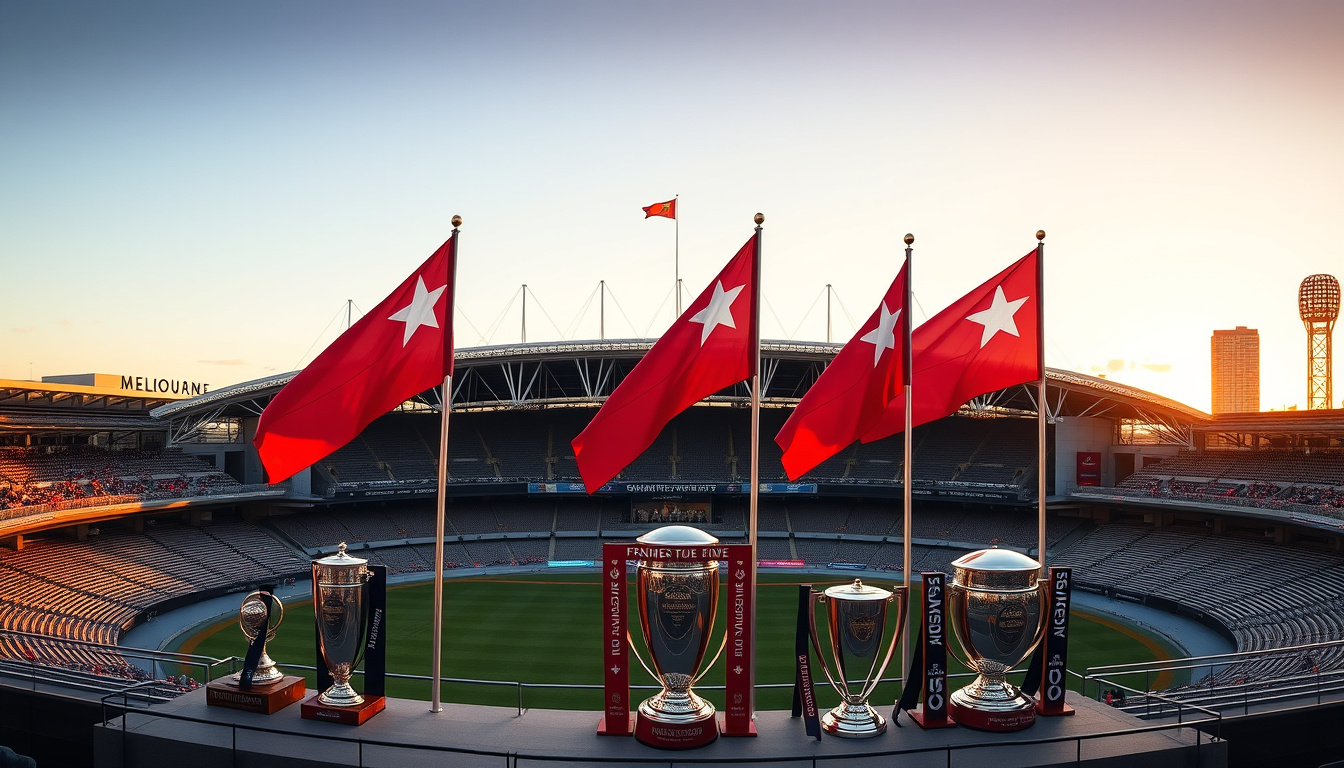
The Melbourne Football Club, known as the Demons, stands as one of the oldest professional sporting clubs in the world. Established on 14 May 1859 at the Parade Hotel in East Melbourne, the club traces its origins back to an 1858 letter by Australian cricket legend Tom Wills, who called for the formation of a football club. Since joining the Victorian Football League (now AFL) in its inaugural 1897 season, the Demons have become a cornerstone of Australian rules football, calling the iconic Melbourne Cricket Ground home and wearing the distinctive blue and red colours that have defined the club since the early 1870s.
The Demons hold a distinguished place in AFL history, having accumulated 13 premierships across different eras of the competition. Their most recent triumph came in 2021, a victory that ended a remarkable 57-year drought and cemented their legacy in the modern era of the sport. From the golden years under legendary coaches to contemporary successes, the Melbourne Football Club continues to represent both a historic institution and a competitive force in Australian rules football.
What is the Melbourne Football Club?
The Melbourne Football Club represents one of the foundational organisations in Australian rules football. The club’s establishment in 1859 predates the formalisation of the VFL by nearly four decades, placing it among the oldest sporting clubs globally. The Demons, as they are affectionately known, adopted their nickname in 1933 under the guidance of coach Frank “Checker” Hughes, a name that has since become synonymous with the club’s identity and passionate supporter base.
The club’s blue and red colours have been worn since the early 1870s, with the Demons nickname officially adopted in 1933. The club’s song, “It’s a Grand Old Flag,” reflects its proud traditions and heritage as one of the founding clubs of the sport.
Key Facts About Melbourne FC
- 13 VFL/AFL premierships spanning from 1900 to 2021, showcasing sustained excellence across different eras
- Founding member of the VFL in 1897, participating in the competition’s debut season
- Only VFL/AFL team to win three consecutive premierships twice, achieving this feat in 1939-1941 and 1955-1957
- Longest drought ended in 2021 after 57 years without a premiership, defeating the Western Bulldogs by 74 points
- Home ground at the Melbourne Cricket Ground, one of the world’s most prestigious sporting venues
- Multiple McClelland Trophies awarded for combined VFL/AFL performance from 1951 to 1991
| Category | Details |
|---|---|
| Founded | 14 May 1859 |
| Location | East Melbourne, Victoria |
| Nickname | Demons (adopted 1933) |
| Colours | Blue and Red |
| Home Ground | Melbourne Cricket Ground (MCG) |
| VFL/AFL Entry | 1897 (founding season) |
| Premierships | 13 (1900, 1926, 1939, 1940, 1941, 1948, 1955, 1956, 1957, 1959, 1960, 1964, 2021) |
| Most Recent Flag | 2021 (vs Western Bulldogs, Perth) |
When was Melbourne Football Club founded and what are its achievements?
The Melbourne Football Club was officially formed on 14 May 1859 at the Parade Hotel in East Melbourne. However, the club’s origins trace back further to an 1858 letter written by Tom Wills, one of Australian cricket’s most celebrated figures, who advocated for the establishment of a football club. This historical connection places Melbourne among the pioneering organisations in what would become Australian rules football. The club’s official history documents its journey from those formative meetings to becoming one of the foundation clubs of the VFL.
The club’s entry into organised competition came in 1897 when it joined the VFL for its inaugural season. From those early years, Melbourne quickly established itself as a powerhouse, claiming its first premiership in 1900. That initial triumph came as something of an upset, with the Demons finishing sixth on the ladder before defeating Fitzroy in the Grand Final. This pattern of exceeding expectations would become a recurring theme throughout the club’s history.
Premiership Success Across the Decades
The Demons have accumulated 13 VFL/AFL premierships across different eras, demonstrating sustained competitiveness throughout the club’s long history. The complete list includes: 1900, 1926, 1939, 1940, 1941, 1948, 1955, 1956, 1957, 1959, 1960, 1964, and 2021. What makes this record particularly remarkable is Melbourne’s unique distinction of being the only VFL/AFL team to achieve three consecutive premierships on two separate occasions.
The Demons won three consecutive premierships twice in their history: first during 1939-1941 under coach Frank “Checker” Hughes, and again from 1955-1957 (plus 1959-1960) under Norm Smith. This remarkable consistency across different coaching regimes demonstrates the club’s sustained excellence.
Memorable Grand Final Moments
Several Grand Final victories stand out in Melbourne’s history for their drama and significance. The 1948 flag came after a drawn Grand Final replay against Essendon, a match that tested the resolve and character of the team. The 1964 premiership was clinched in thrilling fashion, with Neil Crompton’s goal in the dying seconds securing victory against Collingwood in what remains one of the most memorable finishes in Grand Final history.
The 2021 premiership, their most recent, ended a 57-year drought that had weighed heavily on the club and its supporters. The Demons entered the finals as minor premiers and dispatched Brisbane and Geelong with dominant performances before facing the Western Bulldogs in Perth. Despite trailing by 19 points at one stage, Melbourne rallied to secure a commanding 74-point victory, with captain Max Gawn’s leadership proving instrumental throughout the campaign.
Other Notable Achievements
Beyond premierships, the Demons have collected numerous accolades that reflect their competitive standing. The club claimed multiple McClelland Trophies for combined VFL/AFL performance, including recognition in 1955. In 1987, Melbourne won the Panasonic Cup, marking their first senior trophy since the 1971 Night Series and signaling a return to competitiveness after challenging years. The 2021 season also saw the club claim their first minor premiership since 1964, achieved through Max Gawn’s dramatic after-siren goal against Geelong.
Who leads the Melbourne Demons and who are the key players?
The leadership and playing roster of the Melbourne Football Club have featured numerous influential figures throughout its history. The coaching position has been held by several notable individuals who have shaped the club’s fortunes across different eras. The legacy of these leaders, combined with the contributions of exceptional players, has defined the Demons’ identity and competitive success.
Legendary Coaches in Melbourne History
Frank “Checker” Hughes transformed the Melbourne Football Club upon taking over as coach in 1933. His leadership laid the foundation for the club’s first golden era, culminating in the 1939-1941 three-peat premierships. Hughes recruited and developed stars including Allan La Fontaine, Percy Beames, Jack Mueller, and Norm Smith, creating a team that dominated that era of VFL football.
Norm Smith stands as Melbourne’s most successful and longest-serving coach, holding the position from 1952 to 1964 (with earlier stints). Smith’s tactical acumen delivered five premierships between 1955 and 1960, including back-to-back three-peats. His influence extended beyond coaching, as he had already distinguished himself as a brilliant full forward before transitioning to leadership. The Norm Smith Medal, awarded to the best player in the AFL Grand Final, honours his legacy.
Other significant coaching figures include John Northey, who guided the club to finals campaigns during the 1980s, and Neale Daniher, who led the Demons to the 1998 preliminary final and the 2000 Grand Final. Daniher’s tenure represented a period of sustained competitiveness that brought the club close to breaking their premiership drought before the ultimate breakthrough under his successor.
Iconic Players Throughout History
Jack Mueller became a club legend in 1948, kicking six goals in the Grand Final replay against Essendon to secure the premiership. His tragic death shortly after, at age 23, cemented his place in Melbourne folklore. Allan La Fontaine captained the club during the 1930s, while Percy Beames excelled as a rover during those successful years.
Jim Stynes won the 1991 Brownlow Medal as the league’s best and fairest player. His career included the infamous 1987 preliminary final mark infringement that remains one of the most discussed moments in AFL history. Stynes’ bravery and commitment exemplified the character that defines the Demons’ spirit.
In the modern era, Max Gawn captained the side during the 2021 premiership triumph, with his after-siren goal against Geelong sealing the minor premiership. Robert Flower starred during the 1987-88 campaigns that saw Melbourne reach Grand Final contention. The club has also featured distinguished goalkickers including Bob McKenzie (leading goalkicker in 1951) and Noel Clarke (1954), demonstrating the consistent firepower the Demons have possessed across generations.
Where does Melbourne Football Club play its home games?
The Melbourne Football Club conducts its home games at the Melbourne Cricket Ground (MCG), universally known as “The ‘G.” This world-renowned stadium serves as one of the most prestigious venues in global sport, with a capacity exceeding 100,000 spectators. The MCG’s location in Yarra Park, adjacent to the CBD, places it within the heart of Melbourne’s sporting and cultural precinct, making it an iconic setting for Demons home matches.
The partnership between Melbourne and the MCG extends beyond mere venue hire. The club maintains deep historical connections with the Melbourne Cricket Club, with the football club’s origins intertwined with the MCC’s sporting sections. The MCC’s official documentation preserves records of this relationship and the club’s evolution from those early gatherings at the Parade Hotel to establishing the MCG as their spiritual home.
For visitors and supporters planning match-day experiences, understanding the Map of Victoria – Detailed Maps Cities Roads Tourist Guide can help navigate the surrounding areas and appreciate Melbourne’s broader sporting geography. The MCG sits within walking distance of Richmond and Jolimont railway stations, while also being accessible via tram routes along Punt Road and Batman Avenue.
The MCG offers various membership and seating options for Demons supporters, with the club maintaining a strong presence in the Members’ Reserve and surrounding bays. Match days feature the club’s anthem “It’s a Grand Old Flag,” uniting supporters in tradition and pride.
Historical Milestones of the Melbourne Football Club
Understanding the timeline of the Melbourne Football Club reveals the organisation’s remarkable journey through Australian sporting history. From humble beginnings at a hotel in East Melbourne to becoming one of the AFL’s most storied clubs, each milestone has contributed to the Demons’ enduring legacy.
- 1858 – Tom Wills writes a letter calling for the formation of a football club, planting seeds for Melbourne’s establishment
- 1859 – Melbourne Football Club officially formed on 14 May at the Parade Hotel in East Melbourne
- Early 1870s – Club adopts its distinctive blue and red colours
- 1897 – Melbourne joins the VFL for its inaugural season as a foundation club
- 1900 – Claims first premiership, defeating Fitzroy despite finishing sixth on the ladder
- 1926 – Wins second premiership, building momentum for future success
- 1933 – Adopts “Demons” nickname under coach Frank “Checker” Hughes
- 1939-1941 – Achieves first three-peat premiership run under Hughes
- 1948 – Secures premiership following drawn Grand Final replay against Essendon
- 1955-1957 – Wins second three-peat premierships under coach Norm Smith
- 1964 – Claims 12th premiership with Neil Crompton’s match-winning goal in dying seconds
- 2021 – Ends 57-year premiership drought, winning 13th flag by 74 points over Western Bulldogs in Perth
What We Know and What Remains Unclear
While extensive documentation exists about the Melbourne Football Club’s history and achievements, certain areas remain subjects of ongoing discussion or lack definitive confirmation. Distinguishing between established facts and matters of interpretation helps maintain accuracy when examining the club’s legacy.
| Established Information | Areas of Uncertainty |
|---|---|
| 13 VFL/AFL premierships (1900-2021) with exact years documented | Specific details of early 1858 formation discussions before the 1859 official meeting |
| Official founding date: 14 May 1859 at Parade Hotel, East Melbourne | Precise origins and authenticity of the Tom Wills letter regarding football |
| Nickname “Demons” officially adopted in 1933 under Frank Hughes | Exact circumstances and debates surrounding the 1996 proposed merger with Hawthorn |
| Home ground at MCG since VFL establishment in 1897 | Complete details of internal club governance changes during various reform periods |
| 2021 premiership ended 57-year drought with 74-point Grand Final victory | Specific strategic discussions and selection decisions during key historical matches |
| Blue and red colours worn since early 1870s | Some nuanced details of player recruitment and contract negotiations from earlier eras |
The Demons in AFL and Victorian Sporting Context
The Melbourne Football Club occupies a unique position within the broader landscape of Australian sport. As one of the founding clubs of the VFL, the Demons helped establish the competition that would evolve into the AFL and become the premier professional sports league in Australia. This founding status carries significant prestige and responsibility, with Melbourne often viewed as a custodian of the sport’s traditions and heritage.
The club’s geographical roots in East Melbourne and connection to the Melbourne Cricket Ground place it at the epicentre of Victoria’s sporting culture. This proximity to the state’s cricket and football administrative heartlands has influenced the club’s development and its relationships with governing bodies. The Demons have navigated various challenges throughout their history, including the disruptions of World War I when the club endured a winless season in 1919, and the proposed 1996 merger with Hawthorn that was ultimately rejected.
Like all clubs, Melbourne has experienced periods of rebuilding and renewal. The 1951 wooden spoon represented a rare low point, while the 2007 crisis tested the organisation’s resilience. Yet the club’s ability to bounce back, most dramatically with the 2021 premiership, demonstrates the character and fighting spirit that defines the Demons. As the sporting calendar progresses, the Grand Final 2025 NRL – Date, Teams, Tickets and Schedule reminds fans that AFL finals contention remains the ultimate goal for Melbourne each season.
Melbourne holds the unenviable record of the second-heaviest defeat in VFL/AFL history, a stark reminder of the unpredictable nature of sport. These challenging results coexist alongside the club’s numerous achievements, illustrating that every sporting journey includes difficult chapters.
Sources and Official Records
The history of the Melbourne Football Club is documented across multiple authoritative sources, each contributing different perspectives and details to the club’s rich heritage. Primary documentation includes official club records maintained at the Melbourne Football Club website, which preserves honour boards, year-by-year records, and historical photographs. The club’s official publications and administrative records provide firsthand accounts of significant events and decisions.
Academic and journalistic sources complement the club’s internal records. The comprehensive Wikipedia entry for the club aggregates historical data with citations to primary sources, while independent football histories like Demonwiki offer detailed chronological records of matches, players, and club milestones. The Australian Football League’s official records, maintained through afl.com.au, provide league-sanctioned statistics and historical documentation.
The Melbourne Football Club, nicknamed the Demons, is one of the world’s oldest professional sporting clubs, formed on 14 May 1859 at the Parade Hotel in East Melbourne, with origins tracing back to an 1858 letter by Tom Wills calling for a foot-ball club.
— Demonwiki, Melbourne Football Club historical records
The Melbourne Cricket Club’s documentation of its sporting sections, particularly the football club section records, provides institutional context for the club’s early development. Fan communities and independent football websites like Big Footy maintain extensive forums and historical databases that preserve match reports, player profiles, and club statistics that might otherwise remain undocumented.
Summary
The Melbourne Football Club stands as a foundational institution in Australian rules football, with origins dating back to 1859 and a legacy encompassing 13 premierships across different eras of the sport. From the pioneering days of the VFL’s formation in 1897 through to the 2021 triumph that ended a 57-year drought, the Demons have demonstrated remarkable resilience and competitive spirit. The club’s home at the MCG, distinctive blue and red colours, and passionate supporter base combine to create an organisation that embodies both tradition and ambition. Whether measured by historical significance, on-field achievement, or cultural impact within Victoria and broader Australian sport, Melbourne Football Club remains one of the most storied and respected clubs in the game. The Map of Victoria – Detailed Maps Cities Roads Tourist Guide offers context for understanding the geographical spread of the club’s influence across the state.
Frequently Asked Questions
How many premierships have the Melbourne Demons won?
The Melbourne Football Club has won 13 VFL/AFL premierships, with the most recent coming in 2021 when they defeated the Western Bulldogs by 74 points in Perth.
When was the Melbourne Football Club founded?
The club was officially formed on 14 May 1859 at the Parade Hotel in East Melbourne, with origins tracing back to an 1858 letter by Tom Wills advocating for a football club.
What is the nickname of the Melbourne Football Club?
The Melbourne Football Club is nicknamed the “Demons,” a name officially adopted in 1933 under coach Frank “Checker” Hughes.
Where do the Melbourne Demons play their home games?
The Demons play their home games at the Melbourne Cricket Ground (MCG), one of the world’s most prestigious sporting venues with a capacity exceeding 100,000 spectators.
Who was the coach when Melbourne won the 2021 premiership?
Simon Goodwin was the senior coach during the 2021 premiership campaign, with Max Gawn serving as captain throughout that successful season.
What was the Melbourne Football Club’s longest premiership drought?
The 2021 premiership ended a 57-year drought, with the club’s previous flag coming in 1964 before their triumphant return to winning ways.
Who is considered the greatest player in Melbourne Demons history?
Multiple players hold legendary status, including Norm Smith (who excelled as both player and coach), Jack Mueller (1948 hero), and Jim Stynes (1991 Brownlow Medallist).
What colours does the Melbourne Football Club wear?
The Demons wear blue and red colours, which have been the club’s identity since the early 1870s. The distinctive strip is recognised throughout the AFL.
Related stories




Liam O'Brien covers Australian politics and public affairs for Southern Monitor.