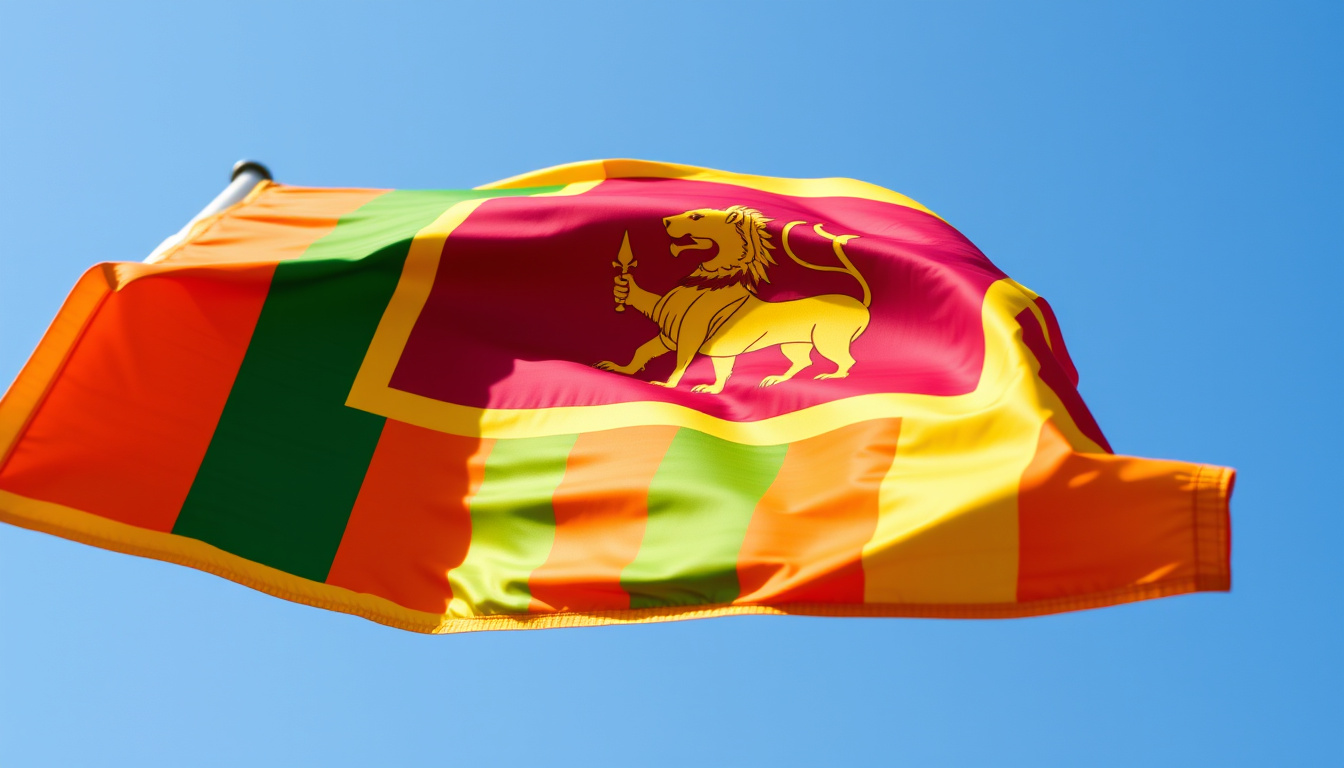
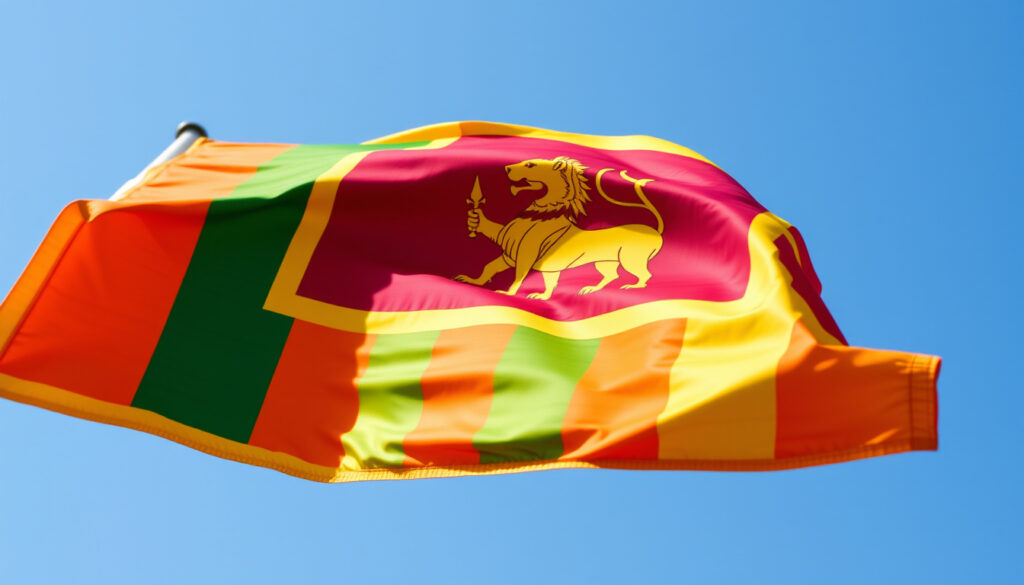
The Sri Lankan flag weaves together ancient royal emblems, Buddhist values, and a deliberate post-colonial compromise. Understanding its design means untangling the lion’s centuries-old symbolism from the orange and green stripes added in 1950 to represent Tamil and Muslim communities.
Adopted: 1950 (modified 1972) ·
Colors: Crimson, gold, orange, green ·
Main symbol: Lion holding a sword ·
Proportions: 1:2 ·
Flag type: National flag
Quick snapshot
- Lion holding a sword (Kastane) (Sri Lanka Embassy Ankara)
- Four pipul leaves (World Atlas)
- Vertical stripes (orange, green) (World Atlas)
- Yellow border (Berger Blog)
- Crimson (background) (Berger Blog)
- Gold (border) (World Atlas)
- Orange (vertical stripe) (Sri Lanka Tourism Info)
- Green (vertical stripe) (World Atlas)
- Origins in the Kingdom of Kandy (Sri Lanka Embassy Ankara)
- Adopted as national flag in 1950 (Sri Lanka Embassy Ankara)
- Modified in 1972 (new lion design, added leaves) (World Atlas)
- One of the oldest flags in continuous use (Berger Blog)
- Proportion 1:2 (World Atlas)
- Lion faces hoist; sword held in right paw (Sri Lanka Embassy Ankara)
- Bo leaves in each corner of crimson field (World Atlas)
- Orange and green stripes at hoist side (Sri Lanka Tourism Info)
The flag’s spec sheet is straightforward, but every measurement carries meaning. Two facts stand out: the 1:2 ratio is standard for many flags, yet the placement of the lion at the fly end leaves no doubt that this is a banner first raised by a monarchy.
The flag’s structure tells a story of negotiated identity. Here are the key specifications.
| Attribute | Value |
|---|---|
| Official name | Lion Flag (Singhalese: සිංහ ධජය) |
| Adopted | 1950 (Dominion of Ceylon); 1972 (Republic of Sri Lanka) |
| Designer | Senanayake Mudiyanselage K. W. R. S. R. C. (attributed to a committee) |
| Proportion | 1:2 |
| Color values | Crimson: #8B0000; Gold: #FFD700; Orange: #FF6600; Green: #006400 |
| Use | National flag and civil ensign |
The lion on the flag is no generic heraldry – it is a direct link to the Sinhalese monarchy that ruled for centuries. Keeping that lion while adding stripes for other communities was a political act of inclusion, not just design.
Why is there a lion on the flag of Sri Lanka?
The lion is not just a regal decoration; it is a centuries-old royal emblem tied directly to the Sinhalese kingdom. According to the Sri Lanka Embassy Ankara, the lion has been a symbol of Sinhalese sovereignty for centuries, appearing on royal standards long before colonial rule. The same source notes that the lion’s sword represents authority and the power to protect the nation.
Historical roots of the lion symbol
The earliest widely cited link connects the lion to King Dutugemunu, who ruled in the 2nd century BCE. The Sri Lanka Tourism Info site explains that the lion standard was used by the ancient Sinhalese monarchy. A lower-confidence tradition, noted by Berger Blog, suggests the lion symbol was brought from India by King Vijaya in the 5th century BCE – but this account has limited documentary support.
- The lion emblem appears on coins and seals from the Anuradhapura period (3rd century BCE–10th century CE).
- The Kingdom of Kandy used a lion flag as its civil standard until 1815.
Connection to the Sinhalese kingdom
During the colonial period, the British Union Jack replaced the lion. But at independence in 1948, the lion was reinstated as the core of the national flag, a deliberate move to reclaim Sinhalese heritage. Sri Lanka Embassy Ankara explains: “the lion flag of the last king of Kandy was hoisted again.”
Meaning of the lion holding a sword
The lion grips a kastane – a traditional Sinhalese sword. The Embassy site interprets this as a symbol of “sovereignty and authority.” The lion’s raised paw and forward posture imply readiness to defend the nation.
What do the colors of the Sri Lanka flag represent?
Every color on the flag was chosen to represent a specific community or value. The symbolism is spelled out by several official and cultural sources.
Crimson background
The maroon (crimson) field occupies the lion side and represents the Sinhalese majority. Berger Blog (a color-industry reference) notes that the shade is commonly linked to the Sinhalese ethnicity, though the exact hue has varied over time.
Yellow (gold) border
The golden border frames the flag and symbolizes unity. World Atlas adds that it also represents “the Buddhist monastic orders that guide the nation’s spiritual life.”
Orange and green vertical stripes
At the hoist side, two vertical stripes broaden the flag’s meaning. The Sri Lanka Tourism Info site states that orange stands for the Tamil community, while green represents the Muslims (Moors). These stripes were added in 1950, seven years after independence, as a direct attempt to make the flag inclusive of the island’s two largest minority groups.
The orange and green stripes were not part of the original lion flag. Their addition in 1950 was a political compromise: the lion alone would have signaled only Sinhalese dominance, so the stripes made the flag a symbol for all Sri Lankans.
The trade-off: the flag gained inclusivity but lost its purely monarchical character. It became a document of nation-building in cloth.
What is the meaning of the Sri Lanka flag?
Beyond the literal symbols, the flag carries a broader message about Sri Lankan identity. World Atlas outlines the official meaning: the flag represents the country’s diverse ethnic groups and religions, with the lion as the unifying force.
National identity and unity
- The flag is a post-colonial compromise that retains a pre-colonial symbol while embracing diversity.
- It is flown on all government buildings and at international events as the sole national emblem.
Religious and ethnic representation
Crimson (Sinhalese), orange (Tamil), green (Muslim), and gold (Buddhist monastic orders). World Atlas confirms that the four Bo leaves in the corners represent the four Buddhist virtues: loving-kindness, compassion, sympathetic joy, and equanimity.
The four pipul leaves on the lion’s chest
Each leaf is a stylized Ficus religiosa (Bo) leaf – the tree under which the Buddha attained enlightenment. The World Atlas entry specifies that the leaves are not merely decorative but carry a moral code. They remind citizens to practice the four brahmavihāras (divine abodes).
What this means: the flag is not just a political symbol but a moral teaching tool, woven into the national fabric.
What is the history of the Sri Lanka flag?
The flag’s evolution mirrors the country’s turbulent political journey – from monarchy to colony to republic.
Pre-colonial flags
Before European contact, the Sinhalese kingdoms used lion flags. Sri Lanka Embassy Ankara notes: “The lion flag has been used since the 6th century by the Sinhalese monarchy.” The exact design varied but the lion was constant.
Colonial period (Portuguese, Dutch, British)
From 1505 onward, colonial powers imposed their own flags. The British replaced all local symbols with the Union Jack after annexing the kingdom of Kandy in 1815. For 133 years, the lion flag disappeared from official use.
Modern flag adoption and modifications
Independence in 1948 brought back the lion flag, but without the minority stripes. That changed in 1950. According to the Embassy site, “the design that was approved in February 1950 retained the lion, sword, and Bo leaves from the civil standard of the last king, while adding two vertical stripes in green and orange.” The flag was hoisted for the first time on March 3, 1950.
In 1972, when Sri Lanka became a republic, the lion design was slightly refined. World Atlas states: “the national flag was officially adopted on May 22, 1972.” The current version standardised the lion’s sword and the shape of the Bo leaves.
The pattern: each change added layers of meaning – from royal badge to colonial void to inclusive symbol of a new nation.
Is the Sri Lanka flag the oldest in the world?
This claim appears frequently online, but it requires careful unpacking.
Comparison with other ancient flags
- Denmark’s Dannebrog dates from 1219 (oldest continuous national flag).
- Scotland’s saltire (c. 13th century) and England’s St. George’s cross (c. 12th–13th century) are older in origin.
- Canada’s maple leaf (1965) and many other modern flags are younger than Sri Lanka’s 1950 design.
Which flags are older?
The Berger Blog states that the lion symbol itself is ancient, but “the flag in its modern form is not the world’s oldest.” The Danish flag, in continuous use since the 13th century, is the clear winner for longevity as a national flag.
Verification of the “one of the oldest” claim
What is true: the symbol of the lion has been used in Sri Lanka for over two millennia. What is misleading: calling the current flag “one of the oldest” when its current design dates only to 1950. The Embassy site mentions the symbol’s long history but does not claim the flag is ancient.
Why this matters: the claim survives because it conflates symbol with design. Travel guides and social posts repeat it, but vexillologists consider the Dannebrog the oldest continuous national flag.
Timeline signal
- 6th century BCE – Lion symbol used on royal standards by King Dutugemunu (Sri Lanka Tourism Info)
- 1815 – British annexation of Ceylon; Union Jack used (Sri Lanka Embassy Ankara)
- 1948 – Independence; initial flag with lion but without stripes (Sri Lanka Embassy Ankara)
- 1950 – Current design officially adopted (with orange and green stripes) (Sri Lanka Embassy Ankara)
- 1972 – Flag modified: lion now holds sword, four leaves added (World Atlas)
- 2015 – Minor color specifications standardized (Berger Blog)
Clarity check
Confirmed facts
- The lion symbolizes Sinhalese ethnicity and strength (Sri Lanka Embassy Ankara)
- The four leaves represent Buddhist virtues (World Atlas)
- The current flag was adopted in 1950 and modified in 1972 (World Atlas)
- Orange stripe = Tamil community (Sri Lanka Tourism Info)
- Green stripe = Muslim community (World Atlas)
What’s unclear
- Exact origin date of the lion symbol as a flag – 6th century is traditional but not precisely documented (Sri Lanka Tourism Info)
- Whether the flag qualifies as “one of the oldest” – depends on definition (continuous national flag vs. use of symbol) (Berger Blog)
“The national flag consisting of a yellow field bearing vertical stripes of green and orange at the hoist and, at the fly end, a crimson rectangle with a lion holding a sword.”
World Atlas (geography reference)
“The lion flag has been used since the 6th century by the Sinhalese monarchy.”
Sri Lanka Embassy Ankara (official source)
“The design that was approved in February 1950 retained the lion, sword, and Bo leaves from the civil standard of the last king while adding two vertical stripes in green and orange.”
Sri Lanka Embassy Ankara (official source)
The Sri Lanka flag is more than a national emblem – it’s a layered document of compromise and continuity. For any traveler, student, or designer looking to understand the country, reading the flag is the fastest way to grasp Sri Lanka’s ethnic balance and its monarchical past. The lion sword has survived colonialism and civic redesign, and today it flies as a symbol that tries – imperfectly but earnestly – to speak for all Sri Lankans.
Related reading: What Is ICE in America? Agency Role and History Explained
Frequently asked questions
What does the lion’s sword represent?
The sword (kastane) symbolizes sovereignty and the authority to protect the nation, according to the Sri Lanka Embassy Ankara.
Why are there four pipul leaves on the lion’s chest?
They represent the four Buddhist virtues: loving-kindness, compassion, sympathetic joy, and equanimity (World Atlas).
Can I use the Sri Lanka flag for commercial purposes?
Commercial use is generally restricted. Check local laws; the flag is a national symbol and misuse can be prosecuted.
What are the proper ways to display the Sri Lanka flag?
It should be flown from sunrise to sunset, never touch the ground, and be treated with respect. Specific rules are outlined by the Embassy.
Is the Sri Lanka flag flown upside down?
No official upside-down version exists. The flag has a hoist stripe orientation – the orange stripe is always on the left, green on the right when flying normally.
What is the difference between the national flag and the presidential flag?
The presidential flag (used by the head of state) incorporates additional symbols like a peacock and a lotus, but is based on the national flag design.
How should the Sri Lanka flag be folded?
There is no official folding code, but it should be folded neatly and stored flat to avoid creasing the lion or stripes.
What is the meaning of the orange and green stripes?
Orange represents the Tamil community, green represents the Muslim community (World Atlas).
Related stories





Noah Harper is Senior Reporter at Southern Monitor, covering breaking stories and explainers.