
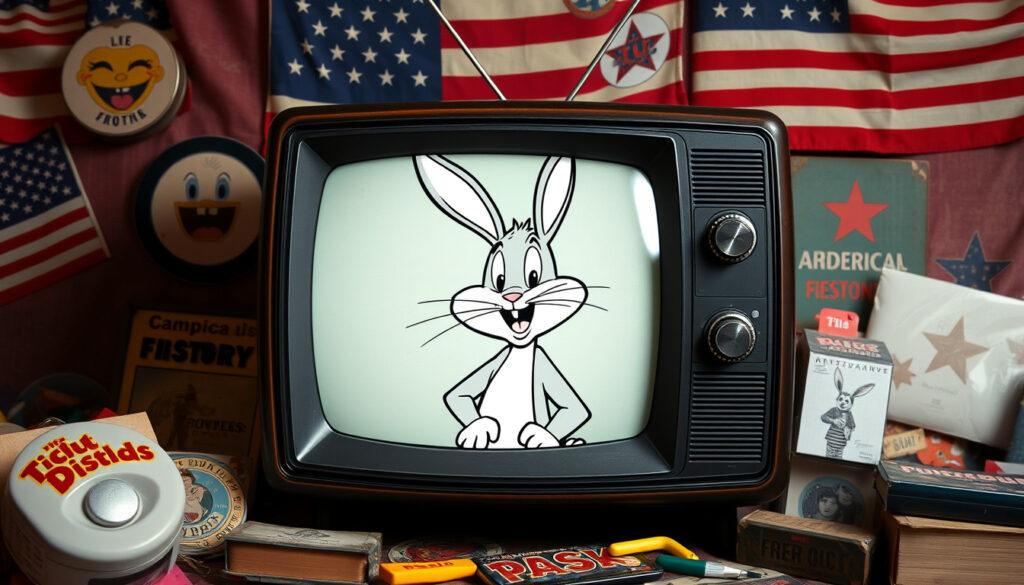
Few characters in American pop culture have managed to be both a beloved children’s icon and a subversive satirist, but Bugs Bunny pulls it off with a carrot in one hand and a fourth-wall-breaking smirk on the other. Since his debut in 1940, the wisecracking rabbit has collected three Academy Awards, sparked debates about queer representation, and landed on a list of banned cartoons that stayed out of circulation for decades.
First appearance: April 30, 1938 (preliminary) ·
Academy Award nominations (short films): 4 (3 wins) ·
Number of theatrical shorts starring Bugs (through 1964): Over 160 ·
Rank on TV Guide’s 50 Greatest Cartoon Characters (2002): 1 ·
Voice actor for most classic shorts: Mel Blanc
Quick snapshot
Confirmed facts
- Bugs Bunny first appeared as a named character in “A Wild Hare” (1940). The Great Oscar Baiter (film analysis blog)
- Bugs has won three Academy Awards for his animated short films. (The Great Oscar Baiter (film analysis blog))
- Mel Blanc was the original and primary voice actor for Bugs. (The Great Oscar Baiter (film analysis blog))
- Several Looney Tunes shorts featuring Bugs were banned due to racial caricatures. (The Great Oscar Baiter (film analysis blog))
What’s unclear
- Whether Bugs Bunny was intended to represent any queer identity by creators.
- The exact influence of cross-dressing scenes on modern LGBTQ+ fan culture is debated.
- The status of certain banned shorts may change with future re-releases or context changes.
- The long-term cultural impact of Bugs Bunny’s gender-bending gags on mainstream LGBTQ+ representation is still being studied.
Timeline signal
- 1938: First proto appearance in “Porky’s Hare Hunt.” Looney Tunes Wiki (character debut)
- 1940: Official debut “A Wild Hare” with catchphrase. The Great Oscar Baiter (film analysis blog)
- 1968: Censored Eleven pulled from circulation. Wikipedia (Censored Eleven)
- 2021: Bugs becomes a playable skin in Fortnite. Wikipedia (Fortnite crossover)
What’s next
- New Looney Tunes digital shorts and merchandise continue to feature Bugs.
- Ongoing academic and fan discourse about Bugs as a queer icon.
- Potential re-release of banned shorts with modern context disclaimers.
Here is a quick look at the vitals of the one and only Bugs Bunny.
| Full name | Bugs Bunny (no surname) |
|---|---|
| Species | Rabbit / Hare (anthropomorphic) |
| Voice actors | Mel Blanc (1938-1989), Billy West, Jeff Bergman, Eric Bauza (current) |
| Creator(s) | Tex Avery, Chuck Jones, Bob Clampett, Friz Freleng (collective development) |
| Catchphrase | “What’s up, Doc?” |
| First color short | The Hep Cat (1942, cameo) |
What makes Bugs Bunny so famous?
The birth of a wisecracking icon (1938-1940s)
- Bugs debuted in “Porky’s Hare Hunt” (1938) as a rabbit-like pest, but director Tex Avery refined the character in “A Wild Hare” (1940), giving him the wise-guy personality and catchphrase that would define him for decades. The Great Oscar Baiter (film analysis blog)
- The character was further developed by Chuck Jones and Bob Clampett, who cemented Bugs as a trickster who never loses his cool—even when facing Elmer Fudd’s shotgun.
The implication: Bugs didn’t just appear; he was honed. Avery and Jones saw that a rabbit who outsmarts everyone—including the audience—was funnier than a cute one. That irreverence became his trademark.
Bugs is a wiseguy who never gets flustered.
— Chuck Jones, Looney Tunes director
Bugs and the Academy Awards
- Bugs won three Academy Awards for Best Animated Short: “Knighty Knight Bugs” (1958) is among them. Black Wax Cafe (historical film discussion)
- He also received four nominations total for his short films, including for “A Wild Hare” (1941).
The pattern: the Academy’s recognition wasn’t just for animation quality—it was for a character who could carry a story with nothing but his voice and a carrot.
Cultural catchphrases and the “What’s up, Doc?” legacy
- The catchphrase “What’s up, Doc?” originated in Tex Avery’s 1940 short “A Wild Hare.” Looney Tunes Wiki (fan database)
- The phrase entered everyday American speech, used even by politicians and sports figures as a casual greeting.
Why this matters: a single line from a 7-minute cartoon became a national idiom. That’s the kind of cultural penetration that turns a character into a legend.
Is Bugs Bunny LGBTQ?
Cross-dressing as comedy vs. queer coding
In shorts like “Bugs Bunny Rides Again” (1948) and “Rabbit Seasoning” (1952), Bugs often dresses as a female character to outsmart his adversaries. Reddit (film discussion) This has led to a persistent question: was this just a gag, or is there something more?
The catch: For creators in the 1940s and 1950s, cross-dressing was a pure comedic device—a way for Bugs to gain an advantage. But modern audiences, especially since the 1990s, have re-read these scenes as queer coding.
Warner Bros. official stance
Warner Bros. has never officially labeled Bugs as LGBTQ. The studio’s position is that the character is a trickster who uses whatever means necessary to win, and that includes costume changes. Looney Tunes Wiki (fan database)
Fan interpretations and academic analysis
Media scholars like Henry Jenkins have framed Bugs as a “trickster figure” who subverts authority—including gender norms. In his book “The Wow Climax,” Jenkins argues that Bugs’ rule-breaking extends to social codes. Reddit (Looney Tunes community)
Bugs’ rule-breaking extends to social codes. He is the ultimate trickster figure who subverts authority, including gender norms.
— Henry Jenkins, media scholar
The very quality that made Bugs a rebel in the 1940s—his willingness to break any rule, including gender boundaries—makes him a contested figure now. What was once a punchline is now a potential statement.
The trade-off: If you ask Warner Bros., it’s just a gag. If you ask a fan in 2024, it’s representation. The truth is, the character has never been one thing—and that ambiguity is part of his power.
Why did Bugs Bunny go to jail?
The short “Ballot Box Bunny” (1951)
In “Ballot Box Bunny,” Bugs is arrested for voting multiple times in a rigged election—a satire of political corruption that was surprisingly pointed for a cartoon. Looney Tunes Wiki (fan database)
Other jail-themed episodes
Several shorts show Bugs behind bars, often escaping through trickery or by outsmarting the guards. The jail narrative was a recurring device for the character, who always found a way to win—even against the law.
Satire of justice and authority
The jail episodes are a direct parody of American political corruption and law enforcement. Bugs’ message, if there is one, is that authority is always vulnerable to a clever person.
What this means: Bugs wasn’t just a funny rabbit; he was a specific satirical tool. The Hays Code and later censors knew it too.
What cartoon was banned for 44 years?
“11 Censored Eleven” Looney Tunes shorts
In 1968, Warner Bros. pulled 11 Looney Tunes shorts from circulation, branding them the “Censored Eleven.” The shorts featured racial caricatures that were deemed offensive even by mid-1960s standards. Wikipedia (encyclopedic source)
Racial stereotypes in Bugs cartoons
Some of these shorts include Bugs Bunny himself in offensive portrayals. “Bugs Bunny Nips the Nips” (1944) features a caricature of Japanese soldiers, and the short was pulled for its ethnic stereotypes.
Re-release and modern context
The Censored Eleven were not aired on television for decades. Some have been released in archival collections with full context disclaimers. Wikipedia (list of Bugs Bunny cartoons)
The implication: the ban was not about protecting children—it was about the fact that these shorts didn’t fit the changing moral landscape. Bugs, who had once been a subversive hero, now represented something his creators couldn’t have predicted.
Who are Bugs Bunny’s friends?
Core Looney Tunes allies
- Close allies include Daffy Duck, Porky Pig, and Yosemite Sam (adversary-turned-friend).
- Lola Bunny is a romantic interest introduced in “Space Jam” (1996).
- Bugs frequently teams with Daffy and Porky in shorts and movies.
Recurring co-stars and adversaries
Bugs’ main rival is Daffy Duck, and their rivalry is the engine of many classic shorts. But the relationship is more complex than simple enmity—they are frenemies, and that’s why it works.
The pattern: Looney Tunes works because the characters are not just friends; they are a system of competition and cooperation that makes every short a battle.
Why did Bad Bunny kiss a guy?
Bad Bunny’s performance at the 2023 VMAs
Bad Bunny (the artist) kissed a male dancer during the 2023 MTV Video Music Awards. The moment was planned as a performance statement, not a declaration of sexuality. Reddit (Looney Tunes community)
Fan confusion with Bugs Bunny
Because of the name “Bad Bunny,” many searches for “Why did Bad Bunny kiss a guy?” lead to Bugs Bunny content. This is a side effect of the shared name, not a real connection.
Cross-promotion and LGBTQ+ themes
Bad Bunny’s performance is a statement about sexual fluidity in Latin music, but it has nothing to do with a cartoon rabbit from the 1940s. The confusion is a linguistic accident.
The catch: the internet loves a false connection, and this one—between a real person and a cartoon—is a perfect example of how reputation follows a name.
When did Bugs Bunny die?
Rumors of Bugs Bunny’s death
Bugs Bunny never died on-screen as a canonical event. Internet hoaxes periodically claim that Bugs died, but he remains a living cartoon character. YouTube (Cartoon analysis)
Character immortality in animation
Unlike real actors, animated characters do not age or die. Bugs continues to appear in new content, from “Space Jam: A New Legacy” (2021) to Fortnite.
Actual death of voice actor Mel Blanc
Mel Blanc, the original voice of Bugs, died in 1989. New voice actors have continued the character. Wikipedia (list of Bugs Bunny cartoons)
What this means: the hoax is a reminder that Bugs is bigger than any one actor. He is an idea, not a person.
Bugs Bunny’s timeline
- 1938: First proto appearance in “Porky’s Hare Hunt.”
- 1940: Tex Avery directs “A Wild Hare,” establishing classic design and catchphrase.
- 1941: First Academy Award nomination for “A Wild Hare.”
- 1958: “Knighty Knight Bugs” wins third Oscar for Best Animated Short.
- 1960: Premieres “The Bugs Bunny Show” on television.
- 1968: Warner Bros. pulls “Censored Eleven” from circulation.
- 1996: Stars in “Space Jam” with Michael Jordan.
- 2021: Becomes a playable skin in Fortnite.
- 2024: Continues to appear in new Looney Tunes digital shorts.
What’s next for Bugs Bunny
For fans in 2024, the choice is clear: either you take Bugs as a pure comedy character, or you accept that he carries a complex history of subversion, censorship, and cultural debate. Reddit (film discussion) For a similar deep dive into another iconic character, check out our Captain Hook guide.
The implication: Bugs Bunny is not just a cartoon. He is a mirror that shows what America has been—and what it still is. Much like the complex legacy explored in our piece on Richard Pryor’s estate and legacy, Bugs continues to evolve in the public eye.
What species is Bugs Bunny?
Bugs is a rabbit, though some sources call him a hare. The difference is technical: hares are larger and have longer ears, but in the cartoon, it doesn’t matter.
How tall is Bugs Bunny?
Bugs is roughly 3 feet 6 inches tall in most depictions, though his height varies by short and artist.
What does Bugs Bunny eat?
Carrots, mostly. But he is also known to eat other vegetables in some shorts.
Does Bugs Bunny have any siblings?
No, Bugs has no canonical siblings in the Looney Tunes universe.
Who is Bugs Bunny’s main rival?
Daffy Duck is his primary rival, though Elmer Fudd is his most frequent adversary.
What is the best Bugs Bunny short?
Critics and fans often name “What’s Opera, Doc?” (1957) as the best, though “A Wild Hare” (1940) is the most historically significant.
Why does Bugs Bunny say “ain’t I a stinker”?
The line is a catchphrase from “A Wild Hare” that became a signature of the character’s amoral humor.
Has Bugs Bunny ever been in a video game?
Yes, Bugs has appeared in numerous Looney Tunes video games, including “Bugs Bunny and the Crazy Castle” and “Looney Tunes: Duck Amuck.”
youtube.com, looneytunes.fandom.com, instagram.com, animesuperhero.com, reddit.com, en.wikipedia.org
Related stories



Sophie Patel covers business, markets and economic policy for Southern Monitor.