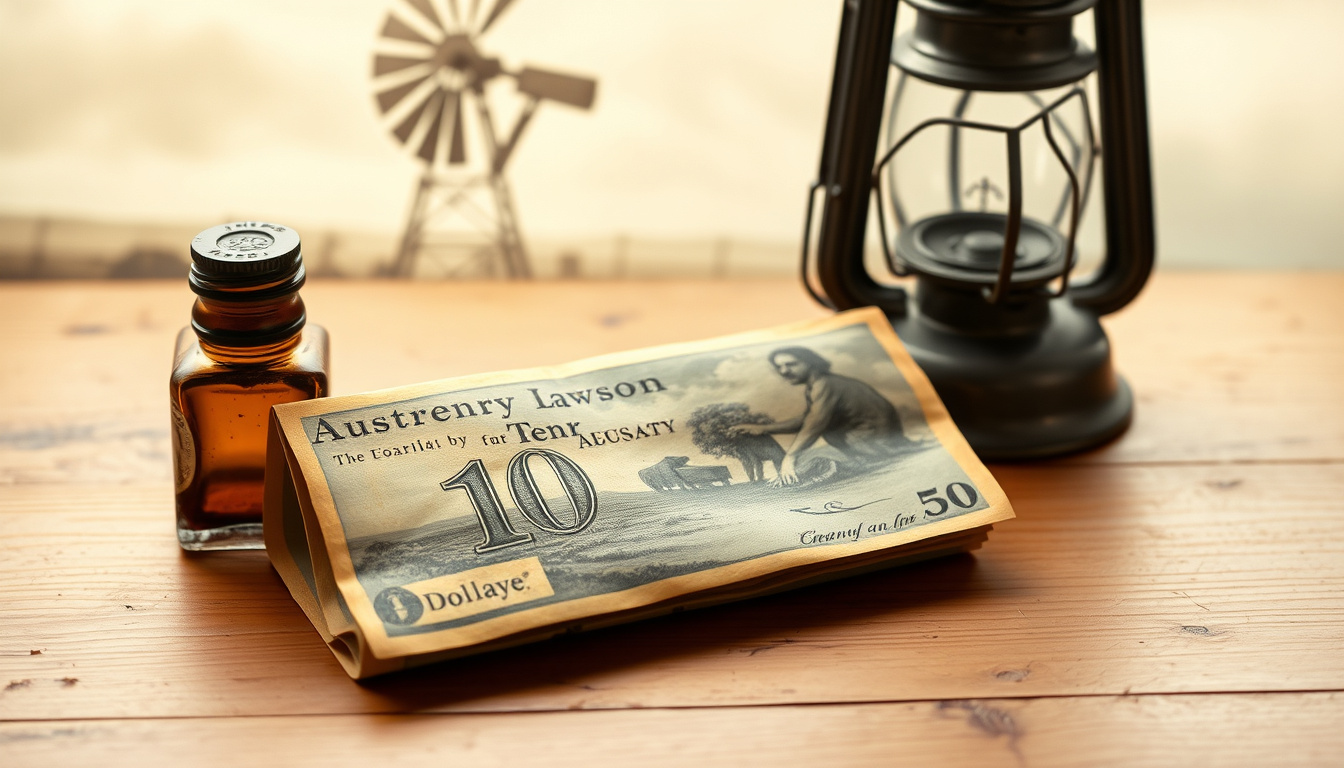
There’s a small jolt of recognition when an old paper tenner turns up in a drawer and a poet’s face stares back at you. Henry Lawson’s portrait sat on Australia’s decimal $10 note from 1966 to 1993 (Reserve Bank of Australia (central bank)), which is how many Australians met him before they ever read a line of his work — and following that note’s story opens into bigger questions about who else appears on Australian money, why Lawson still matters, and what those old notes are worth today.
Born: 17 June 1867, Grenfell, NSW · Died: 2 September 1922, Sydney · Signature story: The Drover’s Wife (1892) · Old $10 note: Paper banknote portrait, 1966–1993 · Decimal high notes: No $500 or $1000 note issued
Quick snapshot
- Born 17 June 1867 at Grenfell, New South Wales (Australian Dictionary of Biography (national biographical register)).
- Died 2 September 1922 (Encyclopaedia Britannica (general reference)).
- Portrait appeared on the first decimal $10 note, issued 1966 (Reserve Bank of Australia Museum (central bank archive)).
- Collector prices for old $1 notes swing with condition, serial prefix, and market demand — no single value applies.
- The “rarest $20 note” label shifts as grading and serial-number research evolves.
- Some details of Lawson’s later-life health rest on personal accounts rather than official medical records.
- 1887: first published poem appears in The Bulletin (Encyclopaedia Britannica (general reference)).
- 1892: The Drover’s Wife is published (National Gallery of Australia (national art collection)).
- 1966: his portrait appears on the new decimal $10 note (Reserve Bank of Australia (central bank)). (Encyclopaedia Britannica (general reference))
- The polymer $10 note (1993) pairs Banjo Paterson with Mary Gilmore — not Lawson (Reserve Bank of Australia (central bank)).
- Current $20, $50, and $100 notes carry Reibey/Flynn, Unaipon/Cowan, and Monash/Melba (Reserve Bank of Australia Museum (central bank archive)).
- No decimal $500 or $1000 note has ever been issued (Reserve Bank of Australia Museum (central bank archive)).
The pattern: Lawson’s life is unusually well documented for a 19th-century bush writer — the real gaps are in the collector market, not in the biography.
Six rows, one pattern: Lawson’s biography is compact, but its after-effects stretch from 1890s bush realism to the design of Australia’s decimal currency.
| Field | Detail | Reference |
|---|---|---|
| Born | 17 June 1867, Grenfell, NSW | Australian Dictionary of Biography (national biographical register) |
| Died | 2 September 1922, Sydney | Encyclopaedia Britannica (general reference) |
| Known for | Poems and short stories about bush life | Australian Dictionary of Biography (national biographical register) |
| First Bulletin poem | A Song of the Republic (1887) | Encyclopaedia Britannica (general reference) |
| Most famous story | The Drover’s Wife (1892) | National Gallery of Australia (national art collection) |
| Old $10 note | Portrait appeared 1966–1993 | Reserve Bank of Australia (central bank) |
Who are some of the most famous poets from Australia?
Australia’s literary canon is small enough that the same names appear on every shortlist — and Lawson is always among them. He is the rare writer whose work is studied in schools and also printed on money.
Why Henry Lawson is grouped with Banjo Paterson
- Both published their defining work in the 1890s through The Bulletin.
- Both wrote about the bush, drought, and working-class Australians — but with opposite temperaments.
- Both appear on Australian $10 notes: Paterson on the current polymer note, Lawson on the paper original.
Readers routinely group Lawson with Banjo Paterson, Dorothea Mackellar, Mary Gilmore, and Judith Wright when naming Australia’s most famous poets (Encyclopaedia Britannica (general reference)). Lawson’s own poems and short stories centred on bush life, poverty, and working-class Australians (Australian Dictionary of Biography (national biographical register)). Where Paterson gave the bush its romantic glow in The Man from Snowy River, Lawson answered with Up the Country and a deliberately rougher vision — fewer heroes, more dust.
Poets of the 1890s bush ballad era
The 1890s bush ballad era is the moment Australian writing stopped imitating England and started sounding like the continent itself.
The 1890s bush ballad era ran through the pages of The Bulletin, which published Lawson’s early stories and verse in the late 1880s (Encyclopaedia Britannica (general reference)). Alongside Paterson, writers such as Mary Gilmore — and later Dorothea Mackellar and Judith Wright — built a national voice out of landscape, drought, and defiance. Lawson’s contribution was to refuse the romance: his bush is isolated, dusty, and short on easy victories. The core works appear in the National Gallery of Australia’s archive:
- The Drover’s Wife (1892) — his most famous story (National Gallery of Australia (national art collection)).
- While the Billy Boils (1896) (National Gallery of Australia (national art collection)).
- Joe Wilson and His Mates (1901) (National Gallery of Australia (national art collection)).
What was the context of Henry Lawson’s writing?
Lawson wrote when Australia was still a collection of colonies and “Australia” was an idea being argued into existence. That context explains why his work felt urgent then, and why it still reads as national now.
Australia in the 1890s
- Colonial period before Federation (1901): no unified nation, but a growing nationalist mood.
- Economic depression, drought, and a wave of strikes in the 1890s.
- Rise of the labour movement, with mateship emerging as a political ideal.
Lawson wrote in the colonial period before Australian Federation, when nationalism and mateship began to appear in local literature. Economic depression, drought, strikes, and the rise of the labour movement shaped the social context of his work (Encyclopaedia Britannica (general reference)). His subjects carried the same weight: hardship, mateship, goldfields life, and outback sheep country (Reserve Bank of Australia (central bank)).
The Bulletin and the bush ballad
The Bulletin gave Lawson a national audience before Australia had a national government.
The Bulletin published Lawson’s early stories and verse in the late 1880s (Encyclopaedia Britannica (general reference)). The magazine was the main publishing outlet for the writers now called the bush balladists, and it shaped the plain, sharp style they shared. Lawson rejected the romanticised bush of popular fiction in favour of a harsher, more realistic view — isolation, poverty, and quiet endurance rather than heroic riders and easy victories.
Lawson’s personal life and hardships
- Eldest of four surviving children of Norwegian-born miner Niels Hertzberg Larsen and Louisa Lawson (Australian Dictionary of Biography (national biographical register)).
- His mother Louisa was a poet, publisher, and feminist (Encyclopaedia Britannica (general reference)).
- Deafness developed in childhood; he left school at about 14 (Encyclopaedia Britannica (general reference)).
The personal details feed the writing. Lawson was the eldest of four surviving children; his father was a Norwegian-born miner, and his mother Louisa was a poet, publisher, and feminist (Encyclopaedia Britannica (general reference)). Significant deafness developed during childhood, and he left school at about 14 (Encyclopaedia Britannica (general reference)) — an early hardening that matches the unsentimental voice of his stories.
Lawson the poet is not Henry Parkes, the New South Wales colonial politician and Father of Federation — Parkes federated the colonies, Lawson wrote the nation’s stories, and the two keep colliding in searches because both belong to the same era (Encyclopaedia Britannica (general reference)).
The implication: Lawson’s writing was not escape literature. It was a working report from a country in the middle of inventing itself — which is exactly why the Reserve Bank later chose his face to represent Australia on money.
How did Henry Lawson die?
Lawson died young, but his death was not the quiet fade-out of a forgotten writer. It was a public event for a nation that had already claimed him.
Illness, alcoholism, and later years
- Died 2 September 1922 in Sydney, aged 55 (Encyclopaedia Britannica (general reference)).
- Long-term health problems included alcoholism and recurring mental illness.
- Official biographies treat the later years with more sympathy than his contemporaries often mustered.
Lawson died on 2 September 1922 in New South Wales (Encyclopaedia Britannica (general reference)). He was 55. His later years carried the weight of chronic illness — alcoholism, failing health, and mental illness — and the biographical record notes that some specifics survive as personal accounts rather than clinical records. The public version of his life had already become a national story; the private version remained harder and more broken.
Funeral and burial at Waverley Cemetery
A state funeral honours a writer without resolving his life: Lawson’s legacy was fixed by the state, but his reputation was built, and fought over, by readers.
Lawson was given a state funeral and is buried at Waverley Cemetery in Sydney (Encyclopaedia Britannica (general reference)). For a writer who spent much of his later life broke and battling, the public ceremony marked how completely official Australia had adopted him — even while his writing kept insisting that the country’s real story was the ordinary person’s struggle.
Why this matters: the gap between Lawson’s difficult life and his state funeral is the gap his writing kept naming — between the myth of the bush and the reality of the people living in it.
Was Henry Lawson on the $10 note?
Short answer: it depends which $10 note you are holding. Long answer: the switch from paper to polymer changed more than the feel of the note.
The 1966 paper $10 note
- Yes — Lawson’s portrait appeared on the first decimal $10 note, issued in 1966 (Reserve Bank of Australia (central bank)).
- The paper note was predominantly blue (Reserve Bank of Australia Museum (central bank archive)).
- Francis Greenway appeared on one side, Lawson on the other (Reserve Bank of Australia Museum (central bank archive)).
The Reserve Bank’s records are unambiguous: Lawson’s image appeared on Australia’s first decimal $10 banknote, issued in 1966 (Reserve Bank of Australia (central bank)). The museum record adds that the note was predominantly blue and that Francis Greenway — the architect behind several early Sydney public buildings — took the other side. The Lawson side carried a profile portrait, manuscript imagery, and scenes from his childhood, drawn mainly from Gulgong in New South Wales (Reserve Bank of Australia Museum (central bank archive)). Gulgong’s wooden shopfronts and dusty streets were the visual shorthand for Lawson’s outback stories.
The current polymer $10 note: Banjo Paterson and Mary Gilmore
- The polymer $10 note introduced in 1993 carries Banjo Paterson and Mary Gilmore (Reserve Bank of Australia (central bank)).
- Lawson does not appear on any current Australian banknote.
The current polymer $10 note, introduced in 1993, pairs Banjo Paterson with Mary Gilmore — two writers with their own claims on the national story, but neither is Lawson (Reserve Bank of Australia (central bank)). So the honest answer is: yes for the paper era, no for the polymer note in your wallet. The swap also marked a shift in how Australia pictured itself on money — away from the solitary bush writer, toward a broader literary family.
The pattern: the Reserve Bank put a poet on the first $10 note in 1966, then swapped him for another pair of poets in 1993. What never changed is that the $10 has been a literary page since decimal currency began.
Who is on the $20, $50, and $100 bills?
Once you know Lawson’s note was replaced, the obvious follow-up is who is on the rest of the wallet. The answer is a deliberate gallery of Australian achievement.
$20 note: Mary Reibey and John Flynn
$20: Mary Reibey (front) · John Flynn (back)
The current $20 note carries Mary Reibey, a transported convict who became one of Sydney’s most successful businesswomen, and John Flynn, founder of the Royal Flying Doctor Service (Reserve Bank of Australia (central bank)). The pairing tells a story of reinvention: a convict past turned into commercial success, and a pioneering outback medical service.
$50 note: David Unaipon and Edith Cowan
$50: David Unaipon (front) · Edith Cowan (back)
The $50 note pairs David Unaipon, the inventor and writer, with Edith Cowan, the first woman elected to an Australian parliament (Reserve Bank of Australia (central bank)). Between them they cover two firsts that Australian money rarely acknowledged before: Indigenous genius and women in political life.
$100 note: John Monash and Nellie Melba
$100: John Monash (front) · Nellie Melba (back)
The $100 note carries John Monash, the engineer and World War I general, and Nellie Melba, the opera singer — the only figure on a current note whose name also became a dessert (Reserve Bank of Australia (central bank)).
What do Aussies call $50 in slang?
- Yellow $50 note → “pineapple”.
That bright yellow $50 note has a well-worn nickname: “pineapple.” Ask almost any Australian and the colour explains itself. It is slang, not official Reserve Bank terminology — but everyone in the country knows what it means.
Are old $1 Australian notes worth anything?
This is the question that follows the banknote trail into a different rabbit hole: the notes Australians actually remember from childhood wallets. The answer is yes, sometimes — and the details determine how much.
Old $1 and $2 note values
- $1 and $2 notes were withdrawn from general circulation decades ago (Reserve Bank of Australia (central bank)).
- They continue to trade as collectibles, not as legal tender.
- Value depends on condition, serial numbers, and rarity — not age alone.
Old $1 and $2 notes are withdrawn from circulation but remain a genuine collector market (Reserve Bank of Australia (central bank)). The catch: “worth anything” has no single answer. A crisp note with a desirable serial prefix can sell for many times its face value; a worn note from the same year might fetch only a few dollars. Collector guides emphasise condition, serial-number quirks, and market demand, and those three variables change the price more than any publication year does.
What is the rarest Australian $20 note?
Rarity in banknotes is a compound of print runs, survival rates, and grading — a note can be old and common, or young and scarce.
Collector guides define $20 note rarity by serial prefix, print run, and condition. The first polymer $20 note was issued in 1994 (Reserve Bank of Australia Museum (central bank archive)), which makes it a recent note in one sense and a collectible target in another. The “rarest” designation is rarely stable: grading research and serial-number records keep shifting the rankings, so today’s rarest note can be dethroned by a new find.
Did Australia ever have a $500 note?
- No decimal $500 note has ever been issued (Reserve Bank of Australia Museum (central bank archive)).
- The highest decimal denomination is $100.
Despite persistent internet rumours, Australia has never issued a decimal $500 note. The highest denomination in the decimal series is $100 (Reserve Bank of Australia Museum (central bank archive)). If someone offers you a “rare” Australian $500 note, the safest response is healthy scepticism.
Is there an Australian $1000 note?
- No — the decimal series never included $1000.
The $1000 note is a myth in the decimal era. No decimal $1000 banknote was ever issued, and no $200 note either — the $100 remains the ceiling (Reserve Bank of Australia Museum (central bank archive)). The stories about million-dollar Australian notes are internet folklore, not currency history.
Was there ever a $200 note in Australia?
- No — the decimal series never included $200.
The $200 note falls into the same category as $500 and $1000: it never existed as decimal legal tender. The Reserve Bank of Australia’s decimal series has always stopped at $100; no $200, $500, or $1000 denomination was ever added (Reserve Bank of Australia Museum (central bank archive)).
The catch: old Australian notes are worth exactly what a willing collector will pay, and that price is set by condition and serial prefix, not by nostalgia. So the practical rule is simple — check the note, check the grade, and treat dramatic stories as a reason for extra caution.
The 1966 paper $10 note: specifications
Eight rows, one pattern: the note was a miniature biography of Lawson’s Australia, from convict architecture to goldfields childhoods.
| Spec | Detail |
|---|---|
| Denomination | $10 |
| First issued | 1966 (Reserve Bank of Australia (central bank)) |
| Series | First decimal banknote series |
| Predominant colour | Blue (Reserve Bank of Australia Museum (central bank archive)) |
| Side A | Francis Greenway with architectural imagery |
| Side B | Henry Lawson with profile portrait, manuscript imagery, and Gulgong childhood scenes (Reserve Bank of Australia Museum (central bank archive)) |
| Paper era | 1966–1993 (Reserve Bank of Australia (central bank)) |
| Successor | Polymer $10 with Banjo Paterson and Mary Gilmore (1993) |
What this means: the note was designed as a portable national gallery — Greenway built the colony, Lawson wrote its stories, and Gulgong stood in for every dusty town in between.
Timeline: from Grenfell to the $10 note
The timeline moves faster than most national sagas: a goldfields birth, a busy writing life, a public funeral, and then a banknote portrait that came decades after death.
- 1867 — Henry Lawson born at Grenfell, NSW (Australian Dictionary of Biography (national biographical register)).
- 1887 — First published poem appears in The Bulletin (Encyclopaedia Britannica (general reference)).
- 1892 — The Drover’s Wife is published (National Gallery of Australia (national art collection)).
- 1896 — While the Billy Boils is published (National Gallery of Australia (national art collection)).
- 1901 — Joe Wilson and His Mates is published (National Gallery of Australia (national art collection)).
- 1922 — Lawson dies in Sydney (Encyclopaedia Britannica (general reference)).
- 1966 — His portrait appears on the new decimal $10 note (Reserve Bank of Australia (central bank)).
- 1993 — The paper $10 is replaced by the polymer note (Reserve Bank of Australia (central bank)).
The pattern: a hard life, a quick canonisation, and a banknote portrait that arrived 44 years after his death — timing that says his reputation was built by readers before the state ever stamped it.
What we know, and what we don’t
Separating the confirmed record from the fuzzy edges keeps the story honest — especially when old banknotes and old lives both attract folklore.
Confirmed facts
- Lawson was born in 1867 and died in 1922 (Australian Dictionary of Biography (national biographical register) / Encyclopaedia Britannica (general reference)).
- His portrait appeared on the old paper $10 note (Reserve Bank of Australia (central bank)).
- Current $20, $50, and $100 notes carry Reibey/Flynn, Unaipon/Cowan, and Monash/Melba (Reserve Bank of Australia (central bank)).
- No decimal Australian $500 or $1000 note exists (Reserve Bank of Australia Museum (central bank archive)).
What’s unclear
- Exact collector prices for old $1 notes depend on condition, serial prefix, and market demand — no single value applies.
- The “rarest $20 note” title hinges on grading and serial-number research that keeps evolving.
- Some details of Lawson’s later-life health come from personal accounts rather than official medical records.
- Official records state what appeared on the 1966 note, not why Lawson was chosen over other candidates.
Why this matters: the historical record is solid on Lawson’s life and banknote legacy; the uncertainty starts only when you try to price a note or diagnose a life.
Voices on Lawson and his legacy
Three sources, one thread: each institution frames Lawson slightly differently, and together they explain why he ended up on a banknote.
“A poet, short-story writer and balladist associated with Australian writing about bush life.”
Australian Dictionary of Biography (national biographical register)
“The paper $10 note featured Francis Greenway on one side and Henry Lawson on the other.”
Reserve Bank of Australia Museum (central bank archive)
“Lawson’s works include The Drover’s Wife, While the Billy Boils and Joe Wilson and His Mates.”
National Gallery of Australia (national art collection)
The trade-off: each archive holds a different piece of Lawson — the literary critic’s Lawson, the currency designer’s Lawson, and the cultural institution’s Lawson. The banknote tied them together.
Lawson’s life ended in 1922, but his face on the 1966 $10 note turned him into everyday national furniture. The paper note is long gone, replaced by a polymer design that tells a different story, and the same curiosity that started with a poet on a tenner leads toward the $20, $50, and $100 portraits — and toward old $1 and $2 notes that still trade in collector markets. The path for collectors and literature fans is clear: examining the note reveals the history of Australian currency, and examining the work reveals the man — together they explain why a portrait of Henry Lawson earned its place on the old $10 note.
Related reading: Henry Lawson on Australia’s $10 banknote · Henry Lawson biography
Frequently asked questions
What was Henry Lawson’s writing style?
Realistic and unsentimental, built on plain language and short sentences. His poems and short stories focused on bush life, poverty, and working-class Australians, and he deliberately rejected the romanticised bush of popular fiction (Australian Dictionary of Biography (national biographical register) / Encyclopaedia Britannica (general reference)).
Where was Henry Lawson born?
At Grenfell, New South Wales, on 17 June 1867 (Australian Dictionary of Biography (national biographical register)).
What is Henry Lawson’s most famous poem?
There is no single official winner, but Up the Country, Faces in the Street, and Second Class Wait Here are the poems most often named, while The Drover’s Wife is his best-known story (Encyclopaedia Britannica (general reference) / National Gallery of Australia (national art collection)).
What are Henry Lawson’s best-known books?
While the Billy Boils (1896) and Joe Wilson and His Mates (1901) are his most cited collections, with The Drover’s Wife as the stand-out story (National Gallery of Australia (national art collection)).
Why is Henry Lawson important to Australian literature?
He helped create a distinctly Australian voice in the 1890s by writing honestly about the bush, poverty, and mateship, and his later portrait on the $10 note made that voice part of everyday national identity (Reserve Bank of Australia (central bank) / Australian Dictionary of Biography (national biographical register)).
How old was Henry Lawson when he died?
He was 55. Born on 17 June 1867 and died on 2 September 1922 (Australian Dictionary of Biography (national biographical register) / Encyclopaedia Britannica (general reference)).
Related stories




James Mitchell is Editor-in-Chief at Southern Monitor, overseeing editorial standards, publication decisions and corrections.