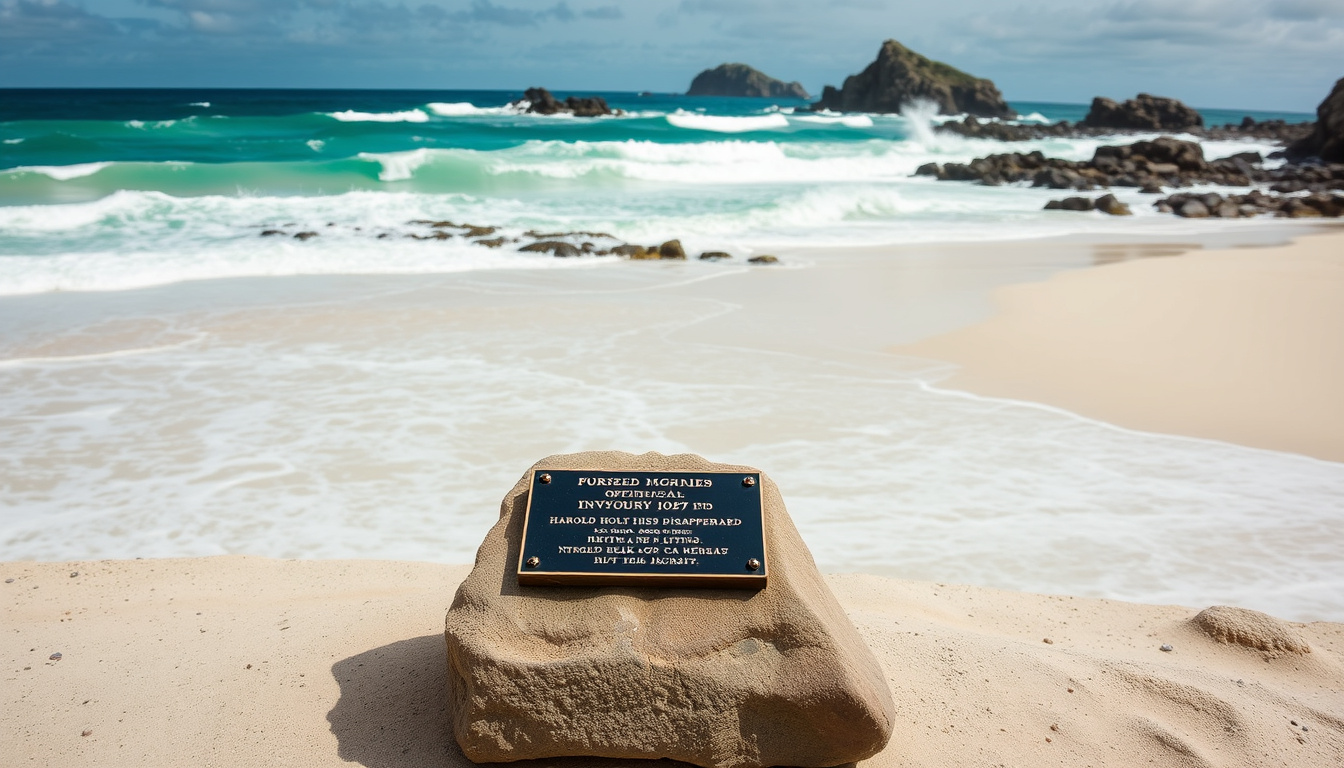
Half a century on, the question still works like a ghost story at dinner: how does a prime minister vanish in front of witnesses on a public beach? Harold Holt entered the water at Cheviot Beach on 17 December 1967 and never came out, and the official record — police files, archival dossiers, a coronial finding — still cannot say what killed him. What the record does say is narrower and more useful: which explanations were investigated, which were supported, and why the missing body kept every alternative alive.
Disappeared: 17 December 1967 · Body: never recovered · Pronounced dead: 19 December 1967 · Memorial guests: approx. 2,000
Quick snapshot
- Holt disappeared at Cheviot Beach, Portsea, on 17 December 1967; his body was never recovered (National Archives of Australia (official government archive)).
- A joint Commonwealth and Victoria Police report, submitted in January 1968, found no indication of anything other than accident (National Archives of Australia (official government archive)). (National Archives of Australia (official government archive))
- Holt was pronounced dead on 19 December 1967 (National Museum of Australia (national cultural institution)).
- The precise cause of Holt’s death was never determined (National Archives of Australia (official government archive)). (National Archives of Australia (custodian of the police file))
- Whether a key witness withheld information appears in archival documents as an allegation, not a finding (National Archives of Australia (custodian of the police file)).
- Governor-General Lord Casey ended Holt’s commission on the evening of 18 December 1967 (National Archives of Australia (prime ministerial timeline)).
- John McEwen was sworn in as prime minister on 19 December 1967 (National Archives of Australia (after-office record)). (National Archives of Australia (prime ministerial timeline))
- The Commonwealth did not consider a separate formal inquiry necessary after accepting the police report (National Archives of Australia (official government archive)).
- The full record — file A1209, 1968/8063 — remains open to researchers (National Archives of Australia (custodian of the police file)).
Eleven record entries, one pattern: the state answered every legal and administrative question, while the physical one stayed open.
| Record entry | Detail | Source |
|---|---|---|
| Disappearance | 17 December 1967, Cheviot Beach, Portsea, Victoria | National Archives of Australia (official government archive) |
| Body recovered | No | National Archives of Australia (official government archive) |
| Pronounced dead | 19 December 1967 | National Museum of Australia (national cultural institution) |
| Joint police report | Submitted January 1968 | National Archives of Australia (official government archive) |
| Police conclusion | No indication of anything other than accidental death | National Archives of Australia (official government archive) |
| Precise cause of death | Not determined | National Archives of Australia (official government archive) |
| Formal inquiry | Not considered necessary by the Commonwealth | National Archives of Australia (official government archive) |
| Search operation | Launched with dive teams and shore-based observers; scaled down five days after the disappearance | SBS News (Australian public broadcaster) |
| Memorial service | 22 December 1967; approximately 2,000 official guests | National Archives of Australia (prime ministerial timeline) |
| Archival file | NAA A1209, 1968/8063 — police reports, correspondence, maps, photographs, press material | National Archives of Australia (custodian of the police file) |
| Police film | Silent reenactment of witness movements and conditions at Cheviot Beach | National Archives of Australia (custodian of the police file) |
What the police investigation actually established
The joint Commonwealth and Victoria Police investigation delivered its report in January 1968, and its central conclusion was unambiguous: no indication that Holt’s disappearance was anything other than accidental (National Archives of Australia (official government archive)).
- Investigators assessed Holt’s last movements as following a routine domestic pattern (National Archives of Australia (official government archive)).
- The same assessment described Holt’s demeanour as normal before he entered the water (National Archives of Australia (official government archive)).
- The report explicitly did not determine the precise cause of death (National Archives of Australia (official government archive)).
In other words, the finding closed the legal question — accident — while leaving the medical one open. After accepting the report, the Commonwealth Government did not consider a separate formal inquiry necessary (National Archives of Australia (official government archive)).
The official case is closed, and it was closed on the only supported answer: accident. The absence of a precise mechanism is not a failure of the investigation — it is the honest residue of a death nobody witnessed.
The implication: Holt’s file was closed not because every question was answered, but because every question that law and administration could answer was.
The conditions that could overcome an experienced swimmer
The official account did not rely on a mystery. It identified a concrete environment: high winds, rough seas and rip tides at Cheviot Beach, conditions that could have overcome Holt despite his familiarity with the beach (National Archives of Australia (official government archive)).
- High winds
- Rough seas
- Rip tides
These were not exotic hazards. They are the working conditions of a surf coast — which is precisely why the official explanation was plausible to investigators and unsatisfying to everyone else.
The official account never needed a freak wave or a dramatic anomaly. Wind, swell and rip are enough to kill a capable swimmer — and the ordinariness of that explanation is what made the story hard to leave alone.
What this means: the police explanation was not weak. It was ordinary — and ordinary causes are exactly what public memory tends to reject when a famous life ends without a body.
Why the body was never recovered
The report acknowledged its hardest limit: Holt’s body was never recovered, and the investigation listed three possible explanations for where it went (National Archives of Australia (official government archive)).
- Marine-animal attack
- Tidal transport out to sea
- Entrapment in rock crevices
Each remained a live possibility; none could be confirmed. Five days after the disappearance, the search operation was scaled down (SBS News (Australian public broadcaster)).
That combination — three unconfirmed mechanisms and a body that never surfaced — is the physical core on which every later theory was built.
A missing body transforms a closed investigation into an open cultural file. Every conspiracy reading starts from the same unclosed physical gap — not from a document that contradicts the police finding.
The pattern: investigators were willing to list mechanisms they could not prove. That honesty is not evidence of concealment — it is an accurate report of a genuinely unknowable fact.
What the archived police file reveals — and what it leaves open
The raw material for any reconstruction survives in a single archival location: file A1209, 1968/8063 in the National Archives, holding police reports, correspondence, maps, photographs and press material (National Archives of Australia (custodian of the police file)).
- Police reports and correspondence
- Maps and photographs
- Press material
- A silent police film reenacting witness movements and conditions
- Documents alleging a key witness may have withheld information
The status of that allegation is precise: it is an allegation preserved in the archival record, not a conclusion of the police report (National Archives of Australia (custodian of the police file)).
The file is the police-era record — a separate stage from the later Victorian coronial process, which sits outside the 1967–68 investigation.
Why this matters: the file is public, coherent and incomplete in exactly one place — and that place is the body, not the paperwork.
Official record vs. the gaps that feed speculation
Four loaded questions, one pattern: the official record answers each one legally while the physical gap behind it stays open.
| Question | Official record | Gap that allows speculation |
|---|---|---|
| How did Holt die? | Accidentally (National Archives of Australia (official government archive)); precise mechanism not determined | No witnessed moment of death, so any alternative can be proposed |
| Where is the body? | Never recovered (National Archives of Australia (official government archive)) | No grave or recovered remains to anchor the story |
| Did witnesses tell everything? | Movements assessed as routine and normal (National Archives of Australia (official government archive)) | Archival documents allege a key witness may have withheld information (National Archives of Australia (custodian of the police file)) |
| Was there enough scrutiny? | No separate formal inquiry considered necessary (National Archives of Australia (official government archive)) | Perceived absence of further process invites suspicion |
The pattern: the official record is coherent on every question except what happened to the body — and that single vacancy is where the theories live.
Timeline: the week Australia lost a prime minister
- — Holt disappears at Cheviot Beach, Portsea (National Archives of Australia (official government archive)).
- — Governor-General Lord Casey ends Holt’s commission (National Archives of Australia (prime ministerial timeline)).
- — Holt is pronounced dead; John McEwen is sworn in as prime minister (National Museum of Australia (national cultural institution); National Archives of Australia (after-office record)).
- — Memorial service; approximately 2,000 official guests attend (National Archives of Australia (prime ministerial timeline)).
- Five days after the disappearance — the search is scaled down (SBS News (Australian public broadcaster)).
- — Joint police report submitted (National Archives of Australia (official government archive)).
- After the report — the Commonwealth decides no separate inquiry is necessary (National Archives of Australia (official government archive)).
The pattern: the constitutional machinery moved within days, the memorial within a week, the investigation within a month — and the physical mystery never moved at all.
Confirmed facts vs. what’s still unclear
Confirmed facts
- Holt disappeared at Cheviot Beach on 17 December 1967 (National Archives of Australia (official government archive)).
- His body was never recovered (National Archives of Australia (official government archive)).
- The January 1968 police report found no indication of anything other than accident (National Archives of Australia (official government archive)).
- He was pronounced dead on 19 December 1967 (National Museum of Australia (national cultural institution)).
What’s still unclear
- The precise cause of death — never determined (National Archives of Australia (official government archive)).
- The fate of the body — marine-animal attack, tidal transport and rock-crevice entrapment all remained possible (National Archives of Australia (official government archive)).
- Whether a key witness withheld information — alleged in the archival file, never established (National Archives of Australia (custodian of the police file)).
- Why the search failed to find anything despite dive teams and shore-based observers (SBS News (Australian public broadcaster)).
- Why no separate formal inquiry followed — the Commonwealth accepted the police report (National Archives of Australia (official government archive)).
The asymmetry: the legal record is settled, the physical record is not — and that imbalance is the entire reason Holt’s name still circulates as a mystery.
What the key sources said
“The joint report found no indication that Holt’s disappearance was anything other than accidental.”
— National Archives of Australia (official government archive)
“Holt was pronounced dead on 19 December 1967, two days after he went missing.”
— National Museum of Australia (national cultural institution)
“A major search operation, including dive teams and shore-based observers, was scaled down five days after the disappearance.”
— SBS News (Australian public broadcaster)
All three sources anchor the same factual spine: Holt entered the water, the search failed, and the file closed without a body. The catch: the institutions that settle the legal record are the same ones that preserve its gaps — which is why the debate keeps restarting.
The record’s real lesson
Holt’s disappearance is not a case of too little information. It is a case of information that answered every legal question and could not answer one physical one: where, exactly, a prime minister went. The police accepted accident; the Commonwealth accepted the police; the archive preserved both the conclusion and the loose threads; and no later document has added a body. For Australians who want the episode settled, the choice is clear: accept the archived finding of accidental death as the supported record, or keep waiting for physical evidence no researcher has produced in more than half a century.
Related reading
- Jim Chalmers: Education, Wife, Wealth and Career Facts
- Ed Husic: Religion, Personal Life, and Political Career
These profiles connect Holt’s disappearance to recurring questions in Australian political memory.
naa.gov.au, naa.gov.au, australiangeographic.com.au, naa.gov.au
Frequently asked questions
What happened to Harold Holt on 17 December 1967?
Holt went swimming at Cheviot Beach near Portsea, Victoria, and disappeared. His body was never recovered (National Archives of Australia (official government archive)).
Was his body ever found?
No. A major search operation — including dive teams and shore-based observers — was scaled down five days after the disappearance, and Holt’s body was never recovered (SBS News (Australian public broadcaster); National Archives of Australia (official government archive)).
What did the January 1968 police report conclude?
The joint Commonwealth and Victoria Police report found no indication that Holt’s disappearance was anything other than accidental, but it did not determine the precise cause of death (National Archives of Australia (official government archive)).
Why do conspiracy theories about Holt persist?
Because the body was never recovered and the precise cause of death was never determined, the physical gap allows speculation. The archival file also preserves documents alleging that a key witness may have withheld information (National Archives of Australia (custodian of the police file)).
Was there a formal inquiry into Holt’s death?
No. After accepting the police report’s conclusions, the Commonwealth Government did not consider a separate formal inquiry necessary (National Archives of Australia (official government archive)).
Who became prime minister after Harold Holt?
John McEwen was sworn in as prime minister on 19 December 1967 (National Archives of Australia (after-office record)).
Where can I see the original investigation documents?
The documents are held in National Archives file A1209, 1968/8063, which contains police reports, correspondence, maps, photographs, press material and a silent police film (National Archives of Australia (custodian of the police file)).
The answers above follow the archived record; the unsolved physical question is the reason the topic recurs.
Related stories




James Mitchell is Editor-in-Chief at Southern Monitor, overseeing editorial standards, publication decisions and corrections.