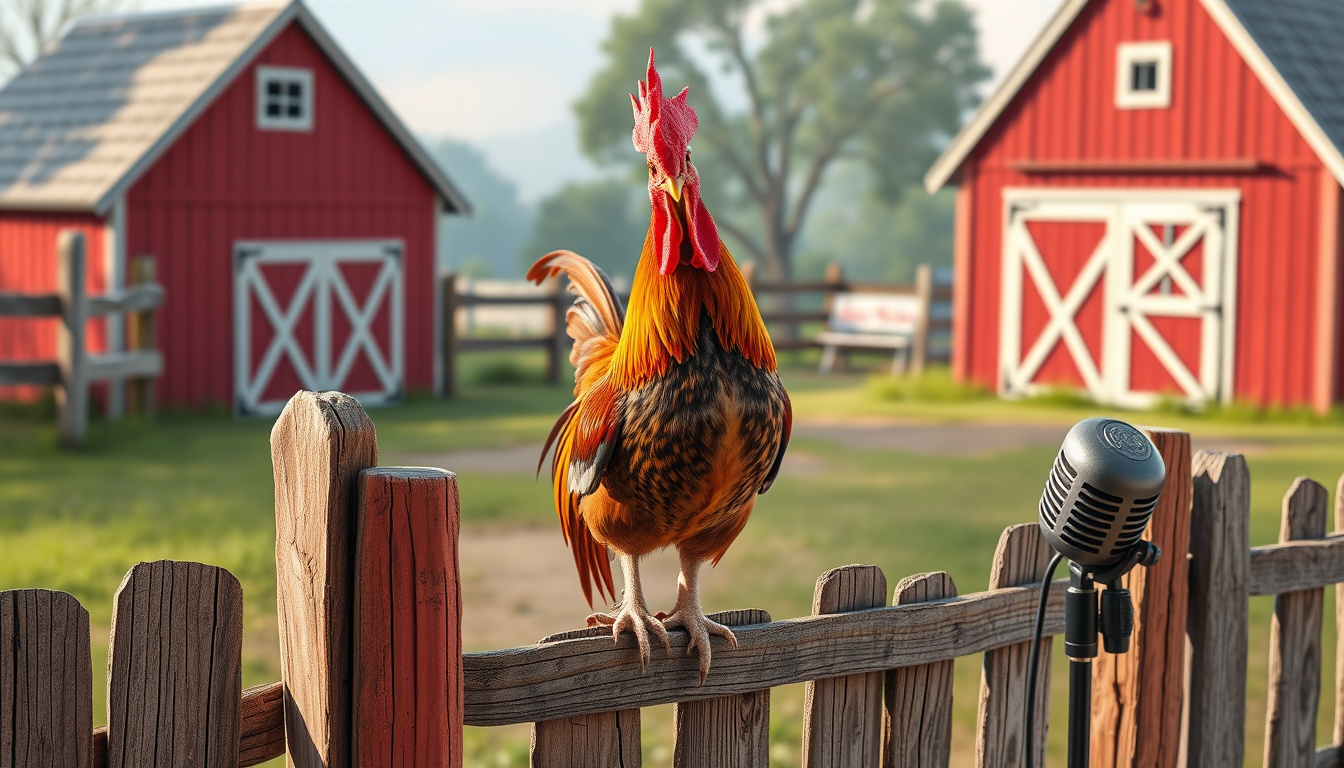
Foghorn Leghorn is one of those voices you can probably hear before you see him: a Southern drawl turned up to cartoon volume, attached to a bird who never met a sentence he couldn’t stretch. He may be a barnyard rooster, but his comedy comes straight from 1940s radio, from the mouth of a blustering senator and through the vocal cords of Mel Blanc.
Debut: Walky Talky Hawky (1946) · Created by: Robert McKimson · Original voice: Mel Blanc · Signature habit: Singing “Camptown Races” to himself
The quick facts below give you the shape of the rooster before you read the longer story.
| Detail | Fact |
|---|---|
| Debut | Walky Talky Hawky (1946) — Wikipedia, the crowd-sourced encyclopedia, records the debut year. |
| Created by | Robert McKimson, with early scripts by Warren Foster — German Wikipedia, the German-language encyclopedia, identifies McKimson as creator. |
| Species | Leghorn rooster — Wikipedia, the crowd-sourced encyclopedia, states the species. |
| Original voice | Mel Blanc — The Retrospectors, a pop-culture history podcast, credits Blanc as the voice. |
| Inspiration | Senator Beauregard Claghorn, from The Fred Allen Show — Wikipedia, the crowd-sourced encyclopedia, names the inspiration. |
| Name origin | “Foghorn” + Leghorn — German Wikipedia, the German-language encyclopedia, explains the name. |
| Recurring habit | Singing “Camptown Races” to himself — German Wikipedia, the German-language encyclopedia, mentions his singing habit. |
| Famous catchphrases | “I say, I say, boy!” and “That’s a joke, son!” — Wikipedia, the crowd-sourced encyclopedia, lists these catchphrases. |
The Foghorn Leghorn snapshot
Foghorn arrived in Walky Talky Hawky in 1946, according to Wikipedia, the crowd-sourced encyclopedia, confirming his debut.
His voice owes a debt to Senator Claghorn, the loud radio blowhard played by Kenny Delmar — Wikipedia, the crowd-sourced encyclopedia, provides this background.
Mel Blanc supplied the original vocal fireworks — The Retrospectors, a pop-culture history podcast, highlights Blanc’s performance.
“Foghorn” plus “Leghorn” is a pun that hides the breed in plain sight — German Wikipedia, the German-language encyclopedia, breaks down the name.
From Radio to Rooster: A Character Built on Borrowed Sound
Foghorn Leghorn did not materialize out of a barnyard; he was assembled from pieces of 1940s American radio comedy. German Wikipedia, the German-language encyclopedia, connects the rooster to director Robert McKimson, with Warren Foster helping shape the early scripts. The result was a character so loud that his first short, Walky Talky Hawky, introduced most of his catchphrases in a single episode.
The deeper inspiration is even more specific. Wikipedia’s character history says Foghorn was inspired by Senator Beauregard Claghorn, a blustering Southern politician played by Kenny Delmar on The Fred Allen Show. That radio senator had a voice so big it could carry across the full width of a broadcast, which is exactly why he translated so well into a cartoon rooster.
The implication: the character was a direct transplant from one medium to another, and the transplant took.
The Voice: Mel Blanc, a Drawl, and a Little Early Doubt
Mel Blanc is the voice most fans hear in their heads, and The Retrospectors, a pop-culture history podcast, credits Blanc with making Foghorn one of the defining vocal performances of the classic Looney Tunes era. Blanc’s drawl is the engine of the character: it turns a simple line like “I say, I say, boy!” into a full-frontal assault on grammar.
Not every detail started out easy. A retrospective at Solent Plastics, relaying a Cartoon Research account, says McKimson initially doubted Blanc could find the right Southern sound for the role. The doubt did not last, and the voice became one of the most imitated in American animation.
“That’s a joke, son.”
Foghorn Leghorn
“The loudest mouth in all the South.”
Warner Cartoon Classics, via Google Play’s collection listing
The pattern: a brief moment of producer hesitation gave way to a voice performance that defined the character for decades.
What’s Confirmed, and What’s Still a Bit Fuzzy
Not every story about Foghorn belongs in the same column. Here is the record, with the caveats left in.
- Confirmed: He debuted in Walky Talky Hawky in 1946 — Wikipedia, the crowd-sourced encyclopedia, provides this confirmation.
- Confirmed: Senator Claghorn was the main inspiration for his voice — Wikipedia, the crowd-sourced encyclopedia, confirms the radio inspiration.
- Confirmed: His name is a pun on “foghorn” and “Leghorn” — German Wikipedia, the German-language encyclopedia, confirms the etymology.
- Caveat needed: Another claimed influence is the Sheriff from Blue Monday Jamboree, a background detail kept alive by Cartoon Research, an animation history site.
- Caveat needed: The exact number of “solo” Foghorn cartoons depends on how you count archive cartoons, because many shorts are ensemble pieces.
The catch: what seems like a simple origin story actually involves multiple radio performers and shows, each contributing a different piece of the character’s vocal identity.
Where to Find the Rooster Today
Warner has made it easy to meet Foghorn again. Google Play’s Warner Cartoon Classics page lists a collection of 17 Looney Tunes shorts and describes Foghorn as “the loudest mouth in all the South.”
If you want a fan-built map of every appearance, the Looney Tunes Wiki maintains a category for Foghorn cartoons. It is not an official archive, but it is a useful index for anyone who wants to chart his whole career.
The implication: the character’s longevity owes something to the very thing that makes his filmography hard to pin down.
Why the Rooster Still Matters
Foghorn Leghorn survives because he sounds like an entire era of American pop culture compressed into one rooster. He carries the radio actor’s timing, the cartoon director’s love of excess, and the voice artist’s gift for making nonsense feel permanent. In a world of remakes and reboots, he remains a reminder that a cartoon does not need a message; it just needs a voice big enough to outlast the broadcast.
solentplastics.co.uk, cartoonresearch.com, hero.fandom.com, cartoonresearch.com, animationscoop.com, topcartoons.tv, en.wikipedia.org, play.google.com
Frequently Asked Questions
Why is Foghorn Leghorn called Foghorn Leghorn?
Who voiced Foghorn Leghorn?
What was Foghorn Leghorn’s first cartoon?
What inspired Foghorn Leghorn’s voice?
What are Foghorn Leghorn’s catchphrases?
Did Foghorn Leghorn sing?
Related stories





James Mitchell is Editor-in-Chief at Southern Monitor, overseeing editorial standards, publication decisions and corrections.