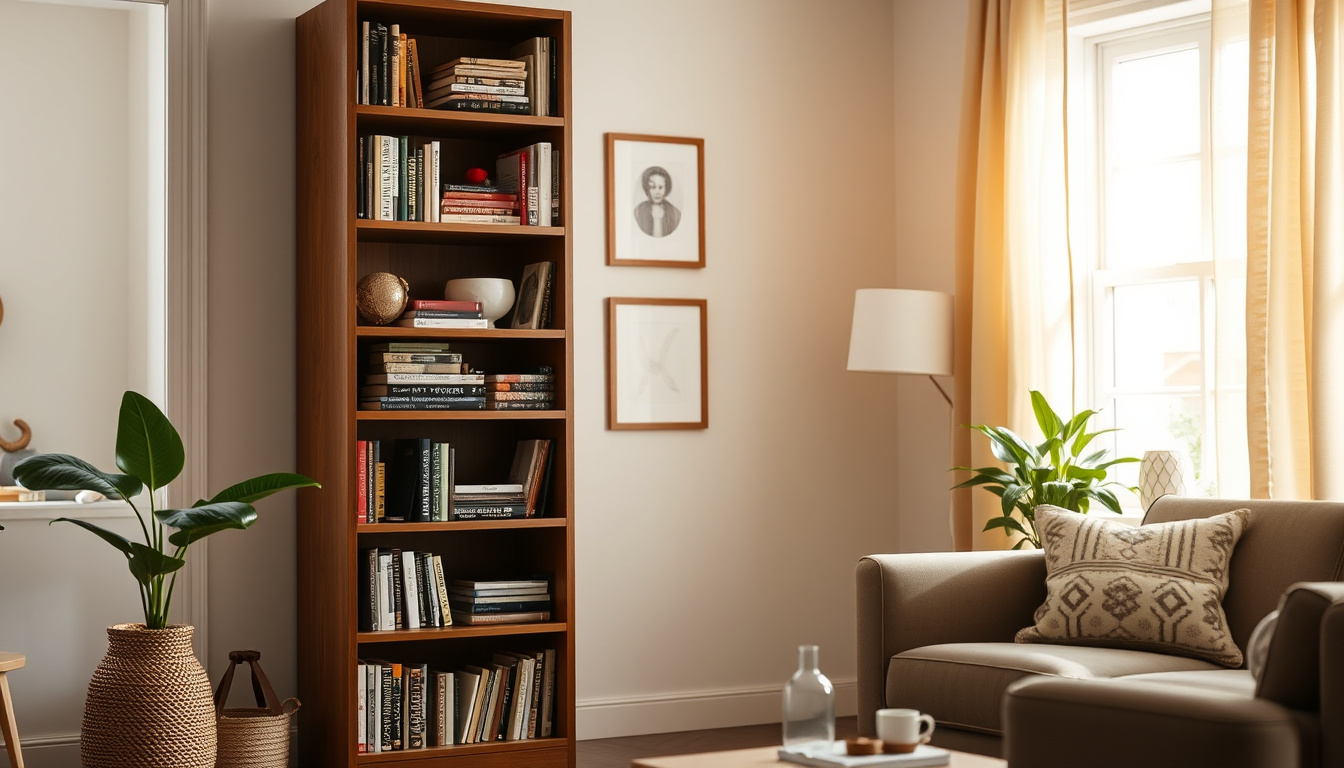

Anyone who has tried to organize a home library on a budget already knows the allure of the IKEA Billy Bookcase: it is cheap, simple, and everywhere. But after a year of heavy books, that perfectly straight shelf often starts to bow, and the warm feeling of a bargain fades. This guide separates the marketing from the mechanics, showing you exactly where the Billy shines and where it fails, so you can decide if it is right for your home.
Price: €65 · Height: 202 cm · Width: 80 cm · Depth: 28 cm · Number of shelves: 6 · Max weight per shelf: 13 kg
Quick snapshot
- Price: €65 (IKEA Ireland product page)
- Launched in 1979 (IKEA global press)
- Max weight per shelf: 13 kg (IKEA Ireland product page)
- Exact frequency of shelf sagging across different load conditions (independent lab data not publicly available) (IKEA (brand claim))
- Long-term durability reports from independent testing bodies (IKEA (brand claim))
- Over 60 million units sold globally (IKEA (brand claim)) – figure not independently audited
- Some users report visible sagging within 6 months of installation (YouTube: home library case study)
- Others report older units (bought in 1992) sagging by 2012 (Facebook: user report)
- IKEA continues to sell the Billy as a modular system without design changes to address sagging
- DIY community provides reinforcement solutions (aluminum channel, center dividers) that extend life
Six key facts, one pattern: the Billy offers strong value on paper, but its true cost depends on how you load it.
| Specification | Value |
|---|---|
| Price | €65 (IKEA Ireland) |
| Dimensions | 80x28x202 cm |
| Material | Particleboard, foil finish |
| Weight capacity per shelf | 13 kg |
| Number of shelves | 6 |
| Launch year | 1979 |
Is the Billy bookcase worth it?
Pros and cons of the Billy bookcase
- At €65, it is one of the most affordable bookshelves on the market (IKEA Ireland product page).
- Modular design allows you to add doors, extensions, and extra shelves (IKEA Ireland product page).
- The particleboard construction is prone to sagging under sustained heavy loads above 13 kg per shelf (YouTube: assembly and reinforcement guide).
- The back panel is thin fiberboard that can warp if not secured firmly to the wall (YouTube: bookshelf reinforcement tutorial).
Price vs quality analysis
A custom built-in bookcase of the same size from a local carpenter in Ireland can cost upwards of €500–€1,000. The Billy saves you that upfront cash. But the trade-off is clear: you are paying for compressed wood chips with a foil veneer, not solid timber. For light loads—paperbacks, decorative items, photo albums—the Billy works fine for years. For heavy hardback collections, the shelves will likely bow within 6 to 12 months (YouTube: home library case study).
A Billy buyer saves €435–€935 upfront but faces reinforcement costs of €10–€50 (aluminum channel or extra dividers) within the first year if loading hardbacks.
Long-term durability
Some users report Billy shelves sagging so badly they have to be flipped every couple of months (Facebook: user reports). Others have double-stacked their units for years without major sagging (Facebook: user reports). The difference comes down to load and reinforcement. The shelf span—80 cm—is the root cause of sagging. Halving that span with a center divider dramatically reduces visible sagging (YouTube: assembly and reinforcement guide).
The implication: Billy is worth it if you plan ahead. Treat the 13 kg limit as a hard ceiling and reinforce before loading, not after.
What are the common problems with BILLY bookcases?
Sagging shelves: causes and solutions
Shelf sagging depends primarily on two variables: the unsupported span and the load placed on it (YouTube: assembly and reinforcement guide). The Billy’s standard shelf spans 80 cm without internal dividers. Adding a center support cuts that span in half and stiffens the shelf considerably. A complete reinforcement strategy requires vertical supports aligned through the full stack, not just one shelf, because load transfers downward (YouTube: bookshelf reinforcement tutorial).
Another method: attach aluminum U-channel strips to the front shelf edge. An IKEA Hackers guide reports that one 8-foot aluminum strip can stiffen three 30-inch shelves (IKEA Hackers (DIY reinforcement community)).
Back panel instability
The back panel is a thin fiberboard sheet that provides shear strength to the entire unit. If the screws holding it are loose—or if the panel is not nailed into every predrilled hole—the sides of the bookcase can bow outward. One Straight Dope user described Billy sides bowing so far that the shelves no longer reached both side panels (Straight Dope (discussion forum)). The fix: use the back panel as a stiffening point by ensuring every nail or screw is fully seated and the panel is tight against the back frame.
Weight capacity limitations
IKEA specifies 13 kg per shelf for the standard-depth Billy (IKEA Ireland product page). That is roughly the weight of 20–30 average hardcover novels. Once you exceed that, the particleboard begins to deflect. Because particleboard has no grain structure, it does not recover from bending—once sagged, it stays sagged.
The 13 kg limit applies per shelf, but the particleboard itself has no memory. Exceed it once, and the shelf is permanently bowed.
IKEA vs DIY Bookcases: Which Is Better?
Cost comparison
A single Billy unit costs €65. A DIY bookcase made from solid pine or birch plywood of the same dimensions costs roughly €50–€80 in materials alone, plus €30–€60 for tools (saw, sander, clamps) if you do not already own them (YouTube: DIY comparison video). So DIY can be cheaper per unit, but only if you already have tools and woodworking skills.
Five data points, one pattern: Billy wins on time and entry cost; DIY wins on strength and longevity.
| Factor | IKEA Billy | DIY Bookcase |
|---|---|---|
| Upfront cost (single unit) | €65 | €50–€140 (depending on materials) |
| Tools required | None (screwdriver included) | Saw, drill, sander, clamps |
| Assembly time | ~10–20 minutes | 2–8 hours |
| Material strength | Particleboard (prone to sag) | Solid wood or plywood (resists sag) |
| Customization | Modular but limited to IKEA add-ons | Unlimited (size, joinery, finish) |
Customization and aesthetics
DIY bookcases can be built to the exact millimeter to fit an alcove. The Billy, by contrast, comes in fixed widths—40, 60, and 80 cm. If your space is 85 cm wide, you are left with a 5 cm gap. DIY also allows for painted finishes, hardwood shelves, and hidden joinery that looks seamless. IKEA’s foil finish is durable but unmistakably budget.
Assembly effort and time
IKEA claims the Billy takes approximately 10 minutes to assemble (YouTube: assembly and reinforcement guide). Real-world assembly, including attaching the back panel and wall-strapping, takes most people 15–25 minutes. DIY requires 2–8 hours depending on complexity. For a renter or someone who needs shelving this weekend, the Billy is the obvious choice.
What this means: for a single room or a light-load display, Billy wins on convenience. For a lifetime home library built to last 30 years, DIY is the better investment.
Why are IKEA Billy bookcases so popular?
Affordable price point
At €65, the Billy is cheaper than a single dinner for two at many Dublin restaurants. That price point has made it the entry-level standard for students, renters, and first-time home buyers across Europe and beyond.
Modular design and expandability
The Billy system includes add-on doors (glass, solid, or foil), height extensions, and additional shelves. You can start with one unit and add width or height later. IKEA has kept the same hole-spacing pattern since 1979, so old and new units are compatible.
Global availability
IKEA operates 400+ stores across 50+ countries. If you live in Cork or Galway, you can have a Billy delivered within a week. That level of accessibility is something no local carpenter can match. The result: IKEA has sold over 60 million Billy units worldwide since its launch in 1979 (IKEA (global brand claim)).
Why this matters: the Billy’s popularity is a logistics triumph. IKEA turned a simple particleboard box into a globally standardized product that fits millions of homes.
What is the IKEA 10 minute rule?
Understanding the IKEA assembly rule
The “10 minute rule” refers to IKEA’s claim that you can assemble a Billy bookcase in approximately 10 minutes (YouTube: assembly and reinforcement guide). The instruction booklet is minimal—mostly pictograms and a single Allen key. For a product aimed at people who do not own tools, this is a deliberate design choice: low barrier to entry.
The bookshelf rule for styling
The “bookshelf rule” is a styling guideline that suggests arranging shelves with symmetry and alternating heights—tall items on one shelf, short items on another, with decorative objects breaking up rows of books. It is not an official IKEA rule, but interior designers and bloggers frequently cite it when styling Billy units for social media.
Practical applications
For the average buyer, the 10-minute rule means you can buy, assemble, and start loading the same afternoon. The bookshelf rule helps your unit look intentional, not like storage. Together they reinforce the Billy’s core promise: fast, easy, and presentable.
“The Billy bookcase is the most popular bookcase in the world because it is the cheapest and easiest to assemble. But the wood is basically compressed cardboard. If you put real books on it, you’ll be turning those shelves every six months.”
— Renee Renovates (YouTube), DIY renovation expert
“If a divider is used on only one shelf, the transferred load can make shelves below bow as much or more. A complete reinforcement strategy requires vertical supports aligned through the full stack.”
— YouTube: How to prevent bookshelves from bowing (DIY tutorial)
The pattern: both rules serve the same goal—getting a decent-looking shelf in your home fast. They do not promise 30-year durability, and they do not need to.
Related reading: **Tefal Frying Pan: Safety, Durability & Jamie Oliver** · **King Quilt Cover Size Guide: Sizing, Hotel Duvets & Tog**
For those considering the Billy, a detailed look at its dimensions and popular hacks can help you decide if it fits your space and style.
Frequently asked questions
How long does a Billy bookcase last?
Depends on load. Under light loads (paperbacks, decor), 10–15 years. Under heavy loads (hardbacks, encyclopedias), shelves may sag within 6 months to 2 years without reinforcement (YouTube: home library case study).
Can the Billy bookcase be painted?
Yes, but the foil finish requires sanding and primer. Many DIYers use a shellac-based primer to prevent the foil from bleeding through (see IKEA Hackers (DIY reinforcement community)).
What are the best alternatives to the Billy bookcase?
DIY solid-wood shelving, the IKEA KALLAX (heavier-duty particleboard, shorter spans), or the IKEA HAVSTA (solid pine, higher price).
Does the Billy bookcase come with doors?
Not as standard, but IKEA sells optional door kits (OXBERG glass doors, BERGSLAG solid doors) that fit the Billy frame directly.
How to prevent Billy bookcase sagging?
Add a center divider to halve the unsupported span, or attach an aluminum U-channel to the front edge of each shelf (IKEA Hackers (DIY reinforcement community)). Never exceed 13 kg per shelf.
What is the warranty on the Billy bookcase?
IKEA offers a 1-year warranty against manufacturing defects. Damage from overloading or improper assembly is not covered (IKEA Ireland customer support).
Can you add doors to a Billy bookcase after purchase?
Yes. IKEA sells OXBERG glass doors and BERGSLAG solid doors separately. They attach to the front frame of the Billy unit with hinges that fit the existing holes.
Related stories





Noah Harper is Senior Reporter at Southern Monitor, covering breaking stories and explainers.